
Dear readers, do you know that local and international tourists go to Kalinga, not only to see its beautiful rice terraces, waterfalls, rivers, lakes, cave and other natural attractions, but visit and see (as of… More

A friendly travel and foodie blog
Dear readers, do you know that local and international tourists go to Kalinga, not only to see its beautiful rice terraces, waterfalls, rivers, lakes, cave and other natural attractions, but visit and see (as of… More

UPDATE: Baguio City Mayor Benjamin Magalong issued a closure order against this theme park due to permit and safety issues, effective November 8, 2022. He said that this move was a safety precaution because of… More

Dear readers, you have another reason to visit or revisit Bohol. Allow Tita S to tell you about an interesting attraction to visit. 1.Mirror of the World is a park and botanical garden located in… More

Location: Province of Palawan1, MIMAROPA2 Region, Philippines
In our fourth day in the picturesque town of El Nido3 in the province of Palawan, my husband and I felt that we gained weight after three days here especially with Sea Cocoon’s yummy buffet breakfast, Hello El Nido’s finger-licking grilled buffet lunch during our island hopping, and the seafood dinners we had along the beach! This is paradise, but is not-so-good for our waistlines! But what can I say! When on vacation, NO DIET! Or, we have a SEE-FOOD DIET, i.e., when we see food, we eat! Right?!
Did you see my posts of our first two tours of El Nido? If not, click here for
HEAVEN ON EARTH: EL NIDO (Palawan, Philippines)
and click here for
BLUE LAGOONS AT EL NIDO (Palawan, Philippines)
Anyway, our third tour called TOUR B – WHITE SAND GALORE: ISLANDS AND CAVES, costs 1,300 per person. Just like the first 2 trips, I packed my hard-plastic beach bag with my needs for the day: sun block, bottles of mineral water, comb, towels, sunglasses, cell phone and power bank, snacks, cash, etc. After breakfast, we all met at the lobby, trooped again to the beach and boarded our big “banca” (boat) for the day.

The first stop was SNAKE ISLAND. I enjoyed this unique island because it had a natural S-shaped sandbar visible during low tide. And guess what, it was low tide today, lucky us! My husband and I walked the whole sandbar and we wished we had a drone to video our walk. We finally reached the end of the sandbar which was a mangrove. We stopped a bit and headed back to the starting point where we were ushered to head up and hike to a small gazebo with a spectacular view of the sandbar and the clear water! The bottled water came in handy to hydrate us going up and down this trail. Take your time, dearest Seniors, it is worth the effort!
Next was ENTALULA BEACH, reputed to be the best beach in Bacuit Bay. It can also be reserved for an intimate lunch/dinner.
The CUDUGNON CAVE was the next stop and cash was handy to enjoy fresh buko juice/cold soft drinks. This site was believed to be the burial site during the Neolithic period4 (10,200 – 2000 BC).

A brief stop at the CATHEDRAL CAVE followed but we did not stay long because the water was a bit rough. However, each passenger was given a chance to have pictures taken with the cave as backdrop.

The PINAGBUYUTAN ISLAND was the last stop. It is a powdered white sand island ideal for snorkeling, laying at the beach, or swimming with loved ones.
This last packaged tour is good but not as good as the first two … anyway, the sandbar was more than enough to make this a memorable trip! Thanks again, Gani Ricarte of Hello El Nido! Just search for his website: www.helloelnido.com
My final words re El Nido: This town is indeed a paradise and a precious treasure for all Filipinos and foreign visitors to visit and experience for generations to come! I pray it will not suffer the same fate as Boracay if they just continue to consistently and strictly implement the El Nido-Taytay Managed Resource Protected Area (ENTMRPA)5. I hope the local government will be able to continue to plan and successfully implement programs against the threats of high human activities and the booming tourism industry in the these towns such as: pollution from waste and sewage disposal; beach erosion; damage to coral reefs due to snorkeling, diving and illegal collection; and, disturbance of bird nesting and marine sites.
This is not a sponsored post; we paid for our El Nido tours. I just want my readers to know more about the Philippines.
See my other El Nido posts:
TOUR PACKAGES THEN AND NOW AT ENTICING EL NIDO (Palawan, Philippines)
BLUE LAGOONS AT EL NIDO (Palawan, Philippines)
HEAVEN ON EARTH: EL NIDO (Palawan, Philippines)
Short and Simple: EL NIDO’S ECO-TOURISM DEVELOPMENT FEE
Say, Say, Say: NO BORACAY-LIKE CLOSURE FOR EL NIDO
I would love to hear from you, dear raders! Did you find this post informative? Have you gone to El Nido? Did you also experience this package tour? What are your observations of the tourism impact to the environment?
See other interesting places through other posts in this category and other categories of SCapades, Pinoy Delights, and Smart Traveler – Now You Know, Short and Simple, and Say, Say, Say. Happy reading, and I hope that you will appreciate what I shared and some of the featured destinations will be part of your future travel plans!
Remember to share this post with your friends, follow me by clicking on the bottom right corner of your device, and do not forget to like this post. Thank you.
– – – – – – – – – – – – – – – – – – – – – – – – – – – – – – –
The following terms are defined for interested readers, especially non-Filipinos, those with “Senior-Moments”, and those too busy or lazy to Google such terms:
1Palawan, according to the Wikipedia page, “Palawan,” accessed November 29, 2017, s a province in the Philippines located in the MIMAROPA Region of the Philippines, founded in 1818, and is now called the Philippines’ Last Frontier. SOURCE: “Palawan,” accessed November 29, 2017, https://en.wikipedia.org/wiki/Palawan.
2MIMAROPA, according to the Wikipedia page, “Mimaropa,” accessed November 29, 2017, is an administrative region of the Philippines which is an acronym for its constituent provinces: Mindoro (Occidental and Oriental), Marinduque, Romblon and Palawan. It was designated as Region IV-B until 2016. It is now also called the Southwestern Tagalog Region. SOURCE: “Mimaropa,” accessed November 29, 2017, https://en.wikipedia.org/wiki/Mimaropa.
3El Nido, according to the Wikipedia page, “El Nido, Palawan,” accessed November 29, 2017, is a first class, highly urbanized city located in the western province of Palawan, the westernmost city in the Philippines, with 66 barangays, and the capital of Palawan. The airport is located in this city and it is also known for the Puerto Princesa Subterranean River National Park, named one of the New7Wonders of the Nature. SOURCE: “El Nido, Palawan,” accessed November 29, 2017, https://en.wikipedia.org/wiki/El_Nido,_Palawan.
4“Neolithic,” accessed November 29, 2017, https://en.wikipedia.org/wiki/Neolithic.
5El Nido-Taytay Managed Resource Protected Area (ENTMRPA) is the largest marine sanctuary in the Philippines, according to the Wikipedia page, “El Nido, Palawan,” accessed November 29, 2017, It covers 18 barangays in El Nido and 3 barangays of its neighboring town, Taytay, involving more than 900 sq. km, using various forest and marine conservation and protection programs, to protect and develop the livelihoods of the seaside local population, amidst the development of tourist in the area. A very small (50 US cents) daily conservation fee is required per visitor. SOURCE: “El Nido, Palawan,” accessed November 29, 2017, https://en.wikipedia.org/wiki/El_Nido,_Palawan.

Location: Province of Palawan, MIMAROPA1 Region, Philippines
My husband and I visited Puerto Princesa2, Palawan3 years ago. The former is a first class, highly urbanized city located in the western province of Palawan, the westernmost city in the Philippines, with 66 barangays, and the capital of Palawan. The airport is located in this city and it is also known for the Puerto Princesa Subterranean River National Park, named one of the New7Wonders of the Nature. Palawan is a province in the Philippines located in the MIMAROPA Region of the Philippines, founded in 1818, and is now called the Philippines’ Last Frontier.
We were invited by my high school buddies and their families to El Nido (a first-class municipality in the northernmost tip of mainland Palawan), from February 19 to 22, 2017. It was our first time to visit this wonderful destination known for its awesome coral reefs, white-sand beaches, unique lagoons and limestone cliffs.
We were likewise curious how tourism can thrive amidst the so-called El Nido-Taytay Managed Resource Protected Area (ENTMRPA)4, the largest marine sanctuary in the Philippines, covering 18 barangays in El Nido and 3 barangays of its neighboring town, Taytay, involving more than 900 sq. km, using various forest and marine conservation and protection programs, to protect and develop the livelihoods of the seaside local population, amidst the development of tourist in the area. A very small (50 US cents) daily conservation fee is required per visitor.
We heard so much about El Nido’s beauty so we did not hesitate to join the group to discover this new destination which was part of our bucket list.

Everything was pre-arranged by my very dependable and travel-savvy friend from the US so my husband and I just paid for our share. Here is the first part of our unforgettable adventure!
Our group arrived at the Puerto Princesa Airport and two vans were waiting for us provided by Daytripper Palawan. The mini-packs of banana chips, bottled water and, of course, the professional driving skills of our drivers were very much appreciated. It was about a 6-hour trip from the airport to El Nido, and we stopped a couple of times for the “call of nature”, to stretch a bit, as well as have our lunch. Some of us appreciated the view while some slept along the way.
We finally arrived at Sea Cocoon, our hotel, and we all checked-in. We used the remaining time to explore the town, its market and retail stalls, the beach, and savored its local and fresh seafood for dinner along a seaside restaurant. We slept early the previous night because this will be the first of our 3 day-tour that will take us around this awesome destination.
We had a good night’s rest after a hot shower and slept soundly on a comfortable bed in our air-conditioned room. We woke up to a beautiful sunny morning and the hotel’s sumptuous buffet breakfast was so good!
I am also lucky to have a well-organized friend who even provided durable hard-plastic beach bags where I could place all my (and my husband’s) needs for the day: sun block, bottles of mineral water for hydration, comb, towels, sunglasses, well-protected cell phone and power bank, snacks, cash, etc. Photos were taken after breakfast, all met at the lobby, trooped to the beach (which was just about 3 minute-walk from our hotel) and before we knew it, we were all aboard our big banca (boat) for the day.
My friend contracted Hello El Nido for the 3 packaged tours and may I say that my husband and I were very satisfied with the services of the management and all the boatmen/crew. Just search for his website: www.helloelnido.com
It also seemed that the local government has standardized the packaged tours of El Nido which is beneficial for us, first-time tourists. Our tour that day is marketed as TOUR C – SECRET ISLANDS AND BEACHES, costing 1,400 pesos each person.
We wore our safety vests and enjoyed the natural beauty – 360 degrees! Worried that you cannot swim? Don’t be! You can stay in the banca but I do not recommend that and I am so sure you will not because of the beauty of all the stops. All destinations are safe for all ages and all stops are worth the trip! So, listen up, it’s our first packaged tour of El Nido and I know you will be excited with me as I recall our tour.
The first stop was SECRET BEACH which can only be accessed by swimming and going through a small crevice in a rock wall. No worries, dearest seniors, I gained weight and still fitted LOL! Besides, the kind boatmen will always be ready to assist you: seniors, kids, and whoever else needs assistance. Once inside, you will be awed by this pristine beach and its beauty and thus, a secret no more!
Next was HIDDEN BEACH, surrounded by fantastic limestone rock formations. You can just float with your life vest or swim, just be careful not to be near sharp corals.
The STAR OF TALISAY BEACH was the next stop. It is a snorkeling site and was also our lunch stop. Now, I am sure you are curious to know about the buffet lunch. Let me tell you that all such meals for our 3 package tours were soooo good, thanks to Hello El Nido! The freshly cooked “inihaw” (grilled) pork and seafood (shrimps/fish/squids), along with fresh vegetables/seaweed salad, hot steamed rice, and fresh fruits were always a welcome feast for our group! Burp! Drinking water was also provided. Happy tummies always! My best advice is for you to bring cash for fresh buko (young coconut) or cold softdrinks sold in island stops.

The MATINLOC SHRINE or the SHRINE OF THE BLESSED VIRGIN, is located in an island maintained by the descendants of the original owner. Be prepared for a 100 peso-entrance fee. The shrine is serene and satisfies the religious among us seniors. The big old house seemed abandoned but you can imagine its splendor when it was new and operational. Our group went up a cemented area with steps leading to the peak where we had an unforgettable view for miles and miles!
Last was HELICOPTER ISLAND, a helicopter-shaped island when viewed from afar, ideal for snorkeling and diving.
This first packaged tour was indeed wonderful! Thanks, Gani Ricarte of http://www.helloelnido.com! Your kind boatmen returned us to our shores early so we can enjoy the majestic sunset in this picturesque island! We felt so lucky to have another dinner along the shore for us to breathe in all the good vibes while we savored the fresh seafood treats we ordered!
Watch out for my next post and discover the other beautiful islands of El Nido!
This is not a sponsored post. We paid for our El Nido tours.
Do visit my other El Nido posts:
TOUR PACKAGES THEN AND NOW AT ENTICING EL NIDO (Palawan, Philippines)
BLUE LAGOONS AT EL NIDO (Palawan, Philippines)
THE ISLANDS AND CAVES OF EL NIDO (Palawan, Philippines)
Short and Simple: EL NIDO’S ECO-TOURISM DEVELOPMENT FEE
Did you find this post informative? I would like to hear from you re your visit to El Nido and your Tour C experience. Simply scroll and click “Leave a comment”.
See other interesting places through other posts in this category and other categories of SCapades, Pinoy Delights, and Smart Traveler – Now You Know, Short and Simple, and Say, Say, Say. Happy reading, and I hope that you will appreciate what I shared and some of the featured destinations will be part of your future travel plans!
Remember to share this post with your friends, follow me by clicking on the bottom right corner of your device, and do not forget to like this post. Thank you.
– – – – – – – – – – – – – – – – – – – – – – – – – –
The following terms are defined for interested readers, especially non-Filipinos, those with “Senior-Moments”, and those too busy or lazy to Google such terms:
1MIMAROPA, according to the Wikipedia page, “Mimaropa,” accessed November 29, 2017, is an administrative region of the Philippines which is an acronym for its constituent provinces: Mindoro (Occidental and Oriental), Marinduque, Romblon and Palawan. It was designated as Region IV-B until 2016. It is now also called the Southwestern Tagalog Region. SOURCE: “Mimaropa,” accessed November 29, 2017, https://en.wikipedia.org/wiki/Mimaropa.
2“Puerto Princesa,” accessed November 29, 2017, https://en.wikipedia.org/wiki/Puerto Princesa.
3“Palawan,” accessed November 29, 2017, https://en.wikipedia.org/wiki/Palawan.
4“El Nido, Palawan,” accessed November 29, 2017, https://en.wikipedia.org/wiki/El Nido,_Palawan.

Dear adventurous readers, how about an adrenaline rush through white water rafting in the Philippines? Allow Tita S to tell you about it.
1.Cagayan de Oro1, or CDO, is a first class2 highly urbanized city3 in the Northern Mindanao4 region5 of the Philippines.
This city is actually geographically located in the province6 of Misamis Oriental7 but is governed administratively independent from the provincial government after it was classified as a highly urbanized city, on November 22, 1983, based on its annual income and population.
2. This city is called the Whitewater Rafting Capital of the Philippines because of the famous and exciting whitewater rafting adventures it offers along the Cagayan de Oro River (also called Cagayan River8).

Photo source: Cagayan de Oro website – https://www.cagayandeoro.gov.ph/index.php/item/371-whitewater-rafting-adventure.html
Watch this 26-second video, taken from Cagayan de Oro Rafting – Kagay Outdoors’ Facebook, posted April 1, 2022: https://www.facebook.com/100063471889766/videos/728155551514012
The jump-off point for this activity is at Barangay9 Mambuaya, a 30-40 minute ride from the city proper.
3. Cagayan de Oro is the only city in the Philippines that offers rafting year-round. However, they say the best time to experience white water rafting is from July to December when the Cagayan de Oro River8 rages for a challenging, yet unforgettable, experience. Note that the peak wet season is June to October but just be aware of typhoons which might affect your travel plans.

Photo source: Department of Tourism – Philippines’ Facebook. posted August 24, 2021 – https://www.facebook.com/itsmorefuninthePhilippines/photos/5882004878536988
4. This thrilling adventure is not for the faint of heart; some even consider it an extreme sport. The 48 km-ride of the Cagayan de Oro River takes 3-5 hours and you need to be physically fit to paddle and brave the turbulent waters of so many rapids, depending on the level of rafting you want (see item 7).
These rapids are separated with long and silent river flows for rafters to relax until they encounter the next rapids. You get to look around and appreciate the flora and fauna along the river. The guide may allow rafters to swim and enjoy the cool waters too.
The rapids are at an interval of not less than 15-19 minutes of each other.
This water adventure may include side trips of cave exploration and river trekking.
5. Here are some things you should know or do:
* It is an advantage if you know how to swim. Learn different swimming skills to be safe always during this adventure. A life vest is required for all in people in the boat, regardless of one’s level of swimming skills.
* Listen and remember all important details emphasized by your guide during the orientation in order to survive this activity as well as enjoy it. Always listen to the command of your guide while rafting.
* Hold your paddle firmly and properly; learn to control it.
* Learn and remember hand commands so you can easily know what to do, whether to stop or to paddle, to grip or stay calm, etc.
* Be calm in case something unfortunate happens. Do not panic; be in control and learn to balance yourself. Do not leave the boat even if the water looks calm. Implement and focus on all guidelines you were told during the orientation so you can overcome the situation to continue and finish this unforgettable adventure.
6. The minimum number of people per raft is 6, accompanied by 2 river guides. You can join a group to complete the number of people required per raft. For additional safety, a person in a kayak can accompany your raft, for a total of 3 trained guides.
7. Cagayan River’s depth, incline and rock formations make rafting an enjoyable experience for tourists. There are several White Water Rafting levels, starting with the beginner’s course, to advance and extreme. The former entails a 3-hour river run involving 14 rapids. The extreme course takes about 4 hours, with 24 rapids.
8. There are many water rafting groups to choose from. Their guides are trained by the Red Cross, Coast Guards, and the Department of Tourism. You can Google them, and preferably get referrals from satisfied tourists. It is advisable to book ahead of time.
9. What if you do not want to go rafting but still want to enjoy the Cagayan River8? Well, you have a choice. You can do river tubing, kayaking, or river trekking. The former allows you to ride a doughnut-shaped rubber tube; while the last two could be tiring. Nonetheless, all three are still fun and unforgettable!
10. The Department of Tourism and the city administration made Cagayan River activities as the banner tourism activities, highlighting whitewater rafting. The latter gained popularity through the years after President Gloria Macapagal-Arroyo and other famous personalities in the country underwent this challenging water adventure.
11. How do you get to Cagayan de Oro City1?
Cagayan de Oro is very accessible; you can go there by air, sea or land.
Those from Manila can ride any of the leading local airlines for 1 1/2 hours to Laguindingan Airport, which services CDO, 46 km (29 mi) away. Those from Cebu,
Clark, Davao or Iloilo can also go by air to this airport.
Visitors not in a hurry can ride a 2Go Travel boat for 32-35 hours from Manila to CDO Port, a modern international seaport. CDO is also accessible by sea from Bacolod; Jagna or Tagbilaran, Bohol; Cebu City, Dumaguete, Iloilo and Tagbilaran.
There are daily bus trips to CDO from Manila, just Google bus companies. However, it takes about 30-40 hours. CDO is also accessible by land from Butuan, Cebu, Davao City, North Cotabato, and Surigao. Nearby provinces also have buses which go to CDO.
12. What do you need to bring for this adventure?
* a dry bag to keep all your things dry
* wear a dri-fit outfit, preferably, to keep you cool and dry; wear a rash guard for protection from sunburn
* wear protective gears like a helmet (just in case you accidentally hit your head), elbow and knee pads
* apply sunblock 30 minutes before this activity
* extra comfortable activewear
* essentials – toiletries, medicine
* first aid kit
* potable water in your personal reusable water bottle
Be sure to coordinate with your tour operator what to bring, i.e., if they will provide all that you need for your whitewater rafting experience, or if you have to bring some personal swimming gear.
13. Where can you stay and how do you go around the city? There are many types of accommodations (hotels, hostels, B&Bs, condotels, inns, etc.) to choose from, depending on your budget. There are also many modes of public transportation as well. Just Google.
14. Where else can you go in CDO (alphabetically arranged)? The less adventurous tourists can also opt for less adrenaline rush but still enjoy their visit to CDO. The peak season is September to March. There are so many places to check out and so many activities for you and your family:
* Amaya View – paraglide, trek the city’s highest mountain peak, relax at the infinity pool, explore Noah’s Ark, option to glamp – see https://www.facebook.com/amayaview/
* Gardens of Malasag Eco-Tourism Village – swim in the swimming pool, appreciate the lush gardens and small zoo – contact: (088) 8855-6183 or (+63) 917-896-8873; visit gardensofmalasag@tieza,gov.ph
* Macahambus Adventure Park – zipline, trek, rappel – see https://www.facebook.com/people/Macahambus-Adventure-Park/100067209004898/
* Mapawa Nature Park – zipline, horseback ride, trek/hike, swim, enjoy waterfalls – see https://www.facebook.com/MapawaPark/
* Museo de Oro – appreciate archaeological and ethnic artifacts – see https://www.xu.edu.ph/museodeoro and https://www.facebook.com/xumuseodeoro/
* Museum of Three Cultures – appreciate 3 dominant cultures in the city – Maranao Muslims, Christians and indigenous people – see https://www.cu.edu.ph/museum-of-three-cultures/ and https://www.facebook.com/cu.museum/
* Seven Seas Waterpark – 12 water slides – see https://www.sevenseaswaterparkresort.com/ and https://www.facebook.com/sevenseaswaterpark/
* Saint Augustine Metropolitan Cathedral – see https://www.facebook.com/acdocathedral2019/
* Tubajon Aquamarine Park – kayak, swim, enjoy mangrove forest
The information was obtained from https://businessmirror.com.ph/2018/12/09/a-pumping-ride-in-the-famed-river-awaits-you-chasing-white-waters-in-cagayan-de-oro/, https://aboutcagayandeoro.com/cagayan-de-oro-tourist-spots-cagayan-de-oro/, https://www.discoverthephilippines.com/cagayan-de-oro-city-visitors-guide/ and https://philippines.travel/activities/white-water-rafting and the Wikipedia page “Cagayan River (Mindanao)”10.
The photo featured in the cover photo-collage was obtained from Department of Tourism – Philippines’ Facebook account – https://www.facebook.com/itsmorefuninthePhilippines/photos/5882004878536988
So, if you will visit Cagayan de Oro1, have I convinced you to try this thrilling and challenging water activity?
Heads up: Before planning to travel, always get updates regarding local government status, rules, restrictions and safety measures of the destination/s you want to visit, taking into consideration your personal health conditions and activity involved, and remember to level your expectations.
This is not a sponsored post. I just want my readers to know more about the Philippines.
Did you find this post informative? I would like to hear your comment/s regarding whitewater rafting in CDO, especially if you were able to experience it.
See other interesting places through other posts in this category and other categories of SCapades, Pinoy Delights, and Smart Traveler – Now You Know, Short and Simple, and Say, Say, Say. Happy reading, and I hope that you will appreciate what I shared and some of the featured destinations will be part of your future travel plans!
Remember to share this post with your Facebook friends, follow me by clicking on the bottom right corner of your device, and do not forget to like this post. Thank you.
– – – – – – – – – – – – – – – – – – – – – – – – – –
The following terms are defined for interested readers, especially those with “Senior-Moments”, those not familiar with Filipino terms, and those too busy or lazy to Google such terms:
1Cagayan de Oro (CDO) is a first class2 highly urbanized city3 located in the Northern Mindanao4 region5 of the Philippines. It is the capital of the province6 of Misamis Oriental7 where it is geographically situated but governed administratively independent from the provincial government. It became a town in 1871, a city on June 15, 1950, and a highly urbanized city on November 22, 1983. It has 80 barangays9 and is the 10th most populous city in the country. It serves as the regional center and business hub of the region. The city’s economy is largely based on industry, commerce, trade, service, and tourism. It is known for its white water rafting and is known as the “Whitewater Rafting Capital of the Philippines”. It is also know for kayaking adventures. It is located along the north central coast of the Mindanao11 group of islands, and is bordered to the north by Macajalar Bay facing the Bohol Sea, the municipalities12 of Opol to the west, Tagoloan and the province of Misamis Oriental to the east, and the provinces of Bukidnon and Lanao del Norte to the south.
The information was obtained from Wikipedia page “Cagayan de Oro”.13
2A 1st class city in the Philippines has an average annual income for the previous 4-year period of at least 500 million pesos, according to the Wikipedia page “Cities of the Philippines.”14
3A highly urbanized city (HUC) is a city with a minimum population of 200,000 inhabitants, as certified by the Philippine Statistics Authority, and with the latest annual income of at least PHP50 million or US$1 million, as certified by the City Treasurer. There are currently 33 such cities in the Philippines. The information was obtained from Wikipedia page “Cities of the Philippines”.14
See a related post: Foreign Seniors Ask: HOW MANY CITIES ARE THERE IN THE PHILIPPINES?
4Northern Mindanao, or Region X, is an administrative region5 in the north-central part of Mindanao11 group of islands. It comprises 5 provinces6: Bukidnon, Lanao del Norte, Misamis Occidental, Misamis Oriental7, the island-province of Camiguin, and 2 highly urbanized cities3 – Iligan and Cagayan de Oro1. The latter is the regional center.
It has a total land area of 2,049,602 ha. (5,064,680 acres), and more than 60% of this area are classified as forest land. Its seas abound with fish and other marine products. Its high elevation accounts for its cool climate and abundant vegetation.
The information was obtained from Wikipedia page “Northern Mindanao.”15
5A region is an administrative division based on geographical, cultural and ethnological characteristics. Each region is further subdivided in provinces6, composed of cities and municipalities12 (or towns), which in turn, are divided into barangays9, formerly called barrios, according to Wikipedia page “Regions of the Philippines” 16.
See a related post: Foreign Seniors Ask: WHAT ARE THE REGIONS OF THE PHILIPPINES?
6A province is the primary administrative and political division in the Philippines. It is the second-level administrative sub-division of a region5. There are 81 provinces (called lalawigan) in the Philippines. Each province is governed by an elected legislature called the Sangguniang Panlalawigan and by an elected governor. The information was obtained from Wikipedia page “Provinces of the Philippines.”17
See a related post: Foreign Seniors Ask: WHAT ARE PROVINCES IN THE PHILIPPINES?
7Misamis Oriental is a coastal province6 located in the Northern Mindanao4 region5 of the Philippines. It is the capital, provincial center and largest city of Cagayan de Oro1, and is governed independently. It was founded in 1939. It has a total land area of 3,131.52 sq.km. (1,209.09 sq.mi.), excluding Cagayan de Oro. It comprises 23 municipalities12 and 2 component cities18 (El Salvador and Gingood). It is bordered on the north by the Bohol Sea, with the island-province of Camiguin just off its northern coast, the provinces of Lanao del Norte on the west, Agusan del Norte on the east, and Bukidnon on the south.
Cebuano is the primary spoken language of this province but many are fluent in Tagalog and English, which are mainly used for business, education and administration. Maranao is also spoken among the Maranao communities within the province.
The information was obtained from Wikipedia page “Misamis Oriental.”19
8Cagayan River, or Cagayan de Oro River, is one of the rivers draining the northern central part of the island of Mindanao11 in the Philippines. The name comes from the word Kagay which means “river” so Kagayan means “a place with a river”. Its mouth is located in Cagayan de Oro. It traverses the municipalities12 of Baungon, Libona and Talakag, connecting tributaries along the way, and finally empties into the Macajalar Bay at Cagayan de Oro1. The main tributaries of this river are: Bubunaoan River, Kalawaig River, Tagite River and Tumalaong River.
It serves as the natural boundary between the provinces6 of Bukidnon and Iligan, and between Bukidnon and Cagayan de Oro. This river is a very popular site for whitewater rafting in the Philippines and is promoted by the Department of Tourism as the main tourist attraction of Cagayan de Oro.
The information was obtained from Wikipedia page “Cagayan River (Mindanao).”10
9A barangay in the Philippines is the smallest administrative division in the Philippines, headed by a barangay captain, aided by a Sangguniang Barangay (Barangay Council). It is the native Filipino term for a village. It was formerly called a barrio. In a metropolitan area, a barangay is an inner city neighborhood, a suburb, or a suburban neighborhood. The word barangay originated from the term balangay, a kind of boat used by a group of Austronesian people who migrated to the Philippines. A number of barangays grouped together is called a district. The information was obtained from Wikipedia page “Barangay.”20
10“Cagayan River (Mindanao),” accessed April 8, 2022, https://en.wikipedia.org/wiki/Cagayan_River_(Mindanao)
11Mindanao is one of the 3 major geographical divisions of the Philippines. It is the second largest island of the country and covers 6 administrative regions5: Caraga, Davao, Northern Mindanao4, SOCCSKSARGEN, Zamboanga Peninsula, and the Bangsamoro Autonomous Region in Muslim Mindanao (BARMM). It is composed of 22 provinces6 and 33 cities (27 provinces and 33 cities, if associated islands are included). The information was obtained from Wikipedia page “Mindanao.”21 Mindanao is located in the southern part of the country; the 2 other geographical divisions of the Philippines are Luzon (in the northern part) and Visayas (the middle part).
12A municipality is a small, single urban administrative division in the Philippines which has corporate status and powers of self-government or jurisdiction as granted by law. It is a unit under a province6, subdivided into barangays9, and is called town, or bayan. In the Philippines, a municipality is headed by a mayor, a vice mayor and members of the Sangguniang Bayan (legislative branch). The information was obtained from Wikipedia page “Municipalities of the Philippines.”22
13“Cagayan de Oro,” accessed April 8, 2022, https://en.wikipedia.org/wiki/Cagayan_de_Oro
14“Cities of the Philippines,” accessed April 2, 2018,
https://en.wikipedia.org/wiki/Cities_of_the_Philippines
15“Northern Mindanao,” accessed April 2, 2018, https://en.wikipedia.org/wiki/Northern_Mindanao
16“Regions of the Philippines,” accessed July 17, 2018, https://en.wikipedia.org/wiki/Regions_of_the_Philippines
17“Provinces of the Philippines,” accessed April 2, 2018, https://en.wikipedia.org/wiki/Provinces_of_the_Philippines
18A component city is a type of city in the Philippines which does not meet the requirements of a highly urbanized city3 and is under the jurisdiction of a province6. If such a city is located along the boundaries of 2 or more provinces, it shall be considered part of the province of which it used to be a municipality12. The information was obtained from the Wikipedia page “Cities of the Philippines.”14
19“Misamis Oriental,” accessed February 2, 2021, https://en.wikipedia.org/wiki/Misamis_Oriental
20“Barangay,” accessed July 9, 2018, https://en.wikipedia.org/wiki/Barangay
21“Mindanao,” accessed April 2, 2018, https://en.wikipedia.org/wiki/Mindanao
22“Municipalities of the Philippines” accessed April 2, 2018, https://en.wikipedia.org/wiki/Municipalities_of_the_Philippines

Dear readers, every February, lots of Filipinos and foreign tourists troop to the city of Baguio to witness the month-long Panagbenga Festival. For those who are not familiar with this event, allow Tita S to tell you about it.
1.Panagbenga Festival is a month-long, annual, colorful, cultural, flower festival which starts every February 1 in the city of Baguio1 as a tribute to the city’s flowers, as a reflection of the history, traditions and values of the city and the Cordillera2, and originally, as a way to rise up from the devastation of the 1990 Luzon earthquake3.

Photo source: https://www.facebook.com/panagbengabaguio/photos/a.249818038527035/250230661819106/
2. The month of February was chosen for this festival to boost tourism since that month is considered a time of inactivity, between the peak seasons of people who visit Baguio, i.e., Christmas season, the Holy Week and the summer season, because of its cool weather. Besides, flowers are mostly in full bloom in February, perfect timing indeed!

Photo source: https://www.facebook.com/panagbengabaguio/photos/a.249818038527035/249818051860367
3. This event started as the idea of Atty. Damaso E. Bangaoet, Jr., John Hay Poro Point Development Corporation’s (JPDC) Managing Director for Camp John Hay4. He presented the idea of holding a flower festival in Baguio City1 to the Board of Directors of JPDC.
Bases Conversion Development Authority (BCDA) Chairman Victor A. Lim and JPDC President Rogelio L. Singson approved the project, and the Board decided to hold it every February since the weather during that month was perfect and the time was between the peak seasons of tourists visiting Baguio1.
JPDC presented the idea to the various sectors of the community, and this was warmly received by government, education, business, media and civic organizations. An advisory group of flower enthusiasts was formed: Rebecca Domogan, Gloria Vergara, Julie Cabato, Willie Magtibay and Efren Chatto. It was initially called the Baguio Flower Festival.
4. The Baguio Flower Festival Foundation, Inc. (BFFFI) was organized “to operate, organize, and manage the Panagbenga Festival to boost tourism by showcasing various events, exhibitions and activities that promote the history, traditions and values of Baguio1 and the Cordilleras2, sustained in an earth-friendly manner”.
5. This festival, through the BFFFI, is a proud member of the International Festival and Events Association (IFEA), the premier association supporting and enabling festival and event professionals worldwide.
6. The Panagbenga Festival was first held on February 1, 1991, with the theme “The Birth of a Tradition”.
Children from the different schools in the city joined adults in street dancing, wearing flowers of different shapes, sizes and colors. Businessmen came up with flower-inspired products. This definitely showed the creativity and cooperation among all members of the community.
7. Venues include: Panagbenga Park, Harrison Road, Baguio Athletic Bowl, Session Road, and Melvin Jones Grounds.
8. This festival was renamed Panagbenga Festival in 1996, as suggested by the archivist and curator of Saint Louis University Museum, Ike Picpican, based on the Kankanaey4 term, panagbenga, meaning “a season of blooming; a time for flowering”, for the festival to have a local name. Since then, this event was called Panagbenga Festival, meaning Flower Festival.
9. Now, you better pronounce Panagbenga correctly, with the accent in the right syllable – pa-NAG-buh-nga!
10. In 1997, this festival was co-sponsored by the Camp John Hay Development Corporation (CJHDevCo),when Camp John Hay4 was privatized.
Tourism Secretary Mina Gabor graced the opening ceremonies, and that year, Session Road, Baguio’s main street, was closed to vehicular traffic for several days for a new activity called “Session Road in Bloom” to make way for flower carts, outdoor cafes and a host of entertainment shows.
In addition, the Baguio Flower Festival and Fashion (BFFF) was held at the Mansion House to highlight the ancient art of the Cordilleras called ikat5. The Flower Tee Golf Tournament was also held for the first time.
11. This festival started for a period of 10 days, extended to 2 weeks, then 3, then held for the whole month of February, until it extended to 5 weeks, taking advantage of the presence of the alumni of the Philippine Military Academy during PMA Week, also timed during Valentine’s Day.
12. An opening activity is organized by the Baguio City1 government and private sectors. Watch a video in https://www.panagbengaflowerfestival.com/gallery/.
A Drum and Lyre Street Dance Competition for elementary school students, at around 8:00 am, marks the beginning of this festival. The finalists will compete again at the Grand Street Parade, during the last Saturday of February.
There are other activities held throughout February like the Panagbenga Cultural Show, Baguio Blooms Exposition, Panagbenga Open Kite Flying Competition and Flower Tee Golf Tournament at the Baguio Country Club, Landscape Exhibition and Competition, Barangay6 Beautification, the search for the Festival Queen, and Philippine Military Academy Alumni Homecoming Weekend.
Yearly, new activities and initiatives were added, and this festival drew more and more visitors to Baguio City1 every February.
The Session Road in Bloom event is usually scheduled starting on the 4th Monday of February, until the 4th Sunday of March.
The most crowd-drawing events happen during the 4th week of February:
* The Parade and Street Dancing Competition which is usually scheduled on the 4th Saturday, starting from Session Road up to Melvin Jones Grounds. Street Dancing performed by dancers in flower-inspired costumes or colorful traditional Cordillera2 tribal clothes, to the tune of the Bendian, a vigorous Ibaloi7 dance of celebration. The lively and colorfully-clad dancers use traditional circular movements which symbolize unity and harmony among the members of the tribe, so, this dance unites the various sectors of the Baguio1 community to bring life to this festival.

Sources of photos in photo collage (top-bottom, l-r): Photo source: https://www.facebook.com/Panagbenga-Festival-1988090207920549/photos/1988111144585122, https://www.facebook.com/PanagbengaFest/photos/146545952758881, https://www.facebook.com/Panagbenga-Festival-1988090207920549/photos/1988110967918473, https://www.facebook.com/Panagbenga-Festival-1988090207920549/photos/1988111027918467 and Street dance parade 2009, along Session Road – Photo source: lolay IMG_0613, CC BY 2.0, created 28 February 2009, https://en.wikipedia.org/wiki/Panagbenga_Festival#/media/File:Panagbenga_2009_-_IMG_0613_(Lolay)_-_Flickr.jpg.
* The Grand Float Parade which is usually held on the 4th Sunday, starting from Session Road up to Melvin Jones Grounds.

Photo source: https://www.facebook.com/1988090207920549/photos/a.1988091027920467/1988091007920469
You get to appreciate the creativity of each of the (about) 20 floats paraded along Baguio’s main streets, with thousands of multi-colored flowers artistically arranged to create a theme, sponsored by companies and local city organizations.

2009 SM float – Photo source: Rhedee from Quezon City, Philippines – SM Baguio Float, CC BY-SA 2.0, created https://en.wikipedia.org/wiki/Panagbenga_Festival#/media/File:Panagbenga,_SM_Baguio_Float_(Rhedee)_-_Flickr.jpg
One of the judging criteria is that each float must be made of 95% natural flowers! If you hate crowds, do not worry because all the floats are left on display in the Melvin Johns Grandstand or the Athletic Bowl, right after the parade. So that is your chance to get as many selfies with each float as you want!

Photo source: https://www.facebook.com/panagbengabaguio/photos/250576425117863
Session Road is closed for a week for exhibits. Wright Park8 honors their pony boys and horse trainers.
Closing ceremonies are held on the last night of the festival at the Baguio Athletic Bowl, near Burnham Park9. A grand fireworks display caps off this festival! Watch a video in https://www.panagbengaflowerfestival.com/gallery/.
13. The Bases Conversion Development Authority (BCDA), in collaboration with the John Hay Poro Point Development Corporation’s (JPDC), gave the official logo of this festival from one of the entries of the annual Camp John Hay4 Art Contest, participated by elementary, high school, and college students of Baguio1 and the theme revolved around preserving the environment with special emphasis on the flowers of the Cordillera2. A spray of indigenous sunflowers from an artwork submitted by Trisha Tabangin, a student of the Baguio City National High School in October 1995, was chosen.
14. The Festival’s Tribute Hymn, entitled Tribute to the Cordillerans, was composed by Professor Macario Fronda of Saint Louis University to honor the local people, and is based on the rhythm and movements of the Bendian Dance mentioned earlier.
15. In 2018, an estimated 1 million people attended this festival. So, in the post-pandemic future, when this festival will be held anew, book your transportation and accommodation well ahead of time, and expect such number of people and traffic in the city. It is advisable to park your private vehicle in, or near, your accommodation, be patient with the traffic if you need to commute, and be ready to walk to the area of the festivities with comfortable footwear and clothing. If you will bring children, be sure that they are always beside you due to the great influx of people. Secure your belongings. Apply sunblock and bring your refillable water bottle to stay hydrated. Bring an umbrella or wear a hat.
Can you imagine a million people who have the tendency to throw their garbage when they cannot find a nearby garbage can around? Please do your part for this not to happen. Bring your trash with you when you leave the venue/s and dispose properly in a designated trash area.
16. Some people associate this festival with the famous Rose Parade10 in Pasadena, California, USA. Yes, Tita S sees the similarity!
17. It is sad that this festival was cancelled for the past 2 years, 2020 and 2021, due to the threat of Covid-19.
18. Great news! Panagbenga Festival opened on March 6, 2022, with the the theme “Let Hope Bloom”, and will continue until March 27. The celebration is low key because of the pandemic and to lessen the risk of transmission. There are no crowd-gathering activities like the grand opening, street dancing parade and flower float parade. However, smaller themed activities are held to continue with the tradition of the festival. Here is the schedule of activities.

Schedule of 2022 events, as of February 21, 2022 – Photo source: Panagbenga Festival Facebook account: https://www.facebook.com/baguioflowerfestival/photos/pcb.2228070350675692/2234022823413778

Photo source: https://www.facebook.com/baguioflowerfestival/photos/pcb.2228070350675692/2229527137196680
You can also go to https://baguiocityguide.com/panagbenga-2022-schedule-of-activities/ for the schedule of activities.
Baguio City is in Alert Level 1 status and, effective March 1, 2022, the local government eased travel restrictions for this festival. Only fully vaccinated tourists who are registered at the official website of the Visitor Information and Travel Assistant (Visita), https://visita.baguio.gov.ph/, will be allowed to enter the city. To prevent this festival to become a superspreader, health protocols are strictly enforced.
For other leisure travel requirements, Visita inquiries and assistance, especially if you come from a lower alert level area, contact: (074) 446 2009 (7:00 am – 11:00 pm), 0956 572 9097 (7:00 am – 3:00 pm), 0956 572 9093 (3:00 pm – 11:00 pm), and 0956 572 9094 (11:00 pm – 7:00 am).
For accommodation options, visit https://visita.baguio.gov.ph/accommodations.
The information was obtained from https://www.panagbengaflowerfestival.com/, http://www.the12list.com/2017/02/panagbenga-12-interesting-facts.html, https://www.pna.gov.ph/articles/1165305, https://www.gmanetwork.com/news/topstories/regions/822641/baguio-eases-travel-restrictions-in-time-for-panagbenga-2022/story/, https://philstarlife.com/geeky/670875-panagbenga-festival-2022, https://www.manilatimes.net/2022/02/24/news/regions/panagbenga-opens-in-baguio-on-march-6/1834054, https://mb.com.ph/2022/02/21/baguio-city-all-set-for-panagbenga-festival-in-march/ and the Wikipedia page “Panagbenga Festival”11.
The sources of photos in the cover photo-collage (top-bottom, l-r) are: https://www.facebook.com/panagbengabaguio/photos/250576425117863, https://www.facebook.com/Panagbenga-Festival-1988090207920549/photos/1988110967918473, lolay IMG_0613, CC BY 2.0, created 28 February 2009, https://en.wikipedia.org/wiki/Panagbenga_Festival#/media/File:Panagbenga_2009_-_IMG_0613_(Lolay)_-_Flickr.jpg and https://www.facebook.com/Panagbenga-Festival-1988090207920549/photos/1988111144585122
This is not a sponsored post. I just want my readers to know more about the Philippine festivals.
Did you find this post informative? I would like to hear your comment/s regarding Panagbenga Festival, especially if you were able to witness the various activities in the past.
See other interesting places through other posts in this category and other categories of SCapades, Pinoy Delights, and Smart Traveler – Now You Know, Short and Simple, and Say, Say, Say. Happy reading, and I hope that you will appreciate what I shared and some of the featured destinations will be part of your future travel plans!
Remember to share this post with your Facebook friends, follow me by clicking on the bottom right corner of your device, and do not forget to like this post. Thank you.
– – – – – – – – – – – – – – – – – – – – – – – – – –
The following terms are defined for interested readers, especially those with “Senior-Moments”, those not familiar with Filipino terms, and those too busy or lazy to Google such terms:
1Baguio is a highly urbanized city12 in the mountainous area of the province13 of Benguet14, in the Cordillera Administrative Region2, Philippines. It is known as the Summer Capital of the Philippines, owing to its cool climate, and people flock to this city especially during summer months. It is also called the City of Pines because of its elevation, at 4,810 feet (1,470 meters) above mean sea level, conducive to pine trees.
It is geographically located in the province of Benguet, serving as the provincial capital from 1901 to 1916, but has since been administered independently from the province since it became a chartered city in 1909.
This city is the regional center of the Cordillera Administrative Region since it is a major center of business, commerce, and education in Northern Luzon. It was founded in 1900, incorporated as a city on September 1, 1909, and became a highly urbanized city on December 22, 1979. It is composed of 129 barangays6.
The information was obtained from the Wikipedia page “Baguio”.15
2Cordilleras is the short term for the Cordillera Administrative Region (CAR) or Cordillera Region, an administrative region16 in the Philippines, located within the island of Luzon17, in the northern part of the Philippines. It is the only landlocked region in the country, bordered by the Cagayan Valley Region to the north, east and southeast, and the Ilocos Region to the west and southwest. It is the least populous region of the Philippines, with a population less than that of the city of Manila.
This region is primarily mountainous and includes Mount Pulag, the highest mountain in Luzon.
The region was officially created on July 15, 1987, through Executive Order 220, signed by President Corazon Aquino. It covers most of the Cordillera Mountain Range of Luzon17 and is home to numerous ethnic peoples. It comprises 6 provinces13: Abra, Apayao, Benguet14, Ifugao, Kalinga, and Mountain Province.
The information was obtained from the Wikipedia page “Cordillera Administrative Region”.18
3The 1990 Luzon earthquake struck the island of Luzon17, in the Philippines, at 4:26 pm on July 16, with an estimated magnitude of 7.7. Its epicenter was near the town of Rizal in the province13 of Nueva Ecija, and resulted in strike-slip movements along the Philippine Fault and the Digdog Fault, within the Philippine Fault System. About 1,621 people were killed, mostly from Central Luzon and the Cordillera Autonomous Region (CAR)2. It caused damage within an area of about 20,000 sq.km., from CAR to the Central Luzon region16.
Baguio1, located over 5,000 feet above sea level, was among the hardest hit, and the earthquake caused the destruction of electric, water, and communication lines, the collapse of 28 buildings, including hotels (e.g., the Hyatt Terraces Baguio Hotel, and the Hotel Nevada), factories, government and university buildings and private homes and establishments, as well as the shutdown of access routes to the city due to landslide debris. Patients in the damaged hospitals were forced to stay inside tents in public places like Burnham Park9.
The city was isolated from the rest of the Philippines for the first 48 hours after the quake. The Loakan Airport was limited only to helicopters, used to evacuate affected residents.
The information was obtained from the Wikipedia page “1990 Luzon earthquake”.19
4Camp John Hay is a mixed-used development which serves as a tourist destination and forest watershed reservation in the city of Baguio1, in the Cordillera Administrative Region2, in the Luzon17 group of islands of the Philippines.
The 213 hectare (530 acres) of land was owned by Ibaloi7 leader Mateo Cariño until October 1903 when US president Theodore Roosevelt signed a presidential order converting the land to a military base of the US Armed Forces, designated as Camp John Hay, a refuge from the relative hotter temperature of the lowlands. During the Japanese occupation period (1942-1945), it became an internment camp of the Imperial Japanese forces and headquarters of General Tomoyuki Yamashita. After the war, it remained under the control of the Americans, and was converted to John Hay Air Base in 1955. It also served as a vacation and recreation sanctuary for American servicemen, until it was officially turned over to the Philippine government in 1991. It was then transformed into a tourist attraction, a human resource development hub, and a forest watershed reservation.
It is managed by John Hay Management Corporation (JHMC). Visit its official website: https://www.jhmc.com.ph/ for its history, among others. For more information about lodging and leisure activities therein, visit the website: https://www.campjohnhay.com/.
The information was obtained from https://www.jhmc.com.ph/, https://www.campjohnhay.com/ and the Wikipedia page “Camp John Hay”.20
5Ikat is a style of weaving that uses a resist dyeing process on either the warp or weft before the threads are woven to create a pattern or design for a motif which is fuzzy in appearance, and known for its colors and striking design patterns, in the Cordilleras2, a region16 in the northern part of the Luzon17 group of islands in the Philippines. Its blurry look comes from the slight bleeding of the dyes into the resist areas. The weavers in the province13 of Kalinga are known for making geometric patterns with nature symbols interlaced with yellow and black fibers and dominant red stripes. The weavers in the municipality21 of Bontoc in the Mountain Province weave geometric shapes of things around them (e.g., man, lizard, mountain, flower, rain). See https://www.nardas.com/cordilleran-weaving-culture/ for more details. This dyeing technique comes from Indonesia and India. The information was obtained from https://www.nardas.com/cordilleran-weaving-culture/ and the Wikipedia page “Ikat”22.
6A barangay in the Philippines is the smallest administrative division in the Philippines, headed by a barangay captain, aided by a Sangguniang Barangay (Barangay Council). It is the native Filipino term for a village. It was formerly called a barrio. In a metropolitan area, a barangay is an inner city neighborhood, a suburb, or a suburban neighborhood. The word barangay originated from the term balangay, a kind of boat used by a group of Austronesian people who migrated to the Philippines. A number of barangays grouped together is called a district. The information was obtained from Wikipedia page “Barangay.”23
7The Ibaloi refers to one of the indigenous ethnic groups collectively known as Igorot (“hill dwellers”) who live in the Cordillera Administrative Region2 of the Philippines. Ibaloi means “people who live in houses”, with ancestors likely to have originated by the Lingayen and Ilocos coasts, and now inhabit the southeastern part of the province13 of Benguet14 which includes Mount Pulag (which they consider the place where spirits join their ancestors). Their native language is Ibaloi, Inibaloi or Nabaloi. They speak 3 dialects: Bokod, Daklan and Kabayan, and often speak Ilokano and Tagalog as a second language. The information was obtained from Wikipedia page “Ibaloi people.”24
8Wright Park is a park with a wooded area in the city of Baguio1 in the Cordillera Administrative Region2 of the Philippines. It was named after American Governor Luke Edward Wright (1846-1922), who served as Governor-General of the Philippines (1904-1906) and Secretary of War (1908-1909).
It is known as a recreational area and its horseback riding services for tourists. The horses are owned and handled by “pony boys” who are often members of the Ibaloi7 community.
The information was obtained from the Wikipedia pages “Wright Park (Baguio)”25 and “Luke Edward Wright”26.
9Burnham Park, officially known as the Burnham Park Reservation, is a historic urban park located in downtown Baguio City1 in the Cordillera Administrative Region2 of the Philippines. It was designed by American architect and Baguio City planner, Daniel Burnham. It has a small pond or lagoon at the center and has regimented rows of grass and sidewalk. Baguio’s City Environment and Parks Management Office is responsible for the maintenance and operation of the park. This park has 12 designated clusters (as of 2018) and 3,004 individual species of flora, including 2,600 trees. The information was obtained from the Wikipedia page “Burnham Park (Baguio)”.27
10The Rose Parade, Tournament of Roses Parade, or Tournament of Roses, is an annual parade, followed by the Rose Bowl Game, produced by the non-profit Pasadena Tournament of Roses Association, and held mostly along Colorado Boulevard in the city of Pasadena, in the Los Angeles metropolitan area, on New Year’s Day (or on a Monday, January 2, if New Year’s Day falls on a Sunday). It was first held on January 1, 1890 and was uninterrupted, except during World War II in 1942, 1943 and 1945, and in 2021 due to the Covid-19 pandemic.
The parade usually starts at 8:00 am Pacific Time and includes flower-covered floats, marching bands, and equestrian units. Since 1902, the parade is followed in the afternoon by the Rose Bowl, one of the major bowl games in college football, to help fund the cost of staging this parade. Honda has been a presenting sponsor of this parade since 2011.
The information was obtained from the Wikipedia page “Rose Parade”.28
11“Panagbenga Festival,” accessed 29 January 2022, https://en.wikipedia.org/wiki/Panagbenga_Festival
12A highly urbanized city (HUC) is a city with a minimum population of 200,000 inhabitants, as certified by the Philippine Statistics Authority, and with the latest annual income of at least PHP50 million or US$1 million, as certified by the City Treasurer. There are currently 33 such cities in the Philippines. The information was obtained from Wikipedia page “Cities of the Philippines”.29
See a related post: Foreign Seniors Ask: HOW MANY CITIES ARE THERE IN THE PHILIPPINES?
13A province is the primary administrative and political division in the Philippines. It is the second-level administrative sub-division of a region16. There are 81 provinces (called lalawigan) in the Philippines. Each province is governed by an elected legislature called the Sangguniang Panlalawigan and by an elected governor. The information was obtained from Wikipedia page “Provinces of the Philippines.”30
See a related post: Foreign Seniors Ask: WHAT ARE PROVINCES IN THE PHILIPPINES?
14Benguet is a landlocked, highland province13 situated within the Cordillera mountains, located in the southern tip of the Cordillera Administrative Region2 of the Philippines, with the municipality21 of La Trinidad as its capital. It is known as the Salad Bowl of the Philippines due to its huge production of upland vegetables. It was founded on November 23, 1900, and declared a province on June 16, 1966. It comprises 13 municipalities21.
It is bordered by the provinces of Ilocos Sur on the northwest, by Ifugao and Mountain Province on the northeast, by La Union on the west, by Pangasinan on the south, and by Nueva Vizcaya on the southeast. The highly urbanized city12 of Baguio1 is geographically located in this province but is administered independently.
The native inhabitants of Benguet comprise 3 ethnolinguistic groups: the Kankanaeys who dominate the northwestern municipalities, the Kalanguyas in the east, and the Ibalois7 on the southeast.
Benguet is one of the country’s leading gold producers. Mining, agriculture, and tourism are the major industries. Popular destinations are Baguio City1, the strawberry and flower fields of La Trinidad, Mount Pulag (the highest in Luzon), the Palina and Naguey rice terraces in Atok, and the Ambuklao and Binga Dams.
The information was obtained from Wikipedia page “Benguet.”31
15“Baguio,” accessed August 16, 2019, https://en.wikipedia.org/wiki/Baguio
16A region is an administrative division based on geographical, cultural and ethnological characteristics. Each region is further subdivided in provinces13, composed of cities and municipalities21 (or towns), which in turn, are divided into barangays6, formerly called barrios, according to Wikipedia page “Regions of the Philippines” 32.
See a related post: Foreign Seniors Ask: WHAT ARE THE REGIONS OF THE PHILIPPINES?
17Luzon is one of the 3 major geographical divisions of the Philippines. Located in the northern part of the country, it is the largest (ranked 15th largest in the world) and most populated island, as well as its economic and political center. Luzon is composed of 8 regions16: Bicol, Cagayan Valley, Calabarzon, Central Luzon, Cordillera2, Ilocos, Mimaropa, and the National Capital Region. The information was obtained from the Wikipedia page “Luzon”.33 The 2 other geographical divisions of the Philippines are Visayas (at the center) and Mindanao (at the south).
18“Cordillera Administrative Region,” accessed 29 January 2022, https://en.wikipedia.org/wiki/Cordillera_Administrative_Region
19“1990 Luzon earthquake,” accessed 29 January 2022, https://en.wikipedia.org/wiki/1990_Luzon_earthquake
20“Camp John Hay,” accessed 29 January 2022, https://en.wikipedia.org/wiki/Camp_John_Hay
21A municipality is a small, single urban administrative division in the Philippines which has corporate status and powers of self-government or jurisdiction as granted by law. It is a unit under a province13, subdivided into barangays6, and is called town, or bayan. In the Philippines, a municipality is headed by a mayor, a vice mayor and members of the Sangguniang Bayan (legislative branch). The information was obtained from Wikipedia page “Municipalities of the Philippines.”34
22“Ikat,” accessed 29 January 2022, https://en.wikipedia.org/wiki/Ikat
23“Barangay,” accessed July 9, 2018, https://en.wikipedia.org/wiki/Barangay
24“Ibaloi people,” accessed 29 January 2022, https://en.wikipedia.org/wiki/Ibaloi_people
25“Wright Park (Baguio),” accessed 29 January 2022, https://en.wikipedia.org/wiki/Wright_Park_(Baguio)
26“Luke Edward Wright,” accessed 29 January 2022, https://en.wikipedia.org/wiki/Luke_Edward_Wright
27“Burnham Park (Baguio),” accessed 29 January 2022, https://en.wikipedia.org/wiki/Burnham_Park_(Baguio)
28“Rose Parade,” accessed 29 January 2022, https://en.wikipedia.org/wiki/Rose_Parade
29“Cities of the Philippines,” accessed April 2, 2018, https://en.wikipedia.org/wiki/Cities_of_the_Philippines
30“Provinces of the Philippines,” accessed April 2, 2018, https://en.wikipedia.org/wiki/Provinces_of_the_Philippines
31“Benguet,” accessed 29 January 2022, https://en.wikipedia.org/wiki/Benguet
32“Regions of the Philippines,” accessed July 17, 2018, https://en.wikipedia.org/wiki/Regions_of_the_Philippines
33“Luzon,” accessed December 2, 2019, https://en.wikipedia.org/wiki/Luzon
34“Municipalities of the Philippines” accessed April 2, 2018, https://en.wikipedia.org/wiki/Municipalities_of_the_Philippines
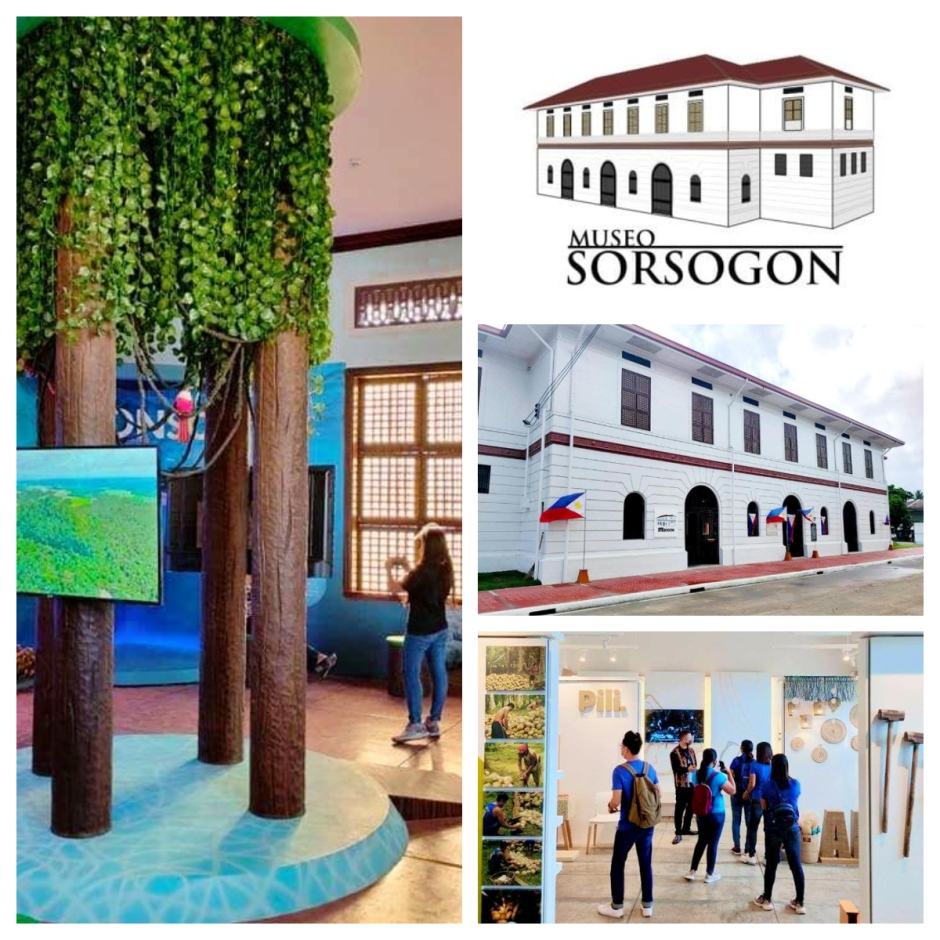
Dear readers, do you know that there is a new historical and cultural hub in Sorsogon? Want to know more? Allow Tita S to tell you a dozen facts about it.
1.The Museo Sorsogon is a new museum in Barangay1 Burabod, in the Provincial Capitol compound of the province2 of Sorsogon3, Sorsogon City4, in the Bicol5 Region6, in the island of Luzon7, Philippines.
2. The two-storey museum is located at the Old Sorsogon Provincial Jail. The latter was built in 1916, and also hosted the Court of First Instance, a symbol of the justice system in the province2.
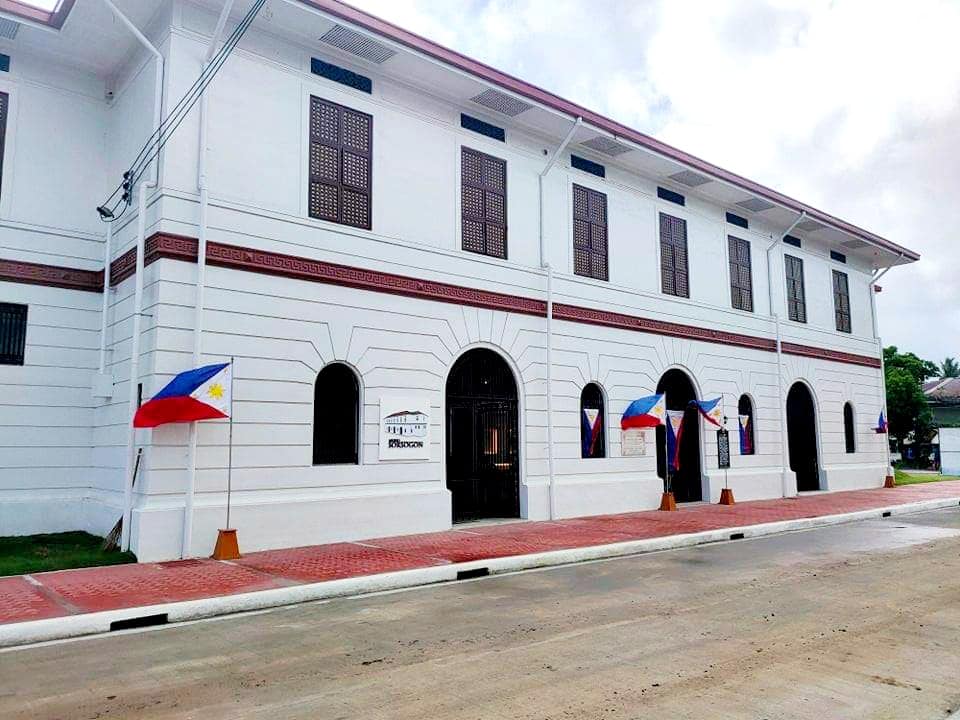
Facade, daytime – Photo source: Museo Sorsogon Facebook, https://www.facebook.com/105504924710260/photos/pb.100063894590424.-2207520000../237871494806935/?type=3
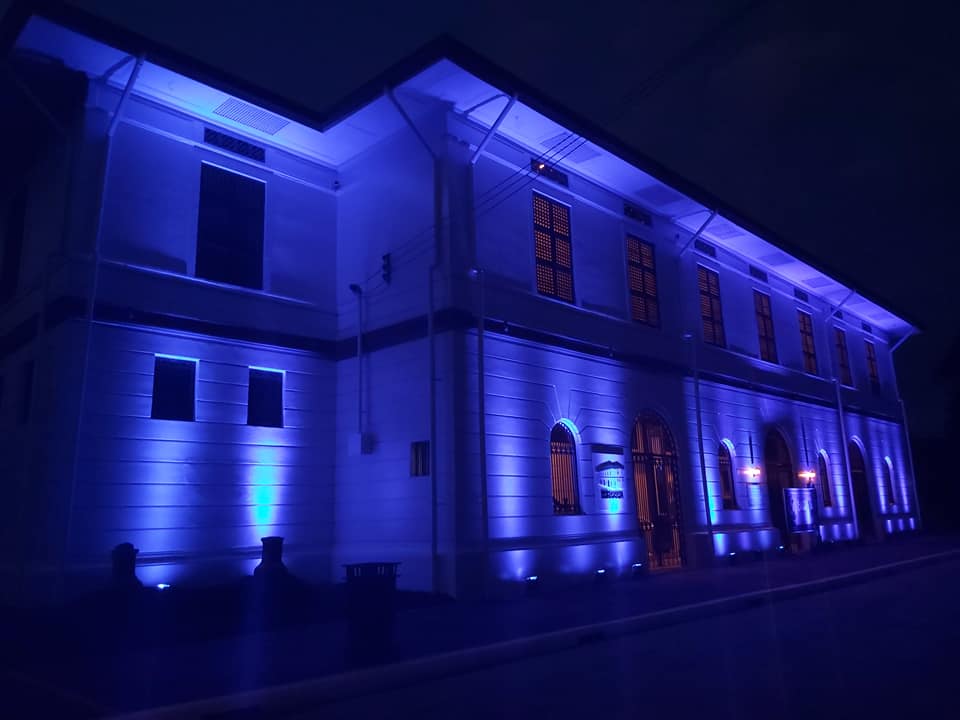
At night – Photo source: Museo Sorsogon Facebook, https://www.facebook.com/105504924710260/photos/pb.100063894590424.-2207520000../216752450252173/?type=3
This project was the brainchild of Governor Francis Joseph G. Escudero when a new penitentiary was built, and the inmates were transferred in 2019. He saw the potential of the vacated building and decided to showcase the province’s history, culture and heritage.

Photo source: Museo Sorsogon Facebook, https://www.facebook.com/photo/?fbid=105507061376713&set=a.248477677292050
The property was restored by the Department of Public Works and Highways.
3. The ten galleries of this museum display significant historical and cultural artifacts and memorabilia of the province2 which highlight its early settlers and settlement, participation in the 1896 Philippine Revolution, status during the American Occupation8, and locally-made products. Relevant artifacts are continuously collected.
The total area per floor is about 830 sqm (to be verified).
Galleries 1 to 5 are located on the first floor of the building:
Gallery 1, called “Ang Lalawigan ng Sorsogon: Ang mga Bayan at Lungsod Nito” (The Province2 of Sorsogon3: Its Municipalities9 and City), showcases 5 areas:
* Ang Pinagmula ng Pangalan ng Sorsogon (The Origin of the Name of Sorsogon)
* Heograpiya ng Sorsogon (The Geography of Sorsogon)
* Ang Klima at mga Importanteng Producto ng Sorsogon (Climate and Important Sorsogon Products)
* Populasyon ng Sorsogon (The Population of Sorsogon)
* Mga Wika ng Sorsogon (Sorsogon Languages)
Pic-11A-fb- 2021 April 24
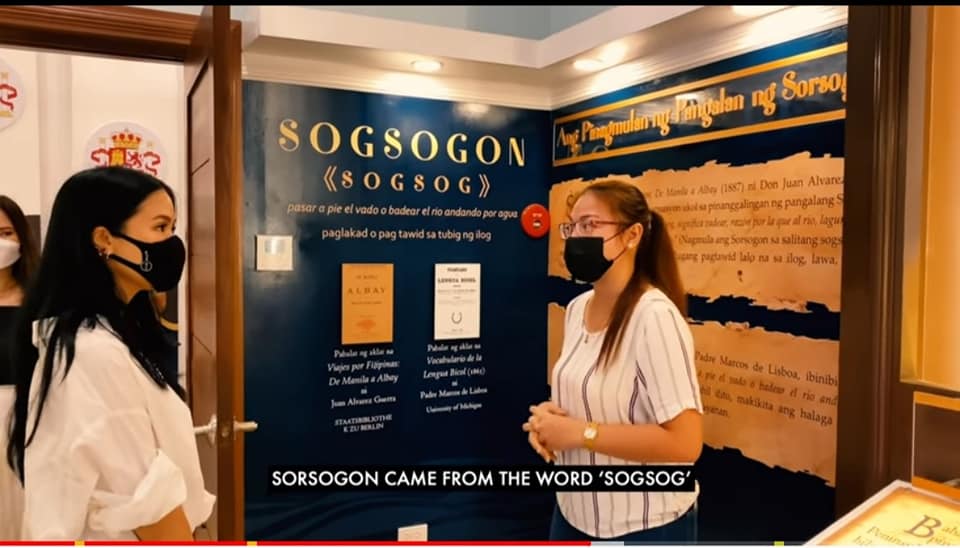
Gallery 1 – Photo source: Museo Sorsogon Facebook, https://www.facebook.com/105504924710260/photos/pb.100063894590424.-2207520000../214624273798324/?type=3
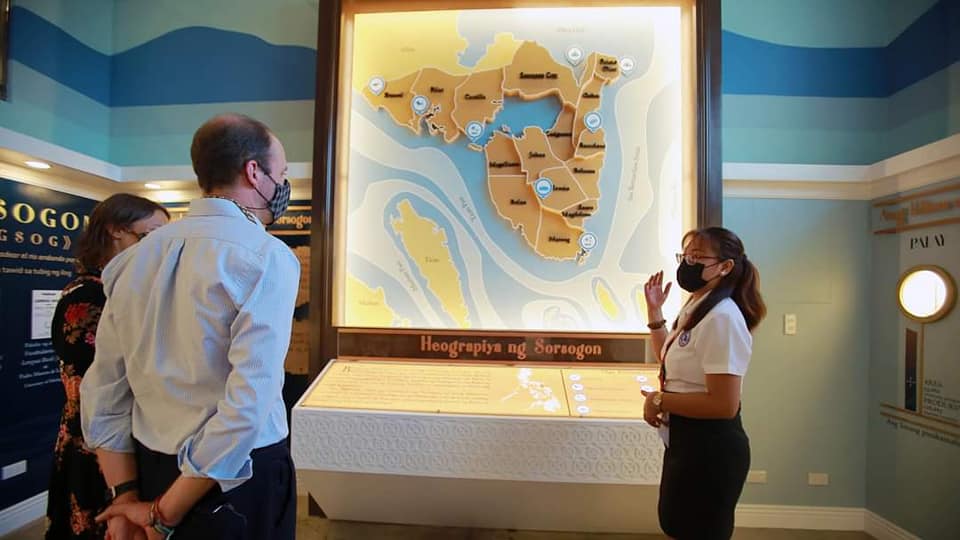
Gallery 1 – Photo source: Museo Sorsogon Facebook, https://www.facebook.com/105504924710260/photos/pb.100063894590424.-2207520000../213354220591996/?type=3
Gallery 2, called “Panahong Prehistoriko at Pagsisimula ng mga Pamayanan” (The Prehistoric Period and the Beginning of Communities), reveals 4 particulars:
* Ang mga Kuweba ng Bato (The Caves of Bato)
* Ang Libingan sa Pilar (The Cemetery of Pilar)
* Ang Pagsisimula ng mga Sinaunang Pamayanan (The Beginning of Early Settlements)
* Mga Alamat ng Lawa ng Bulusan (Legends of Lake Bulusan)

Gallery 2 – Photo source: Museo Sorsogon Facebook, https://www.facebook.com/105504924710260/photos/pb.100063894590424.-2207520000../196376745623077/?type=3
Gallery 3, called “Sorsogon noong Panahon ng mga Espanyol” (Sorsogon3 during the Spanish Period), contains 10 displays:
* Ang Misa sa Gibal-ong (Gibalon) Magallanes (The Mass of Gibalon, Magallanes)
* Ang Misyon ng mga Pransiskano sa Sorsogon (The Franciscan Mission in Sorsogon)
* Erecciones de Pueblos y Parroquias: Pagtatatag ng mga Bayan noong ika-17 Daantaon (The Establishment of Towns and Parishes During the 17th Century)
* Pag-aalsa sa Sorsogon (Uprising in Sorsogon)
* Astilleros: Ang Halaga ng Sorsogon sa Kalakhang Galyon (The Importance of Sorsogon in the Galleon Trade)
* Ang mga Pagsalakay ng mga Pirata sa Sorsogon (The Pirate Attacks in Sorsogon)
* Baluartes, Estacadas y Castillos: Ang mga Tanggulan at Moog sa Sorsogon (Bastions, Stockades and Castles: The Forts and Towers in Sorsogon)
* Ang mga Bahay-na-Bato ng Sorsogon (The Stone Houses of Sorsogon)
* Mga Tradisyong Relihiyoso sa ibat-ibang Bayan ng Sorsogon (Religious Traditions in the Different Towns of Sorsogon)
* Ang Espesyal na Debosyon kay Ina, Nuestra Señora de Peñafrancia10 sa Sorsogon (The Special Devotion to our Mother, Our Lady of Peñafrancia of Sorsogon).
Gallery 4, called “Rebolusyon sa Sorsogon” (Sorsogon3 Revolution), presents 3 parts:
* Kronolohiya ng mga Kaganapan (Chronology of Events)
* Si Obispo Jorge Barlin sa Sorsogon (Bishop Jorge Balrin11 of Sorsogon)
* Ang mga “Pulahanes” sa Sorsogon (The “Pulahanes”12 of Sorsogon).
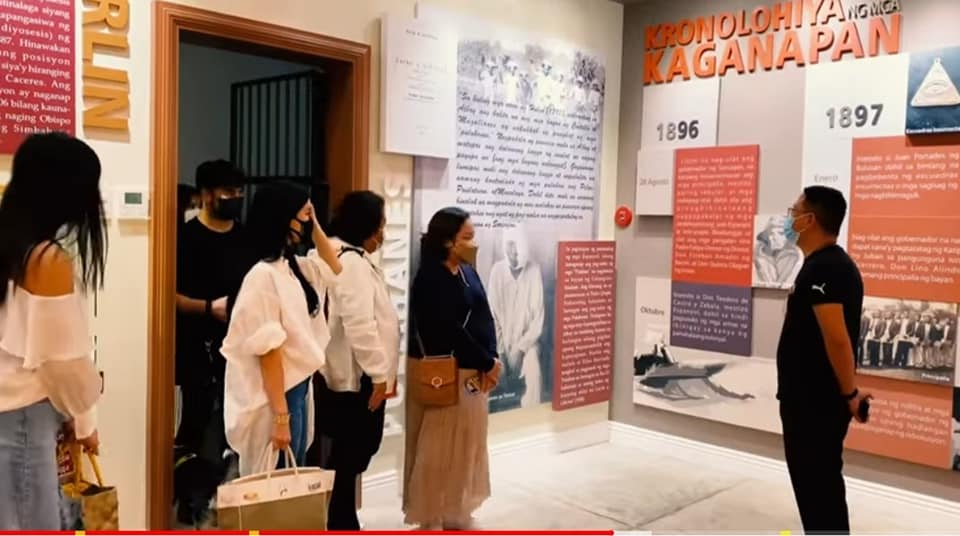
Gallery 4 – Photo source: Museo Sorsogon Facebook, https://www.facebook.com/105504924710260/photos/pb.100063894590424.-2207520000../214624293798322/?type=3

Gallery 4 – Photo source: Museo Sorsogon Facebook, https://www.facebook.com/105504924710260/photos/pb.100063894590424.-2207520000../213354260591992/?type=3
Gallery 5, called “Sorsogon sa Pananakop ng mga Amerikano” (Sorsogon3 During the American Occupation8), shows 8 details:
* Pagdating ng mga Amerikano (The Arrival of the Americans)
* Ang mga “Amerikanistas” at mga Anti-Amerikano; Ang Pagkilos ni Lt. Col. Emeterio Funes (The “Amerikanistas” and the Anti-Americans: The Action of Lt. Col. Emeterio Funes13)
* Pagtatanggol ng Donsol Laban sa mga Amerikano (Donsol’s Defense Against the Americans)
* Mga Gurong Amerikano (Thomasites) at ang Pampublikong Edukasyon sa Sorsogon (The American Teachers (Thomasites14) and Public Education in Sorsogon)
* Larawan ng Bagong Kaayusan (A Portrait of the New Order)
* Pampublikong Istraktura (Public Structures)
* Pagsupil sa Kolera (Cholera Control)
* Sa Ilalim ng Pamahalaang Komonwelt (Under the Commonwealth Government15)
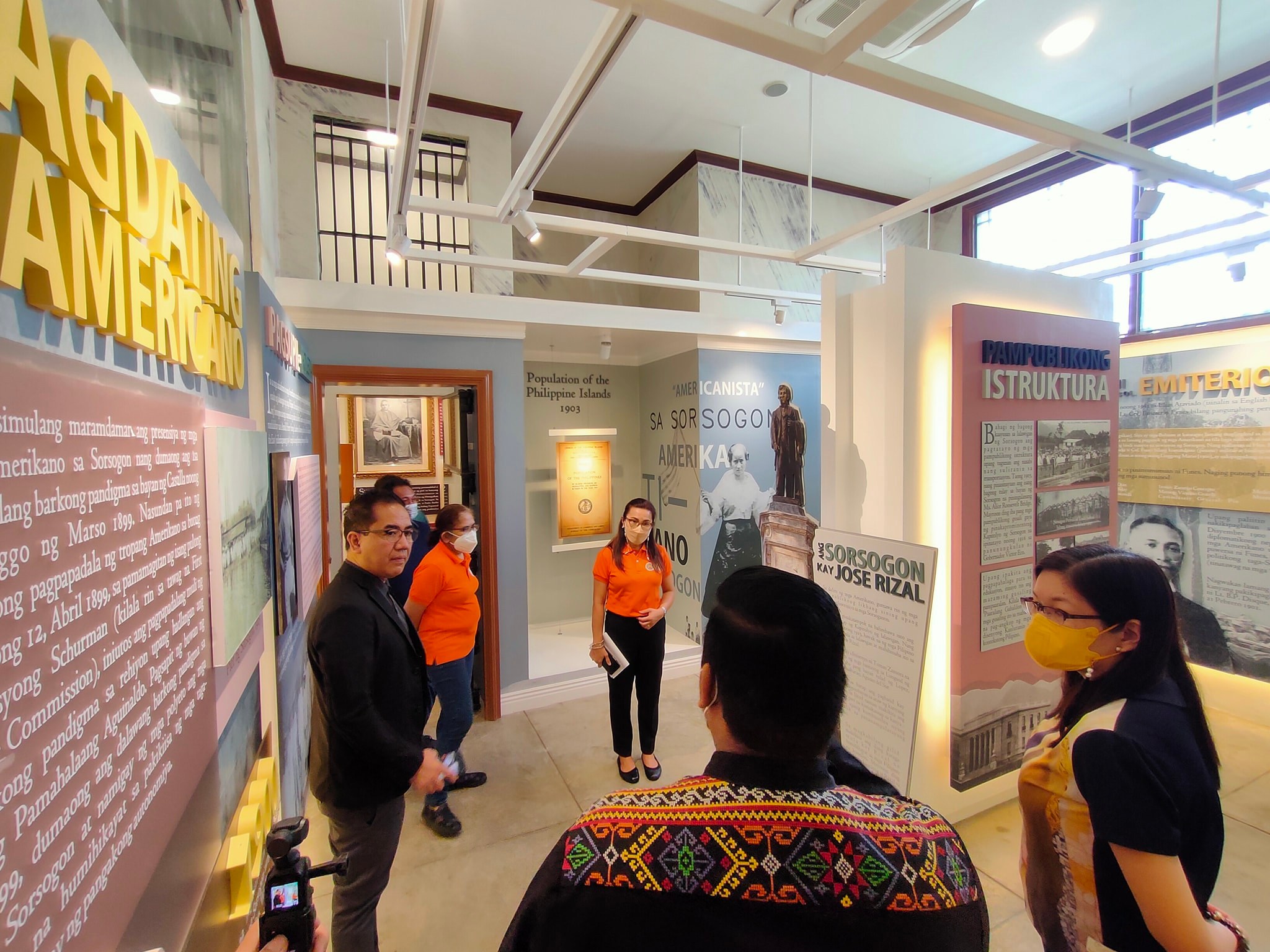
Gallery 5 – Photo source: Museo Sorsogon Facebook, https://www.facebook.com/photo.php?fbid=327500262723124&set=pb.100063894590424.-2207520000..&type=3

Gallery 5 – Photo source: Museo Sorsogon Facebook, https://www.facebook.com/105504924710260/photos/pb.100063894590424.-2207520000../213354280591990/?type=3
Galleries 6 to 10 are located on the second floor:
Gallery 6, called “Sorsogon sa Pananakop ng mga Hapon” (Sorsogon3 During the Japanese Occupation16), uncovers 7 scenes:
* Ang Ikalawang Digmaang Pandaigdig at ang Pananakop ng Sorsogon (The Second World War and the Conquest of Sorsogon)
* Mga Gerilla ng Sorsogon: Ang Gerilla Yunit ni Lapus (Sorsogon Guerillas17: The Guerilla Unit of Lapus18)
* Mga Gerilla ng Sorsogon: Ang Gerilla Yunit ni Escudero (Sorsogon Guerillas: The Guerilla Unit of Escudero19)
* Ang mga War Tunnel ng Bulan (The War Tunnels of Bulan)
* Ang Masaker ng mga Tsino ng Bulan (The Massacre of the Chinese of Bulan)
* Ang Pagtatapos ng Digmaan (The End of the War)
* Mga Bayaning Gerilya ng Sorsogon (Guerilla Heroes of Sorsogon)
Pic-8B-fb- 2021 March 27
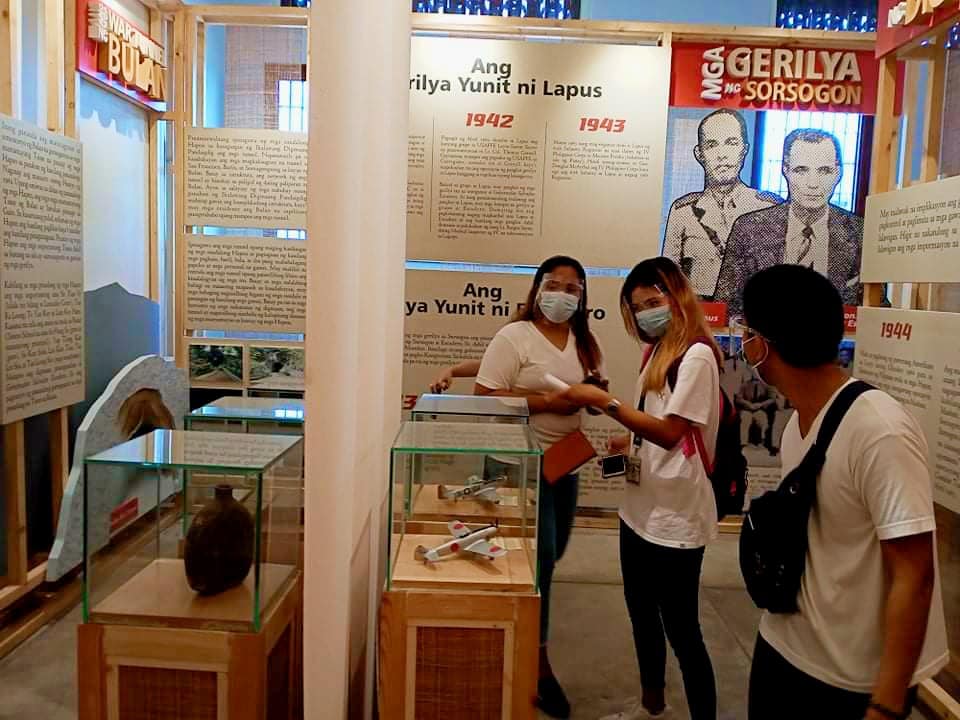
Gallery 6 – Photo source: Museo Sorsogon Facebook, https://www.facebook.com/105504924710260/photos/pb.100063894590424.-2207520000../196376465623105/?type=3
Gallery 7, called “Pagbangon at Pag-unlad” (Rise and Development), reveals 3 points:
* Mga Anak ng Sorsogon sa Panahon ng Batas Militar hanggang sa People Power (Sorsogueños During Martial Law Until People Power20)
* Mga Mapaminsalang Bagyo (Destructive Typhoons)
* Mga Aktibidad bg Bulkang Bulusan (The Activities of Mount Bulusan)
Gallery 8, called “Mga Industriya ng Sorsogon” (Sorsogon Industries), features 4 products: niyog (mature coconut), pagpapanday (blacksmithing), pili (pili nut) and abaka (abaca)
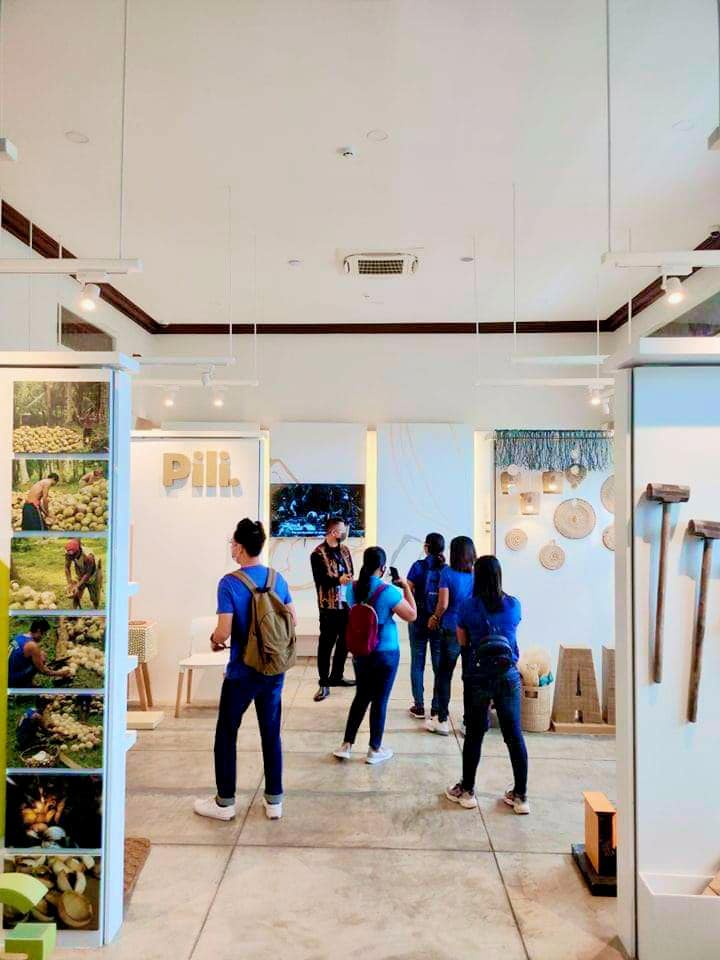
Gallery 8 – Photo source: Museo Sorsogon Facebook, https://www.facebook.com/105504924710260/photos/pb.100063894590424.-2207520000../196376518956433/?type=3
Gallery 9, called “Pantomina sa Tinampo”, exhibits 2 events:
* Kasanggayahan Festival21
* Pantomina sa Tinampo22 (Traditional Courtship Folk Dance, Guinness World Record Title Holder 2019)
Gallery 10, called “Mga Pook Pasyalan sa Sorsogon”, displays 4 features:
* Isla, Dagat, Dalampasigan (Island, Sea, and Beach)
* Anyaya ng Inang Kalikasan (Invitation of Mother Nature)
* Paglalakbay na Makasaysayan (Historical Journey)
* Mayamang Kultura at Pananampalataya (Rich Culture and Faith)

Gallery 10 – Photo source: Museo Sorsogon Facebook, https://www.facebook.com/105504924710260/photos/pb.100063894590424.-2207520000../213354330591985/?type=3
4. The yard, at the back of the museum, was converted into an 875-sq.m. open-air amphitheater, with a six-tier seating area. It can be a venue for events and stage performances.

Photo source: Museo Sorsogon Facebook, https://www.facebook.com/105504924710260/photos/pb.100063894590424.-2207520000../207628101164608/?type=3
5. The Kape-Terya (Cafeteria) and the Kape-Tolyo (coffee shop) are dining areas located at the back of the museum, inside the amphitheater. The former offers local snacks; the latter offers both hot and cold coffee to museum visitors. They help make the museum more sustainable.

Kape-tolyo – Photo source: Museo Sorsogon Facebook, https://www.facebook.com/105504924710260/photos/pb.100063894590424.-2207520000../177207384206680/?type=3
6. The Provincial Government of Sorsogon3 partnered with the Department of Trade and Industry (DTI) so that micro, small and medium enterprises can display their “made in Sorsogon” products in the Souvenir Shop, located at the entrance of the museum. Snacks, beauty products made from pili, handicrafts, and accessories are sold with no price mark-up.
7. The museum also features the original artworks of the provincial jail inmates, like the Sputnik gang’s rendition of the portrait of Cuban revolutionary Che Guevara.
8. There is also a restored mural of Lady Justice (Justitia) at the second floor, in Gallery 8. It was painted by a certain V. L. Jesalva.
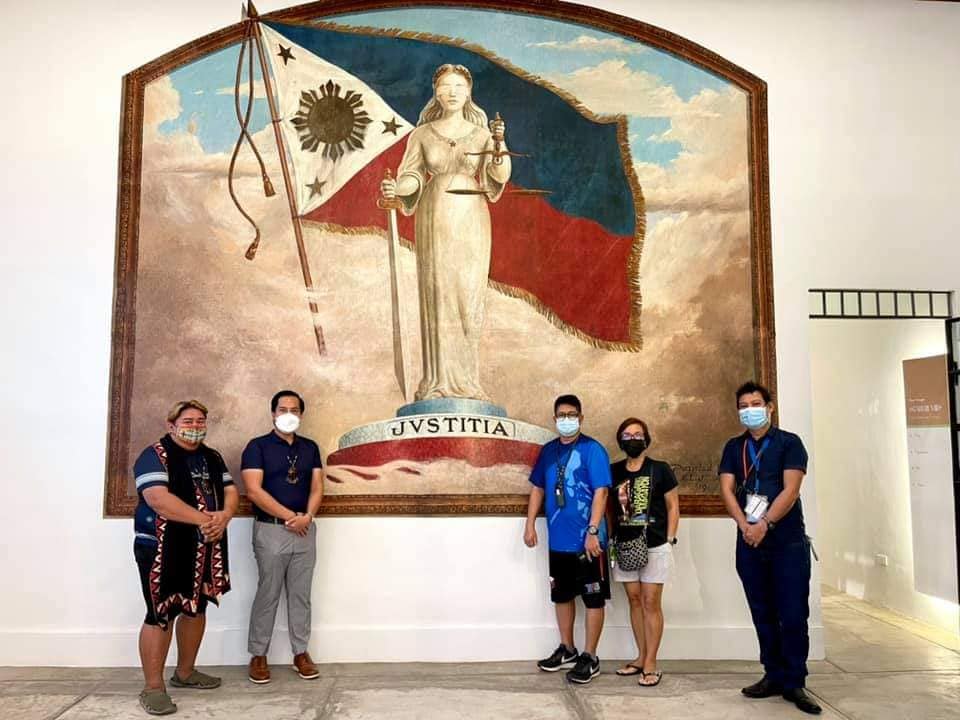
Photo source: Museo Sorsogon Facebook, https://www.facebook.com/photo.php?fbid=260982636041554&set=pb.100063894590424.-2207520000..&type=3
9. The National Historical Commission of the Philippines (NHCP) managed the curatoria development of this new museum and restored the Justitia mural. It also facilitated the loans of important artifacts from the National Museum of the Philippines.
The NHCP formally turned over the museum to the Sorsogon Provincial Government on March 12, 2021, during its inauguration and blessing. NHCP Chairman Rene R. Escalante presented the Certificate of Turn-over to Governor Francis Joseph G. Escudero, and the latter spearheaded the unveiling ceremonies.
10. The museum was blessed by Sorsogon Bishop Jose Alan V. Dialogo.
The inauguration was also attended by Deputy Speaker Evelina G. Escudero, National Museum of the Philippines Director-General Jeremy R. Barns, Sorsogon Vice Governor Manuel L. Fortes, Jr., Sorsogon City Mayor Ma. Ester E. Hamor, and other local government officials.
11. Museo Sorsogon opened to the public on March 15, 2021, from 8:30-11:30 AM and 1:00-4:30 PM, Monday to Friday.
Visitors must be 15-65 year-old, and bring a valid ID with birthday, and own pencil (no ballpen please) to fill up the forms in the museum.
Good news – for now, admission is free, but visitors are required to schedule their visits to prevent overcrowding due to the pandemic and follow safety protocols of the province and IATF23. No face mask and face shield, no entry! Do not bring any large backpack, food or drinks, and pets. There is an elevator for PWD guests.
Here are the guidelines through photos:
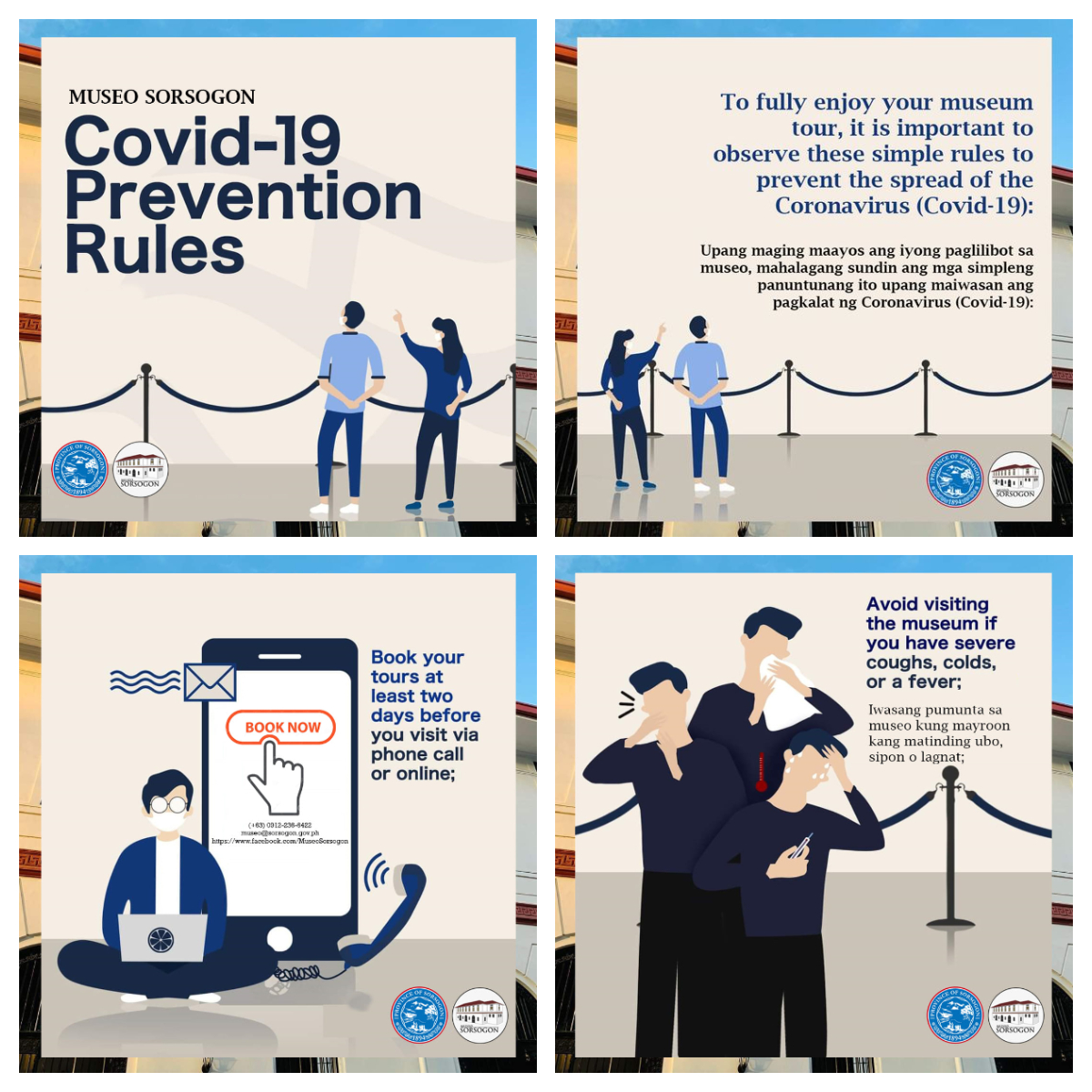

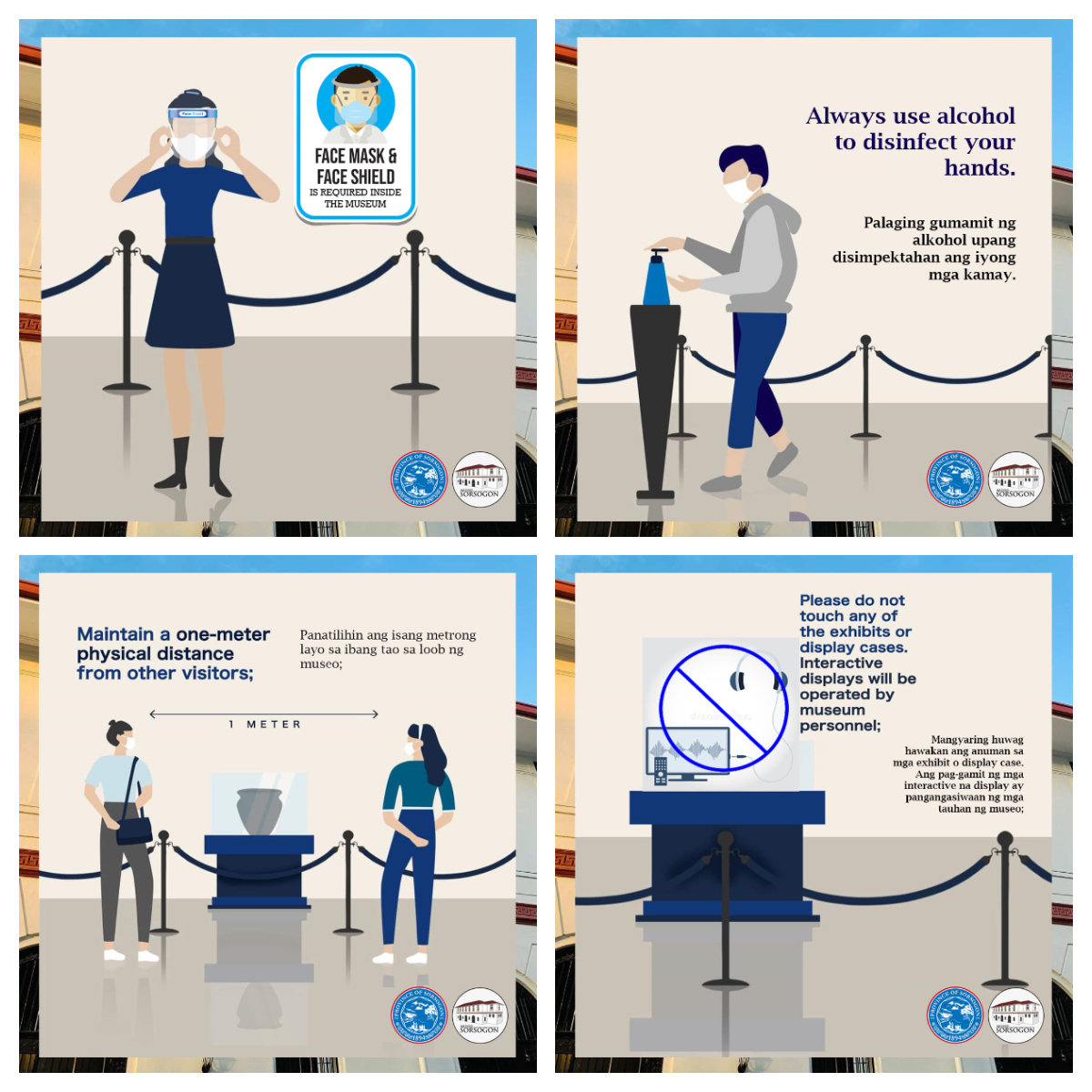

Groups with 10 or more members need to book two days ahead of their visit to be given a time slot and briefing. There is free parking space at the back of the Museo Amphitheater.
12. The fastest route from Manila to Bicol5 is via the Pan-Philippine Highway which has tolls, more or less 520 km from Manila. The Museum is located at the back of the Provincial Capitol building, and is visible in the City Proper.
You can email museo@sorsogon.gov.ph, call (+63) 0912-236-6422, or message https://www.facebook.com/MuseoSorsogon.
The information was obtained from the following sources: https://nhcp.gov.ph/nhcp-sorsogon-province-inaugurate-museo-sorsogon/, http://bicol.politics.com.ph/2021/03/15/gov-escudero-spearheads-unveiling-of-museo-sorsogon/, https://www.facebook.com/MuseoSorsogon, and https://thebicolbloc.com/sorsogon-museum-reopens-at-the-century-old-jailhouse-courthouse/ and Mr. Jerome D. Dia, Museo Sorsogon’s Museum Curator.
The photos featured in the cover picture-collage wers obtained from (l-r, top-bottom): Museo Sorsogon Facebook, https://www.facebook.com/105504924710260/photos/pb.100063894590424.-2207520000../196376632289755/?type=3, https://www.facebook.com/photo/?fbid=248477717292046&set=a.248477673958717, https://www.facebook.com/105504924710260/photos/pb.100063894590424.-2207520000../237871494806935/?type=3, and https://www.facebook.com/105504924710260/photos/pb.100063894590424.-2207520000../196376518956433/?type=3.
Tita S wishes to visit this place when it will be safe to do so for seniors. However, for Bicolanos, why not go to this new museum? Be proud of your history, culture and Sorsogon products! #MuseoSorsogon
By the way, I also featured Sorsogon in 4 previous posts, check out the 3 destinations and include them in your Sorsogon visit and tell me about it, ok?
THROWBACK – A THRILL OF A LIFETIME: SWIMMING WITH THE GENTLE GIANT – THE BUTANDING
PRETTY IN PINK – 3: SUBIC BEACH (Matnog, Sorsogon, Philippines)
PRETTY IN PINK – 4: TIKLING BEACH (Matnog, Sorsogon, Philippines)
THE FIRST MASS IN LUZON: MAGALLANES, SORSOGON
Did you find this post informative? I would like to hear from you re Museo Sorsogon.
See other interesting places through other posts in this category and other categories of SCapades, Pinoy Delights, and Smart Traveler – Now You Know, Short and Simple, and Say, Say, Say. Happy reading, and I hope that you will appreciate what I shared and some of the featured destinations will be part of your future travel plans!
Remember to share this post with your friends, follow me by clicking on the bottom right corner of your device, and do not forget to like this post. Thank you.
– – – – – – – – – – – – – – – – – – – – – – – – – –
The following terms are defined for interested readers, especially those with “Senior-Moments”, not familiar with the terms used in this post, and those too busy or lazy to Google such terms:
1A barangay in the Philippines is the smallest administrative division in the Philippines, headed by a barangay captain, aided by a Sangguniang Barangay (Barangay Council). It is the native Filipino term for a village. It was formerly called a barrio. In a metropolitan area, a barangay is an inner city neighborhood, a suburb, or a suburban neighborhood. The word barangay originated from the term balangay, a kind of boat used by a group of Austronesian people who migrated to the Philippines. A number of barangays grouped together is called a district. The information was obtained from Wikipedia page “Barangay.”24
2A province is the primary administrative and political division in the Philippines. It is the second-level administrative sub-division of a region6. There are 81 provinces (called lalawigan) in the Philippines. Each province is governed by an elected legislature called the Sangguniang Panlalawigan, and by an elected governor. Remember, a province in the Philippines is divided into cities and towns (called municipalities21), which in turn, are divided into barangays1, formerly called barrios. The information was obtained from Wikipedia page “Provinces of the Philippines.”25
3Sorsogon is a province2 located in the Bicol5 region6, in the island of Luzon7, in the Philippines, founded on October 17, 1894. It is the southernmost province in Luzon and is subdivided into 14 municipalities9 (or towns) and one city (Sorsogon City4, its capital). The people are called Sorsogueños.
It covers a total area of 2,119.01 km2 (818.15 sq.mi.). It is bordered by the province of Albay to the north, the Ticao and Burias Passes to the west and northwest, the Philippine Sea to the east, and to the south by the San Bernardino Strait. Mount Bulusan, the tallest peak, rises 1,560 m (5,120 ft) above sea level. It is interesting to know that all municipalities lie along the coast, except landlocked Irosin.
Sorsogon is the gateway of Luzon to the Visayas26 and Mindanao27 through its Roll-on/Roll-off ferry terminal facilities located in the municipalities of Matnog, Bulan and Pilar.
For more information, visit its website: www.sorsogon.gov.ph. The information was obtained from the Wikipedia page “Sorsogon”.28
4Sorsogon City is a 3rd class city29 and capital of the province2 of Sorsogon3, in the Bicol5 region6, in the island of Luzon7, Philippines. It is the only city in the province and was established as a component city30 created by virtue of Republic Act No. 8806, enacted on August 16, 2000, and ratified on December 16, 2000, from the merger of Bacon and Sorsogon municipalities9, with a total of 64 barangays1.
It is called the “Gateway to Southern Philippines” because it serves as a trans-shipment point from the provinces of the islands of Visayas26 and Mindanao27. It covers a land area of 31,292 hectares (120.82 sq.mi.). This city is bounded by the Albay Gulf in the north, the municipality of Manito (of the province of Albay) in the northwest, and the Sorsogon municipalities of Castilla in the west, Casiguran in the southwest, Prieto Diaz in the east, Gubat in the southeast, and Sorsogon Bay in the south.
The information was obtained from the Wikipedia page “Sorsogon City”.31
5Region V, or Bicol Region, is a Philippine region6 located in the island of Luzon7, with Legazpi as its regional center and largest city. It has 6 provinces2: Albay, Camarines Norte, Camarines Sur, Catanduanes, Masbate, and Sorsogon3. It is called the “Home of the Uragons”, referring to the brave Bicolano people.
This region is bounded by the Lamon Bay to the north, the Ragay Gulf to the west, and the Philippine Sea to the east. Camarines Norte and Camarines Sur, the northernmost provinces, are bordered to the west by the province of Quezon (of the Calabarzon region31).
The information was obtained from the Wikipedia page “Bicol Region”.32
6A region is an administrative division based on geographical, cultural and ethnological characteristics. Each region is further subdivided in provinces1, composed of cities and municipalities9 (or towns), which in turn, are divided into barangays1, formerly called barrios, according to Wikipedia page “Regions of the Philippines” 33.
7Luzon is the largest and most populous island in the Philippines. It is ranked the 15th largest island in the world by land area, at 109,964.9 sq.km. (42,457.7 sq mi). It is the northern portion, among the three primary island groups in the Philippine archipelago, with Visayas26 at the center, and Mindanao27 at the southern part. It is the economic and political center of the country, with Manila as the capital city, and Quezon City as the country’s most populous city. It has a population of 53 million, as of 2015, representing 52.5% of the country’s total population, and the fourth most populous island in the world. The name Luzon comes from the Tagalog word lusong, a large wooden mortar used to de-husk rice. The information was obtained from the Wikipedia page “Luzon”34 .
8The American colonization of the Philippines began when Spain ceded the Philippines to the United States with the signing of the Treaty of Paris35 on December 10, 1898, after the Spanish-American War36.
The interim US military government of the Philippine Islands37 experienced a period of great political turbulence, characterized by the Philippine-American War38. Starting 1901, the military government was replaced by a civilian government, the Insular Government of the Philippine Islands, with William Howard Taft as its first Governor-General. A series of insurgent governments ensued until 1904.
After the Philippine Independence Act of 1934, a Philippine presidential election was held in 1935, with Manuel L. Quezon elected and inaugurated President of the Philippines on November 15, 1935. The Insular Government was dissolved and the Commonwealth of the Philippines15 was created to be a transitional government in preparation for the country’s independence. On July 4, 1946, the United States formally recognized the independence of the Republic of the Philippines.
The information was obtained from the Wikipedia page “History of the Philippines (1898-1946)”.39
9A municipality is a small, single urban administrative division, or local government unit (LGU), in the Philippines which has corporate status and powers of self-government or jurisdiction as granted by law. It is a unit under a province2, subdivided into barangays1, and is locally called bayan. In the Philippines, a municipality is headed by a mayor, a vice mayor, and members of the Sangguniang Bayan (legislative branch). It can enact local policies and laws, enforce them, and govern its jurisdictions. It can enter into contracts and other transactions through its elected and appointed officials and can tax as well. It enforces all local and national laws. There are almost 1,500 municipalities in the Philippines. The information was obtained from Wikipedia page “Municipalities of the Philippines.”40
10Nuestra Señora de Peñafrancia, or Our Lady of Peñafrancia, is a wooden statue of the Blessed Virgin Mary venerated in Naga City41, in the Bicol5 region6, in the island of Luzon7, Philippines. This image came from the original image enshrined in Salamanca, Spain, and is housed at the Peñafrancia Basilica42, where every September, novena43 festivities are held. Pope Pius XI granted the image a Canonical coronation on September 20, 1924 through his Apostolic delegate, Monsignor Guillermo Piani. The information was obtained from Wikipedia page “Our Lady of Peñafrancia.”44
11Jorge Balrin (1850 – 1909) was the first Filipino who was consecrated a bishop in the Roman Catholic Church. He was the first Filipino and Bicolano bishop, and was parish priest and vicar forane45 of Sorsogon3 from 1887 to 1906. He served as archbishop of the Roman Catholic Archdiocese of Caceres46 in the Philippines until 1909. The information was obtained from Wikipedia page “Jorge Barlin.”47
12Pulahanes refers to the people who were members of a religious revival of Philippine beliefs that developed in the Visayas26, prior to the Philippine Revolution48. Pulahan literally means “those wearing red” in Cebuano, the most widely spoken of the Visayan languages. They are also called dios-dios, literally “god pretender” or “false god”, from the Spanish word for god, dios. They were called as such because their religious leaders had the penchant for identifying themselves with Christian religious figures, and led cult-like religious movements, promising prosperity, supernatural powers, or healing to their followers.
Their practices centered mostly on Philippine mythology, along with Folk Catholicism, and believed in anting-anting49 and the babaylan50 (shaman). They had religious rituals using bottles of holy oil, prayer books such as the Bible, consecrated anting-anting, as blessings before battles. They specialized in using a heavy crescent-shape bolo knife in their battles, and were regarded by the Americans as notorious fighters and experts in hand-to-hand combat.
The movement was started by Ponciano Elofre, the Cabeza de Barangay of Zamboanguita, Negros Oriental (a province in the Central Visayas region). Although it peaked with around 15,000 members, this movement was severely crippled during the Philippine Revolution after the Philippine Constabulary took over patrols in Samar, an island in eastern Visayas, and the US military declared the island as “pacified”.
The information was obtained from Wikipedia page “Pulahan.”51
13Lt. Col. Emeterio Escava Funes (1870 – 1909) is considered to be the foremost among the unsung heroes of Bulusan, a municipality9 of the province2 of Sorsogon3. He became part of the revolutionary forces under Gen. Miguel Malvar52, and was declared as politico-militar governor of Sorsogon by Gen. Vito Belarmino in March 1900. He then led the revolutionary forces in eastern and southern Sorsogon. His most popular triumph over the American forces happened in Boco Pass, Barangay San Francisco, on April 25, 1900. His headquarters in Bulusan was attacked by American forces on November 21, 1900 but he was victorious. Another victory happened on December 18, 1900.
He finally surrendered on February 21, 1901, took the oath of allegiance to the USA, and returned to live an ordinary life as a landowner and family man. Because of him, Bulusanons are perceived as a people who are assertive of their rights and are not afraid to fight for them.
The information was obtained from https://www.facebook.com/111541666928468/posts/col-emeterio-funes-y-escava150th-birth-anniversary1870-march-2-2020considered-to/187375096011791/.
14 The Thomasites were a group of 600 American teachers who travelled from the US to the newly occupied territory of the Philippines on the transport ship USS Thomas, and arrived in Manila in August 1901. The term was expanded to include any teacher who arrived in the first few years of the American colonial period of the Philippines8.
After a two-day quarantine, they were assigned to various provinces2, built elementary schools and learning institutions, and taught English, agriculture, grammar, geography, mathematics, general courses, trade courses, housekeeping and household arts (sewing, crocheting and cooking), manual trading, freehand and mechanical drawing, and athletics (baseball, basketball, indoor baseball, tennis, and track and field). They transformed the Philippines into the third largest English-speaking nation in the world, and became the precursors of the present-day US Peace Corps Volunteers.
The information was obtained from Wikipedia page “Thomasites.”53
15The Commonwealth of the Philippines was the administrative body that governed the Philippines from 1935 to 1946 with foreign affairs managed by the USA, aside from a period of exile in World War II from 1942 to 1945 when Japan occupied the country. It was designed as a transitional administration in preparation for the country’s full achievement of independence. In 1946, the Commonwealth ended, and the Philippines claimed full sovereignty as provided in the 1935 Constitution. The information was obtained from Wikipedia page “Commonwealth of the Philippines.”54
16The Japanese Occupation of the Philippines occurred between 1942 and 1945 when Imperial Japan occupied the Commonwealth of the Philippines15 during World War II.
The invasion of the Philippines started on December 8, 1941, 10 hours after the attack on Pearl Harbor. A guerilla campaign by Philippine resistance forces controlled 60% of the islands, mostly jungle and mountain areas. General Douglas MacArthur returned to the Philippines on October 20, 1944. Fighting continued until Japan’s formal surrender on September 2, 1945, recording around 500,000 Filipinos who died during the occupation.
The information was obtained from Wikipedia page “Japanese occupation of the Philippines.”55
17A guerilla is a member of a small group of combatants, like armed civilians, who fights a larger and traditional military, using military tactics like ambushes, hit-and-run tactics, petty warfare, raids, sabotage, and mobility to fight a larger and less-mobile traditional military, according to the Wikipedia page “Guerrilla warfare”.56
18Major Licerio P. Lapus was the Provincial Inspector of Sorsogon (Philippine Constabulary). He became the leader of a group of guerillas17 who hunted down Makapili soldiers (militant group loyal to the Japanese Army) and executed abusive Japanese officers.57
19Salvador Escudero, Sr. was the governor of Sorsogon3 from 1946 to 1955. He built a 1,500 man group in the province2 and fought with Major Lapus’18 rebuilt group. He fell ill in March 1943 and was evacuated to Samar.57
20The EDSA Revolution, or the People Power Revolution, was a series of popular demonstrations in the Philippines from February 22-25, 1986, mostly in the famous highway, EDSA, short for Epifanio de los Santos Avenue. It is considered a non-violent revolution which eventually led to the ouster of President Ferdinand Marcos.
21The Kasanggayahan Festival is a festival celebrated in the whole province2 of Sorsogon3 during the last week of October. It commemorates the founding of Sorsogon as a province. Festivities include a series of agro-industrial, cultural, economic, historical, and religious activities, showcasing the province’s agricultural products. One of the main activities and highlight of this festival is the Pantomina sa Tinampo22. The information was obtained from the Wikipedia page “Sorsogon”.28
22Pantomina sa Tinampo is a kind of cultural-ethnic street dance, native to the province2 of Sorsogon3. It is the traditional wedding, courtship, or love, dance which originated from the Bicol5 region6. It remains popular especially in remote areas, showcased in various occasions like family reunions and birthdays.58, 59 and 60
It is one of the main activities and highlight of the Kasanggayahan Festival21 held during the last week of October. Hundreds of men and women participate, clad in colorful traditional Filipino couture, while dancing barefoot, as they parade around Sorsogon City4. The information was obtained from the Wikipedia page “Sorsogon”.28
On October 31, 2019, the province of Sorsogon was recognized by the Guinness World Records to hold the largest and longest Filipino folk dance called Pantomina sa Tinampo22, performed with 7,127 participants, in a single venue.
23IATF-EID, or simply the IATF, stands for the Inter-Agency Task Force on Emerging Infectious Diseases. It is a task force organized by the executive of the Philippine government to respond to affairs concerning emerging infectious diseases in the Philippines. It was created through Executive Order No. 168, issued by President Benigno Aqunio III in 2014.
It convened in January 2020, during the administration of President Rodrigo Duterte, to address the growing viral outbreak in Wuhan, China, eventually known as severe acute respiratory syndrome coronavirus 2 (SARS-CoV-2), the virus that caused COVID-19. It is chaired by the Secretary of the Department of Health. See https://en.wikipedia.org/wiki/Inter-Agency_Task_Force_on_Emerging_Infectious_Diseases for the co-chairs and members of IATF as well as its activities.
The information was obtained from Wikipedia page “Inter-Agency Task Force on Emerging Infectious Diseases.”61
24“Barangay,” accessed December 30, 2018, https://en.m.wikipedia.org/wiki/Barangay
25“Provinces of the Philippines,” accessed May 29, 2019, https://en.wikipedia.org/wiki/Provinces_of_the-Philippines
26Visayas is one of the 3 major geographical divisions of the Philippines. It covers 3 administrative regions: Central Visayas, Eastern Visayas and Western Visayas. It consists of 6 major islands (Bohol, Cebu, Leyte, Negros, Panay and Samar) mostly surrounded by the Visayan Sea, and is composed of 16 provinces2, according to Wikipedia page “Visayas”.62 The 2 other geographical divisions of the Philippines are Luzon7 (the northern part) and Mindanao27 (the southern part).
27Mindanao is one of the 3 major geographical divisions of the Philippines. It is the second largest island of the country and covers 6 administrative regions6: Caraga, Davao, Northern Mindanao, SOCCSKSARGEN, Zamboanga Peninsula, and the Bangsamoro Autonomous Region in Muslim Mindanao (BARMM). It is composed of 22 provinces2 and 33 cities (27 provinces and 33 cities, if associated islands are included). The information was obtained from Wikipedia page “Mindanao.”63 Mindanao is located in the southern part of the country; the 2 other geographical divisions of the Philippines are Luzon7 (in the northern part) and Visayas26 (the middle part).
28“Sorsogon,” accessed March 29, 2020, https://en.wikipedia.org/wiki/Sorsogon
29A third class city in the Philippines has an average annual income for a 4-year period of 240 million, but less than 320 million pesos, according to the Wikipedia page “Cities of the Philippines.”64.
30A component city is a type of city in the Philippines which does not meet the requirements of a highly urbanized city65. It is under the jurisdiction of a province2. If such a city is located along the boundaries of 2 or more provinces, it shall be considered part of the province of which it used to be a municipality9. The information was obtained from Wikipedia page “Cities of the Philippines.”64
31“Sorsogon City,” accessed March 29, 2020, https://en.wikipedia.org/wiki/Sorsogon_City
32“Bicol Region,” accessed March 29, 2020, https://en.wikipedia.org/wiki/Bicol_Region
33“Regions of the Philippines,” accessed July 17, 2018, https://en.wikipedia.org/wiki/Regions_of_the_Philippines
34“Luzon,” accessed April 2, 2018, https://en.wikipedia.org/wiki/Luzon
35The Treaty of Paris was a treaty signed by Spain and the USA on December 10, 1898, that ended the Spanish-American War36. Spain relinquished all claim of sovereignty over and title to Cuba and also ceded Guam, Puerto Rico and the Philippines to the USA. The cession of the Philippines involved a compensation of $120 million from the USA to Spain to cover infrastructure owned by Spain. It came into effect on April 11, 1899, when the documents of ratification were exchanged. The information was obtained from the Wikipedia pages “Treaty of Paris”66 and Spanish-American War”67.
36The Spanish-American War was an armed conflict between Spain and the USA in 1898. Hostilities began in the aftermath of the internal explosion of USS Maine in Havana Harbor in Cuba, leading to US intervention in the Cuban War of Independence. The war led to the US emerging predominant in the Caribbean region, and resulted in US acquisition of Spain’s Pacific possessions. That led to US involvement in the Philippine Revolution68 and ultimately to the Philippine-American War38. This ended with the Treaty of Paris35. The information was obtained from the Wikipedia page Spanish-American War”67.
37The US Military Government of the Philippine Islands (1898 – 1902) was a military government established by the United States on August 14, 1898, a day after the capture of Manila. General Wesley Merritt acted as the military governor, under the authority of the US president as Commander-in-Chief of the US Armed Forces. He was followed by General Elwell S. Otis, General Arthur MacArthur, and Major General Adna Chaffee.
An American-style school system was introduced, initially with soldiers as teachers; civil and criminal courts were established, including a supreme court; and local governments were established in towns and provinces2.
The information was obtained from the Wikipedia page “US Military Government of the Philippine Islands”68.
38The Philippine-American War, Filipino-American War, the Philippine War, the Philippine Insurrection, or the Tagalog Insurgency, was an armed conflict between the First Philippine Republic69 and the USA from February 4, 1899 to July 2, 1902. This conflict arose when the First Philippine Republic objected to the terms of the Treaty of Paris35 under which the USA took possession of the Philippines from Spain, ending the Spanish-American War36. The information was obtained from the Wikipedia page “Philippine-American War”70.
39“History of the Philippines (1898-1946),” accessed November 2, 2018,
https://en.wikipedia.org/wiki/History_of_the_Philippines_(1898%E2%80%931946)
40“Municipalities of the Philippines,” accessed January 29, 2019, https://en.wikipedia.org/wiki/Municipalities_of_the_Philippines
41Naga City is an independent component city30 in the Bicol5 region6, in the island of Luzon7, Philippines. It was founded in 1575 as Ciudad de Nueva Caceres46 by Captain Pedro de Chaves, by order of Spanish Governor-General Francisco de Sande. It was the third Spanish royal city in the Spanish East Indies71, after Iloilo and Manila. It was renamed Naga in 1919 and became a city on June 18, 1948.
It is geographically and statistically classified under the province2 of Camarines Sur, but is administratively independent of the provincial government. It is now the Bicol region’s business, commercial, cultural, educational, financial, industrial, medical, and religious center. It is known in different names: “The Queen City of Bicol” and the “Heart of Bicol” due to its central location on the Bicol Peninsula; “The Pilgrim City” since it is the destination of the largest Marian pilgrimage in Asia – Our Lady of Peñafrancia10, whose image is one of the most popular objects of devotion in the country; and “One of the Seven Golden Cities of the Sun” as stated by Nick Joaquin (1917 – 2004), a popular Filipino journalist and short story and novel writer.
The information was obtained from https://naga.gov.ph/cityprofile/ and the Wikipedia page “Naga, Camarines Sur”72. Visit its website: www.naga.gov.ph
42The Peñafrancia Basilica, or Minor Basilica of Our Lady of Peñafrancia, is a Roman Catholic Minor Basilica located on the outskirts of Naga City41, in the Bicol5 Region6, in the island of Luzon7, Philippines, founded by Archbishop Teopisto V. Alberto, completed in 1982. It is the only basilica in the Bicol Region and one of the largest Marian Pilgrimage sites in Asia, with the image of Our Lady of Peñafrancia10 enshrined therein. The information was obtained from the Wikipedia page “Peñafrancia Basilica”73.
43A novena is an ancient tradition of devotional praying in Christianity consisting of private or public prayers repeated for nine consecutive days or weeks. The term comes from the Latin word novem, meaning “nine”. The first novena was believed to have been the nine days between the Feast of the Ascension and Pentecost by the disciples of Jesus who gathered and devoted themselves to prayer.
The prayers are often derived from devotional prayer books, or consist of the recitation of the rosary, or of short prayers through the day. The prayers are printed in small booklets and is often dedicated to a specific angel, saint, Marian title of the Blessed Virgin Mary, or one of the personages of the Holy Trinity. In the Catholic tradition, much-used novena prayers include doctrinal statements in addition to a personal petition.
The information was obtained from the Wikipedia page “Novena”74.
44“Our Lady of Peñafrancia,” accessed March 29, 2020, https://en.wikipedia.org/wiki/Our_Lady_of_Pe%C3%B1afrancia
45Vicar forante is a formal title conferred upon a pastor of a parish who serves as a senior figure, though usually without specific jurisdictional authority, over a section of a diocese, and has specific powers under canon law. The information was obtained from the Wikipedia page “Dean (Christianity)”75.
46Nueva Caceres was the former Spanish city in the Philippines, established by Captain Pedro de Chaves, in honor of Governor-General Francisco de Sande who was a native of the city of Caceres, in Spain. It was considered the center of economy and industry in the Bicol Region, and was named as the capital of the province of Camarines.
After the province was dissolved in 1829, the city became the capital of Camarines Sur in 1857, and from 1902 – 1908, some villages of Canaman and Camaligan were annexed to the city. In 1919, after the fall of the Spanish colonial government, most of the city became part of the municipality9 of Naga41, while some villages in the northwest were returned to their respective mother towns to reform the old municipalities.
The information was obtained from the Wikipedia page “Nueva Caceres”76.
47“Jorge Barlin,” accessed March 29, 2020, https://en.wikipedia.org/wiki/Jorge_Barlin
48The Philippine Revolution is the revolution that started in 1896 when the Spaniards discovered the Katipunan77, and ended in 1898.
49Anting-anting, agimat, or anting, is a Filipino term for amulet or charm. It is also a Filipino system of magic and sorcery with special use of amulets, charms and talismans. It is also called bertud or galing. It is art of a wider Southeast Asian tradition of tribal jewelry.
In Philippine occult tradition, there is usually a corresponding agimat to deal with a particular area in a person’s life, mostly for removing hexes and exorcism of evil spirits. An agimat is usually accompanied by a small book of magic incantations which must be read during Good Friday or a certain special date to attain the amulet’s full power and benefit. An agimat could also be in the form of a clothing with magic words inscribed on it, or even in the form of edible enchanted mud.
The information was obtained from the Wikipedia page “Agimat”78.
50Babaylan, balian or katalonan, is the common term for the Philippine shamans of the various ethnic groups of the pre-colonial Philippine islands (900 – 1565, the end of Spanish colonization). They specialized in communicating, appeasing, or harnessing the spirits of the dead and the spirits of nature. They were mostly women or feminized men (asog or bayok). They were believed to have spirit guides, by which they could contact and interact with the spirits and deities (anito or diwata) and the spirit world. There are different subtypes of babaylan specializing in the arts of healing and herbalism, divination, and sorcery; see https://en.wikipedia.org/wiki/Philippine_shamans.
The information was obtained from the Wikipedia pages “Philippine shamans”79 and “History of the Philippines (900-1565)”80.
51“Pulahan,” accessed March 29, 2020,https://en.wikipedia.org/wiki/Pulahan
52General Miguel Carpio Malvar (1865 – 1911) was a Filipino general who served during the Philippine Revolution48, and subsequently, during the Philippine-American War38. He assumed command of the Philippine revolutionary forces during the latter, following the capture of Emilio Aguinaldo (the first president of the country) by the Americans on March 23, 1901. The information was obtained from the Wikipedia page “Miguel Malvar”81.
53“Thomasites,” accessed March 29, 2020, https://en.wikipedia.org/wiki/Thomasites
54“Commonwealth of the Philippines,” accessed March 29, 2020, https://en.wikipedia.org/wiki/Commonwealth_of_the_Philippines
55“Japanese occupation of the Philippines,” accessed March 29, 2020,https://en.wikipedia.org/wiki/Japanese_occupation_of_the_Philippines
56“Guerilla warfare,” accessed November 2, 2018, https://en.m.wikipedia.org/wiki/Guerilla_warfare
57Annex A: Guerrilla Leaders and Units Notable Guerrilla …, https://drum.lib.umd.edu, compiled from data in General Headquarters, Southwest Pacific Area, Military Intelligence Section, General Staff, “Guerrilla Resistance Movements in the Philippine,” 1-81, 31 March 1945, Box 255, RG 407, Philippines Archive Collection, National Archives II, College Park, Maryland
58https://www.guinnessworldrecords.com/world-records/585900-largest-filipino-folk-dance
61“Inter-Agency Task Force on Emerging Infectious Diseases,” accessed March 29, 2020, https://en.wikipedia.org/wiki/Inter-Agency_Task_Force_on_Emerging_Infectious_Diseases
62“Visayas,” accessed April 2, 2018, https://en.wikipedia.org/wiki/Visayas
63“Mindanao,” accessed April 2, 2018, https://en.wikipedia.org/wiki/Mindanao
64“Cities of the Philippines,” accessed March 17, 2018, https://en.wikipedia.org/wiki/Cities_of_the_Philippines
65A highly urbanized city is a type of city in the Philippines with a minimum population of 200,000 as certified by the Philippine Statistics Authority (PSA), and with the latest annual income of at least 50 million pesos. There are currently 33 such cities in the Philippines (see a related post: ___). The information was obtained from the Wikipedia page “Cities of the Philippines.”64
66“Treaty of Paris (1898),” accessed March 29, 2020, https://en.wikipedia.org/wiki/Treaty_of_Paris_(1898)
67“Spanish-American War,” accessed March 29, 2020, https://en.wikipedia.org/wiki/Spanish%E2%80%93American_War
68“United States Military Government of the Philippine Islands,” accessed March 29, 2020, https://en.wikipedia.org/wiki/United_States_Military_Government_of_the_Philippine_Islands
69The First Philippine Republic, Philippine Republic or Malolos Republic was a nascent revolutionary government in the Philippines, formally established with the proclamation of the Malolos Constitution on January 21. 1899, in Malolos, Bulacan, with Emilio Aguinaldo as the first president, and endured until the capture of Aguinaldo by the American forces on March 23, 1901, in Palanan, Isabela, which effectively dissolved the First Philippine Republic. The information was obtained from the Wikipedia page “First Philippine Republic”.82
70“Philippine-American War,” accessed March 29, 2020, https://en.wikipedia.org/wiki/Philippine%E2%80%93American_War
71The Spanish East Indies were the overseas territories of the Spanish Empire in Asia and Oceania from 1565 to 1901, governed from Manila in the Spanish Philippines. See https://en.wikipedia.org/wiki/Spanish_East_Indies for the territories included and other details. The information was obtained from the Wikipedia page “Spanish East Indies”.83
72“Naga, Camarines Sur,” accessed March 29, 2020, https://en.wikipedia.org/wiki/Naga,_Camarines_Sur
73“Peñafrancia Basilica,” accessed March 29, 2020, https://en.wikipedia.org/wiki/Pe%C3%B1afrancia_Basilica
74“Novena,” accessed March 29, 2020, https://en.wikipedia.org/wiki/Novena
75“Dean (Christianity),” accessed March 29, 2020, https://en.wikipedia.org/wiki/Dean_(Christianity)
76“Nueva Caceres” accessed March 29, 2020, https://en.wikipedia.org/wiki/Nueva_C%C3%A1ceres
77The Katipunan is the Philippine revolutionary secret society founded by anti-Spanish Filipinos in Manila in 1892. It aimed to gain independence from Spain through a revolution, according to the Wikipedia page “Katipunan”.84
78“Agimat,” accessed March 29, 2020, https://en.wikipedia.org/wiki/Agimat
79“Philippine shamans,” accessed March 29, 2020, https://en.wikipedia.org/wiki/Philippine_shamans
80“History of the Philippines (900-1565),” accessed March 29, 2020, https://en.wikipedia.org/wiki/History_of_the_Philippines_(900%E2%80%931565)
81“Miguel Malvar,” accessed March 29, 2020, https://en.wikipedia.org/wiki/Miguel_Malvar
82“First Philippine Republic,” accessed March 29, 2020, https://en.wikipedia.org/wiki/First_Philippine_Republic
83“Spanish East Indies,” accessed March 29, 2020, https://en.wikipedia.org/wiki/Spanish_East_Indies
84“Katipunan,” accessed March 6, 2018, https://en.wikipedia.org/wiki/Katipunan

Dear Balikbayan and foreign readers, great news! The Philippines is opening its doors on February 2022 based on the recommendations of the Task Force on Covid-19 New Variants and Sub-Technical Working Group on Data Analytics. Allow Tita S to share with you the details.
First, no more color-coding system to categorize countries, territories, and jurisdictions based on their Covid-19 risk levels. So, this means that fully-vaccinated nationals of non-visa required countries will be allowed to enter the Philippines starting February 10, 2022! Actually, this was supposed to happen on December 1, 2021, but Omicron arrived so it was deferred.
Starting February 1, 2022, fully-vaccinated travelers will only be required to present a negative RT-PCR test taken within 48 hours prior to departure from the country of origin.
You must present your passport, valid for at least 6 months at the time of arrival, and a return or outbound ticket to your country of origin or next country of destination.
How do you prove that you are fully vaccinated? There are 3 accepted documents:
* World Health Organization (WHO) International Certificates of Vaccination and Prophylaxis
* VaxCertPH
* National or state digital certificate of the foreign government which has accepted VaxCertPH under a reciprocal arrangement, unless otherwise permitted by the IATF (Inter-Agency Task Force).
And you know what? Upon arrival in the Philippines, qualified, fully-vaccinated travelers will no longer be required to observe mandatory facility-based quarantine! You only need to self-monitor for any signs or symptoms for 7 days, with the first day being the date of arrival, and report to the local government unit of your destination upon the manifestation of symptoms, if any.
So, how about partially-vaccinated, unvaccinated travelers, or persons whose vaccination status cannot be independently validated?
* First, you need to present a negative RT-PCR test taken within 48 hours prior to departure from your country of origin;
* You are required to undergo facility-based quarantine until the release of your negative RT-PCR test taken on the 5th day.
* You need to undergo home quarantine until your 14th day, with the date of arrival being the first day.
* The local government units and Barangay Health Emergency Response Teams will monitor all arriving passengers undergoing home quarantine.
And, how about minors? Minors are exempted from the requirement of being full-vaccinated and providing proof of immunization prior to boarding. They just have to follow the quarantine protocol applied to the parent or guardian traveling with them.
The Department of Tourism (DOT) will closely monitor the situation and ensure that health and safety protocols will be strictly implemented in all tourism establishments, according to Secretary Berna Romulo-Puyat.
So, now that entry requirements have eased, will you visit the Philippines?
The information was obtained from https://www.philstar.com/headlines/2022/01/28/2157010/philippines-sets-new-covid-19-rules-arriving-travelers, https://newsinfo.inquirer.net/1546537/palace-facility-quarantine-no-longer-required-for-fully-vaxxed-travelers-starting-feb-1 and https://www.usatoday.com/story/travel/news/2022/01/28/philippines-travel-tourism-reopen/9252394002/.

Dear Filipino readers, if by chance you have not been to Quezon City for a while because of the pandemic, do not be surprised that Roosevelt Avenue is no longer called by that name. Allow Tita S to tell you about it.
1.On December 10, 2021, President Rodrigo Duterte signed Republic Act No. 11608, a law renaming Roosevelt Avenue, in the first district of Quezon City, as Fernando Poe Jr. Avenue or FPJ Avenue.
2. The said avenue is a 2.871-km (1.784 mi) road which is the principal north-south tertiary road serving the San Francisco del Monte district of Quezon City, Philippines. It is between EDSA2, in the north, and Quezon Avenue, in Barangay1 Santa Cruz, in the south.
The avenue and adjacent area are also referred to by local residents as Muñoz, being the site of a popular wet market, the Muñoz Market, named after its owner, Demetrio Muñoz, a philanthropist, businessman and presidential adviser during the term of Diosdado Macapagal from the province of Pampanga.
At the opposite end of this avenue, on Quezon Avenue, is Fisher Mall, a commercial establishment built on the land that used to be the main terminal of the Pangasinan Transportation Company (PANTRANCO) that went bankrupt in 1993.
3. In 2010, a bill was authored in Congress by Quezon City 1st congressional district representative Vincent Crisologo, renaming Roosevelt Avenue after his predecessor, former Representative Reynaldo Calalay.
The Senate amended House Bill No. 7499, originally to rename the adjacent Del Monte Avenue after the actor Fernando Poe Jr. since it was protested by various religious groups and the National Historical Commission of the Philippines (NHCP) because of its “profound religious significance as the site of the first Christian community in Quezon City”. Senate President Vicente Sotto III then introduced the amendment to rename Roosevelt Avenue instead.
On September 13, 2021, the Senate approved the amendment and the bill. The House concurred with the said amendment on September 28, 2021, and it was transmitted to President Rodrigo Duterte on November 20, 2021, for his signature. He signed it on December 10 and it was published in the Official Gazette on January 13, 2022, for the law to take effect 15 days thereafter.
4. To give you a brief background, Roosevelt Avenue was named after US President Franklin D. Roosevelt who signed the Tydings-McDuffie Act3 in 1934 that established the Philippine Commonwealth4 and set a 10-year transition to full independence of the country.
5. You might ask, why was Roosevelt Avenue chosen for this Act? Well, Fernando Poe’s ancestral home is located there and he spent most of his childhood years there too.
6. Fernando Poe, Jr. (2939-2004), born Ronald Allan Kelly Poe, is known as “The King of Philippine movies”, making 259 movies in his 48-year-career (1955-2003) as an actor in Philippine movies. Popularly called FPJ or Da King, he started as a stuntman at age 14, and worked his way to be a multi-awarded action star. He eventually also became a film director, producer, screenwriter, and philanthropist.

Photo source: https://www.facebook.com/Fernando-Poe-Jr-Fans-Club-103716666347141/photos/103722286346579
He is the husband of actress Susan Roces and the father of Senator Mary Grace Poe-Llamanzares. He passed away on December 14, 2004, at the age of 65 due to thrombosis with multiple organ failure after suffering from a stroke and slipping into a coma, only months after his failed presidential bid.
He was posthumously declared as a National Artist for Film in 2012, after President Benigno Aquino III approved and signed Proclamation 435.
7. The Department of Public Works and Highways (DPWH) will issue the necessary rules, orders, and circulars to implement the provisions of the Act within 60 days from its effectivity.
The information was obtained from https://www.pna.gov.ph/articles/1165365, https://www.manilatimes.net/2022/01/13/news/duterte-oks-law-renaming-roosevelt-avenue-after-fpj/1829209, https://newsinfo.inquirer.net/1540297/da-king-on-the-map-qc-now-has-fpj-avenue, https://ent.abs-cbn.com/articles-photos/06082219-remembering-fpj-10-facts-you-may-not-know-about-da-king-fernando-poe-jr-15031 and the Wikipedia pages “Fernando Poe Jr. Avenue”5 and “Fernando Poe Jr.”6.
The 2014 photo of Roosevelt Avenue, included in the cover-photo collage, was taken northbound in San Francisco del Monte, Quezon City. It was obtained from: RioHondo at English Wikipedia, CC BY-SA 3.0, created 11 December 2014, https://en.wikipedia.org/wiki/Fernando_Poe_Jr._Avenue#/media/File:Roosevelt_Avenue_Quezon_City.jpg
Heads up: Before planning to travel, always get updates regarding local government status, rules, restrictions and safety measures of the destination/s you want to visit, taking into consideration your personal health conditions and activity involved, and remember to level your expectations.
This is not a sponsored post. I just want my readers to know more about the Philippines.
Did you find this post informative? I would like to hear your comment/s regarding FPJ Avenue and changes in the names of streets in the Philippines.
See other interesting places through other posts in this category and other categories of SCapades, Pinoy Delights, and Smart Traveler – Now You Know, Short and Simple, and Say, Say, Say. Happy reading, and I hope that you will appreciate what I shared and some of the featured destinations will be part of your future travel plans!
Remember to share this post with your Facebook friends, follow me by clicking on the bottom right corner of your device, and do not forget to like this post. Thank you.
– – – – – – – – – – – – – – – – – – – – – – – – – –
The following terms are defined for interested readers, especially those with “Senior-Moments”, those not familiar with Filipino terms, and those too busy or lazy to Google such terms:
1A barangay in the Philippines is the smallest administrative division in the Philippines, headed by a barangay captain, aided by a Sangguniang Barangay (Barangay Council). It is the native Filipino term for a village. It was formerly called a barrio. In a metropolitan area, a barangay is an inner city neighborhood, a suburb, or a suburban neighborhood. The word barangay originated from the term balangay, a kind of boat used by a group of Austronesian people who migrated to the Philippines. A number of barangays grouped together is called a district. The information was obtained from Wikipedia page “Barangay.”7
2Epifanio de los Santos Avenue (EDSA), is a limited-access circumferential highway passing through 6 Metro Manila’s cities (from north to south): Caloocan, Quezon City, San Juan, Mandaluyong, Makati and Pasay. It is the longest and most congested highway in the metropolis, stretching some 23.8 km (14.8 mi). This avenue links the North Luzon Expressway at the Balintawak Interchange in the north, to the South Luzon Expressway at the Magallanes Interchange in the south, as well as the major financial districts of Makati Central Business District (in the city of Makati), Ortigas Center (within the joint boundaries of Pasig, Mandaluyong, and Quezon City), and Araneta Center (in Quezon City). It is named after Epifanio de los Santos8. The information was obtained from Wikipedia page “EDSA.”9
3The Tydings-McDuffie Act, officially the Philippine Independence Act, is a US federal law that established the process for the Philippines, then an American territory, to become an independent country after a 10-year transition period. Under this act, the 1935 Constitution of the Philippines was written and the Commonwealth of the Philippines4 was established, with the first directly elected President of the Philippines, Manuel L. Quezon. It also established limitations on Filipino immigration to the US. The act was authored in the 73rd US Congress by Senator Millard E. Tydings of Maryland and Representative John McDuffie of Alabama, and signed into law by President Franklin D. Roosevelt. The information was obtained from Wikipedia page “Tydings-McDuffie Act”10 and “Manuel L. Quezon”11.
4The Philippine Commonwealth was the administrative body that governed the Philippines from 1935 to 1946, aside from a period of exile in World War II from 1942-1945 when Japan occupied the country. It was established following the Tydings-McDuffie Act3 to replace the Insular Government, a US territorial government.
It was designed as a transitional administration in preparation for the country’s full independence. It had a strong executive branch and a Supreme Court. Its foreign affairs remained managed by the US. Women’s suffrage was adopted and the economy recovered to its pre-Depression level before the Japanese occupation in 1942. In 1946, the Commonwealth ended, and the Philippines claimed full sovereignty as provided in the 1935 Constitution.
The information was obtained from Wikipedia page “Commonwealth of the Philippines.”12
5“Fernando Poe Jr. Avenue,” accessed January 19, 2022, https://en.wikipedia.org/wiki/Fernando_Poe_Jr._Avenue
6“Fernando Poe Jr.,” accessed January 19, 2022, https://en.wikipedia.org/wiki/Fernando_Poe_Jr.
7“Barangay,” accessed July 9, 2018, https://en.wikipedia.org/wiki/Barangay
8Epifanio de los Santos (1871-1928), sometimes known as Don Pañong or Don Panyong, was a noted Filipino historian, journalist, lawyer, and civil servant. He was considered one of the best Filipino writers and regarded as a literary genius. He was the first Filipino to become a member of the Spanish Royal Academy of Language, Spanish Royal Academy of Literature, and Spanish Royal Academy of History in Madrid, at a young age.
He was a polyglot, fluent in Spanish, English, French, German, Ita, Tingian and Ibalao. He was a young associate editor of the revolutionary paper La Independencia (1898), co-founder of other newspapers, and made valuable publications. He was one of the brilliant writers in the Golden Age of Fil-Hispanic literature who had published numerous titles and books, and was honorary member of the Academia Filipina de la Lengua Española. As a versatile researcher, he also contributed to early Philippine studies on anthropology, ethnology, archaeology, linguistics, and demographics.
He also entered politics, serving as a member of the Malolos Congress (1898-1899) from Nueva Ecija, and later as governor of Nueva Ecija (1902-1906). He was named as the district attorney of San Isidro, Nueva Ecija in 1900, and later as fiscal of the provinces of Bulacan and Bataan. He was named as an assistant technical director of the Philippine Census in 1918.
He traveled all over the world to search for rare Philippine documents in museums, archives and libraries, and was able to collect almost 200 paintings and sculptures, and musical literatures, opera records, 115 valuable printed materials and 213 documents and manuscripts on the Philippine revolution, and historical pictures. His Filipiniana collection was rated by foreign scholars as the best in the world, that cannot be found elsewhere even in the Philippine National Library and the US Library of Congress. In Europe, he was recognized as the philologist (a person who studies language in oral and written historical sources) and writer of biographical matters about the Philippines.
He was appointed Director of the Philippine Library and Museum by Governor General Leonard Wood in 1925, serving until his death in 1928. After his death, by virtue of the Philippine Clarin Act, the Philippine government bought his priceless collection for PHP19,250 from his widow and heirs.
The information was obtained from Wikipedia page “Epifanio de los Santos.”13
9“EDSA,” accessed January 19, 2022, https://en.wikipedia.org/wiki/EDSA
10“Tydings-McDuffie Act,” accessed January 19, 2022, https://en.wikipedia.org/wiki/Tydings-McDuffie_Act
11“Manuel L. Quezon,” accessed January 19, 2022, https://en.wikipedia.org/wiki/Manuel_L._Quezon
12“Commonwealth of the Philippines,” accessed January 19, 2022, https://en.wikipedia.org/wiki/Commonwealth_of_the_Philippines
13“Epifanio de los Santos,” accessed January 19, 2022, https://en.wikipedia.org/wiki/Epifanio_de_los_Santos

Dear foreign readers, do you know that the Philippines has a Niagara-like falls in the Visayas? Allow Tita S to tell you about it.
1.Lulugayan Falls is a curtain waterfall located in Barangay1 Literon, in the municipality2 of Calbiga3, in the province4 of Samar5, part of the Visayas6 group of islands of the Philippines. It is located 14 km from the town proper.
2. It is dubbed as Mini Niagara (Falls) since this waterfalls is about 50 meters wide, making it one of the widest waterfalls in the Philippines.

Photo source – Facebook, The Philippines: https://www.facebook.com/itsmorefuninthePhilippines/photos/6328750350529103
3. Its highest drop is about 30 meters.
4. It is part of Lulugayan Falls and Rapids, with hundreds of waterfalls cascading down the 14-km rapids from the source at Lake Kalidongan, and drains into the Calbiga River.
5. It is Samar’s most popular waterfalls and among the most visited waterfalls in the Eastern Visayas7 region8.

Photo source – Facebook, Lulugayan Falls: https://www.facebook.com/lulugayanfallscalbiga/photos/a.112948627281669/112948607281671
6. There is a legend about the name of this waterfalls. According to local folklore, a fairy once lived there and every time she loosened her long hair from hair clips, the sound of the torrent became so powerful and was heard even by those far away. The word lulugay means allowing long hair to hang free or loosely.
7. Now, how do you get to the municipality2 of Calbiga3 from Manila?
There are daily 1 1/2-hour-flights from Manila, via Philippine Airlines, Cebu Pacific Air and Air Asia, going to:
* Calbayog Airport in Samar5 – You then take a 2 1/2 hour-road trip to Calbiga, Samar, covering 116 km.
* Tacloban Airport in Leyte9 – You then take a 1 1/2 hour-road trip to Calbiga, Samar, covering almost 63 km.
Once in Calbiga3, proceed to the Municipal Tourism Office to inform them of your intention to visit this falls because only 150 tourists are allowed daily. You need to secure a permit and pay fees:
* Entrance fee – PHP30 for locals, PHP100 for foreigners, PHP50 for students
* Environmental fee – PHP50 per person
* Tour guide for 10 persons – PHP500
* Cottage (optional) – PHP300
* Habal-habal10 ride, Calbiga town proper to Literon – PHP400
* View deck (optional) – PHP100
* Life vest (optional) – PHP30
You can also contact them ahead of time to confirm rates and make further inquiries like hiring a van from Tacloban to Calbiga and back. Call 09176565147, from 8:00 am – 5: 00 pm (Monday-Friday) and 8:00 am – 3:00 pm (Saturday and Sunday).
If you have a vehicle, the parking area is provided at the tourism eco-lodge. You can then ride the habal-habal10 for the 14-km ride to the falls.
8. By now, are you interested to go to Lulugayan Falls? When is the best time to go? It is advisable to visit during summer months and do not visit after heavy rain because of muddy waters. Visit during weekdays and non-holidays; avoid weekends, if possible.

Photo source – Facebook, Lulugayan Falls: https://www.facebook.com/lulugayanfallscalbiga/photos/303946311515232
9. So, what do you need to wear and bring with you? Wear your swimwear and aqua shoes (for slippery rocks), and apply eco-friendly sunblock.
If you want the 40-minute trek going to the falls during summer, with a guide, wear comfortable clothes, a hat and suitable shoes; bring your full water bottle for hydration, and apply eco-friendly sun block and insect repellant.
Bring a dry bag for your change of clothes, toiletries, medicine/s (if applicable), and whatever else you feel is essential. Bring your own food and drinks, and dispose of trash responsibly.
Good news! The Department of Public Works and Highways (DPWH) was able to complete a 7.78-km new access road, transversing the mountainous barangays of Polangi, Panayuran and Literon, reducing walking time from 40-minutes to 10 minutes! This is great! Kudos to DPWH!
10. Tourists can get to appreciate designated and safe pools that would be ideal to swim or simply cool down on a hot summer day with family or friends. The water is cold and invigorating.

Photo source – Facebook, Municipality of Calbiga – Local Tourism Office: https://www.facebook.com/photo/?fbid=163507512629316&set=a.163507479295986
There is also an area to hang out within the view of the waterfalls, and couples or groups can even have a picnic there.
There is a function hall, and if you pass through a hanging bridge, you get to a treehouse for a panoramic view of the waterfalls.

Hanging Bridge– Photo source – Facebook, Municipality of Calbiga – Local Tourism Office: https://www.facebook.com/206660896579357/photos/pb.100069102044435.-2207520000../369084560336989/?type=3

Photo source – Facebook, Municipality of Calbiga – Local Tourism Office: https://www.facebook.com/206660896579357/photos/pb.100069102044435.-2207520000../369084477003664/?type=3
The information was obtained from https://www.pna.gov.ph/articles/1078900, https://www.dpwh.gov.ph/dpwh/news/15675 and the Wikipedia page “Calbiga”11.
The photo featured in the cover photowas obtained from the Facebook account of The Philippines: https://www.facebook.com/itsmorefuninthePhilippines/photos/6328750350529103.
Heads up: Before planning to travel, always get updates regarding local government status, rules, restrictions, and safety measures of the destination/s you want to visit, taking into consideration your personal health conditions and activity involved, and remember to level your expectations.
This is not a sponsored post. I just want my readers to know more about the Philippines.
Did you find this post informative? I would like to hear your comment/s regarding Lulugayan Falls, especially if you were able to visit it.
See other interesting places through other posts in this category and other categories of SCapades, Pinoy Delights, and Smart Travelers – Foreign Travelers Ask, Now You Know, and Say, Say, Say. Happy reading, and I hope that you will appreciate what I shared and some of the featured destinations will be part of your future travel plans!
Remember to share this post with your Facebook friends, follow me by clicking on the bottom right corner of your device, and do not forget to like this post. Thank you.
– – – – – – – – – – – – – – – – – – – – – – – – – –
The following terms are defined for interested readers, especially those with “Senior-Moments”, those not familiar with Filipino terms, and those too busy or lazy to Google such terms:
1A barangay in the Philippines is the smallest administrative division in the Philippines, headed by a barangay captain, aided by a Sangguniang Barangay (Barangay Council). It is the native Filipino term for a village. It was formerly called a barrio. In a metropolitan area, a barangay is an inner city neighborhood, a suburb, or a suburban neighborhood. The word barangay originated from the term balangay, a kind of boat used by a group of Austronesian people who migrated to the Philippines. A number of barangays grouped together is called a district. The information was obtained from Wikipedia page “Barangay.”12
2A municipality is a small, single urban administrative division in the Philippines which has corporate status and powers of self-government or jurisdiction as granted by law. It is a unit under a province4, subdivided into barangays1, and is called town, or bayan. In the Philippines, a municipality is headed by a mayor, a vice mayor and members of the Sangguniang Bayan (legislative branch). The information was obtained from Wikipedia page “Municipalities of the Philippines.”13
3Calbiga is a 4th class14 municipality2 in the province4 of Samar5, in the Eastern Visayas7 region8 of the Philippines. It has a total land area of 283.7 sq.km. (109.54 sq.mi.), and subdivided into 41 barangays1. It is known for 5 tourist spots, among others:
* Langun-Gobingob Caves – This is the largest cave system in the Philippines, and the 2nd largest cave in Asia, the 2nd largest cathedral cave in the world, and the largest karst15 formation in the Philippines and the world’s 3rd largest karst formation at 7 km long, with an area of 900 sq.km. (347.5 sq.mi). No wonder, Calbiga is dubbed “The Caving Capital of the Philippines”.
* Lulugayan Falls and Rapids – Just imagine hundreds of waterfalls cascading down the 14-km rapids from Lake Kalidongan to the Calbiga River! It is about 50-meters wide and called Mini Niagara.
* Kanyawa Caves – Another huge caves system, with 15 galleries and features, among others, underground rivers, stalactites, and stalagmites.
* Kalidongan Lake – A crater-like lake, 90-100 meters in diameter, lined with clean white limestone, and flows into the Calbiga River and Maqueda Bay.
* Maqueda Bay and Mangrove Forests – This is the richest spawning grounds in the Eastern Visayas region for fish and crustaceans.
The information was obtained from https://www.showcaves.com/english/ph/caves/Calbiga.html, https://www.traveling-up.com/exploring-the-underworld-calbiga-caves-samar/, and the Wikipedia page “Calbiga”11.
4A province is the primary administrative and political division in the Philippines. It is the second-level administrative sub-division of a region8. There are 81 provinces (called lalawigan) in the Philippines. Each province is governed by an elected legislature called the Sangguniang Panlalawigan and by an elected governor. The information was obtained from Wikipedia page “Provinces of the Philippines.”16
See a related post: Foreign Seniors Ask: WHAT ARE PROVINCES IN THE PHILIPPINES?
5Samar, formerly Western Samar, is a province4 located in the central-western sections of the Samar island in the Eastern Visayas7 region8 of the Philippines. Its capital is the city of Catbalogan. It is connected to the island of Leyte9 via the San Juanico Bridge. Fishing and agriculture are the major economic activities in this province.
It was founded on June 19, 1965. It covers an area of 6,048.03 sq.km. (2,335.16 sq.mi.). It has 24 muinicipalities2 and 2 component cities17 – Calbayog and Catbalogan. It is bordered the provinces of Northern Samar on the north, Eastern Samar on the east, by Leyte and Leyte Gulf on the south, and Samar Sea on the west.
The information was obtained from Wikipedia page “Samar (province).”18
6Visayas is one of the 3 major geographical divisions of the Philippines. It covers 3 administrative regions: Central Visayas, Eastern Visayas and Western Visayas. It consists of 6 major islands (Bohol, Cebu, Leyte, Negros, Panay and Samar) mostly surrounded by the Visayan Sea, and is composed of 16 provinces4, according to Wikipedia page “Visayas”.19 The 2 other geographical divisions of the Philippines are Luzon (the northern part) and Mindanao (the southern part).
7Eastern Visayas, or Region VIII, is an administrative region8 in the Philippines which consists of 3 main islands: Samar, Leyte and Biliran. It lies on the east central section of the Philippines and faces the Philippine Sea to the east. The region has 6 provinces4 (Biliran, Eastern Samar, Leyte9, Northern Samar, Samar5 and Southern Leyte), one independent component city20 (Ormoc), and one highly urbanized city21 (Tacloban). The information was obtained from the Wikipedia page “Eastern Visayas”.22
8A region is an administrative division based on geographical, cultural and ethnological characteristics. Each region is further subdivided into provinces4, composed of cities and municipalities2 (or towns), which in turn, are divided into barangays1, formerly called barrios, according to Wikipedia page “Regions of the Philippines” 23.
See a related post: Foreign Seniors Ask: WHAT ARE THE REGIONS OF THE PHILIPPINES?
9Leyte is a province4 which occupies the northern and central sections of the Eastern Visayas7 region8, in the Visayas6 group of islands, in the central part of the Philippines. It is located north of the province of Southern Leyte, west of Samar Island, and south of the province of Biliran. To the west, across the Camotes Sea, is the province of Cebu. It geographically faces the Pacific Ocean so Leyte is prone to typhoons.
The capital of Leyte is the city of Tacloban, administered independently from the province3. This province consists of 40 municipalities2 and 3 cities (Baybay, Ormoc and Tacloban).
Leyte is known for the MacArthur Leyte Landing Memorial National Park, a protected area (as of July 12, 1977) located in the municipality2 of Palo that commemorates the historic landing of General Douglas MacArthur in Leyte Gulf at the start of the campaign to recapture and liberate the Philippines from Japanese occupation on October 20, 1944.
The information was obtained from the Wikipedia pages “Leyte (province)”24 and “MacArthur Landing Memorial National Park”25.
10A habal-habal, or motorcycle taxi, is a popular public mode of transportation in remote towns in the Philippines with narrow and rough roads, as well as in areas with a steep and/or rough terrain. It is a highly improvised two-wheeled single motorcycle, fitted with wooden planks on both sides and the back, which could carry 6-10 people with their baggage, making it look like the US space satellite named “Skylab” and its protruding satellite wings, which plunged to Earth from space in 1979. Thus, it is also called Skylab.26
11“Calbiga,” accessed December 9, 2021, https://en.wikipedia.org/wiki/Calbiga
12“Barangay,” accessed July 9, 2018, https://en.wikipedia.org/wiki/Barangay
13“Municipalities of the Philippines” accessed April 2, 2018, https://en.wikipedia.org/wiki/Municipalities_of_the_Philippines
14A 4th class municipality in the Philippines has an average annual income for a 4-year period of more than PHP160 million, but less than PHP240 million, according to the Wikipedia page “Municipalities of the Philippines.”13.
15A karst is a topography formed from the dissolution of soluble rocks characterized by underground drainage systems with sinkholes and caves, according to the Wikipedia page “Karst”27.
16“Provinces of the Philippines,” accessed April 2, 2018, https://en.wikipedia.org/wiki/Provinces_of_the_Philippines
17A component city is a type of city in the Philippines which does not meet the requirements of a highly urbanized city21 and is under the jurisdiction of a province4. If such a city is located along the boundaries of 2 or more provinces, it shall be considered part of the province of which it used to be a municipality2. The information was obtained from the Wikipedia page “Cities of the Philippines.”28 18“Samar (province),” accessed August 5, 2021, https://en.wikipedia.org/wiki/Samar_(province)
19“Visayas,” accessed April 2, 2018, https://en.wikipedia.org/wiki/Visayas
20An independent component city (ICC) is a type of independent city29 in the Philippines which has a charter that explicitly prohibits its residents from voting for provincial officials. There are currently 5 such cities: Cotabato, Dagupan, Naga (Camarines Sur), Ormoc and Santiago. The information was obtained from Wikipedia page “Cities of the Philippines”.28
21A highly urbanized city (HUC) is an independent city29 with a minimum population of 200,000 inhabitants, as certified by the Philippine Statistics Authority, and with the latest annual income of at least PHP50 million or US$1 million, as certified by the City Treasurer. There are currently 33 such cities in the Philippines. The information was obtained from Wikipedia page “Cities of the Philippines”.28
22“Eastern Visayas,” accessed January 4, 2020, https://en.wikipedia.org/wiki/Eastern_Visayas
23“Regions of the Philippines,” accessed July 17, 2018, https://en.wikipedia.org/wiki/Regions_of_the_Philippines
24“Leyte (province)” accessed August 4, 2021, https://en.wikipedia.org/wiki/Leyte_(province)
25“MacArthur Landing Memorial National Park” accessed August 4, 2021, https://en.wikipedia.org/wiki/MacArthur_Landing_Memorial_National_Park
26https://globalvoices.org/2014/04/06/habal-habal-philippine-motorcycle-that-can-carry-10-passengers/
27“Karst,” accessed February 1, 2021, https://en.wikipedia.org/wiki/Karst
28“Cities of the Philippines,”accessed April 2, 2018, https://en.wikipedia.org/wiki/Cities_of_the_Philippines
29An independent city in the Philippines is no longer subject to review by any province’s Provincial Board (Sangguniang Panlalawigan), stops sharing its tax revenue with any province4, and is directly supervised by the President of the Philippines. There are currently 38 independent cities in the Philippines. There are two kinds of independent cities: independent component city20 and highly urbanized city21.

“Getting older is like climbing a mountain;
you get a little out of breath, but the view is much better!”
(Ingrid Bergman, 1915-1982)
Just when we thought that Christmas season 2021 was safer for all of us with very low Covid cases, we started family get-togethers, going out of town (at least), and making 2022 travel plans for the family. Omicron affected so many people in so short a time, but hopefully when it declines by February 2022, we can plan domestic trips, at least, for the rest of the year, barring any surge or mutation.
Louise Hay said: “Know that you are the perfect age. Each year is special and precious, for you shall only live it once. Be comfortable with growing older.”
So, Tita S is here again to remind you and your family to celebrate important senior and senior-related dates in 2022, with or without travel restrictions. You know why? We just have to live with this virus as long as we get vaccinated, get booster shots, comply with health protocols, get enough exercise and rest, and continue to pray, pray, pray!
Anyway, here are the 19 special senior and senior-related days celebrated worldwide for 2022:
1.FEBRUARY 14 – PARENTS’ WORSHIP DAY – India
This special day is also called Matru Pitru Poojan Diwas and is celebrated every February 14 as an alternative to Valentine’s Day, in India. It is based on the Sanskrit words for mother and father. It was first held in 2007 at Asaram’s1 Gurukul2, in the city of Ahmedabad. It was inspired by the pujan3 of Shiva4 and Partavi5, performed by Ganesha6.
Children from all religions honor their parents and seek their blessings by offering them garlands and tilaka7. The celebration cements the bond between family members and imbibes the good values of respect, obedience and humility among children. Parents are invited to schools and children worship them by performing aarti8 and offering sweets, as per Directorate of Public Instructions.
The information was obtained from the Wikipedia pages “Parents’ Worship Day”9 and “Parents’ Day”10.
2. MAY – OLDER AMERICANS MONTH (OAM) – USA
This is celebrated yearly every May in the USA to honor adults (65 years old and above) and their contributions, especially those who defended that country. This was declared by President John F. Kennedy in 1963.11

Photo source: https://acl.gov/oam/2022/older-americans-month-2022-logos
The Administration for Community Living (ACL) announced that the May 2022 theme is: Age My Way, an opportunity to explore the many ways older adults can remain in, and be involved with, their communities.12 For more information, visit the website of the Administration for Community Living (ACL): oam.acl.gov. #OlderAmericansMonth
3. MAY 8 –
MOTHER’S DAY – 97 countries
This annual celebration honors the mother/s of the family, observed by 97 countries, every second Sunday of May. It was founded by Anna Jarvis of West Virginia, USA, as a memorial to her mother, and first celebrated in 1908. Dates vary in other countries. See Wikipedia page “Mother’s Day”13 for more information.

Just so you know, Mother’s Day in the Philippines was officially proclaimed to be held every first Monday of December, together with Father’s Day in 1921. Governor-General Charles Yeater made the original declaration, based on the request of the Ilocos Norte Federation of Women’s Clubs for Mother’s Day to be held on the first Monday of December. President Manuel Quezon then renamed it as Parent’s Day to honor fathers as well. But in 1998, President Estrada returned the dates, after President Corazon Aquino separated Mother’s and Father’s Day and changed the dates to those observed by the Americans. The information was obtained from the Wikipedia page “Mother’s Day”.13
PARENTS’ DAY – South Korea
This is an annual traditional holiday in South Korea, celebrated by both the public and the government sectors every May 8. Family events focus on the parents, who are traditionally given carnations. Public events are led by the Ministry of Health and Welfare, and include public celebrations and awards.
This started in 1930 when some Christian communities began to celebrate Mother’s Day or Parents’ Day, and combined Korean traditional Confucianism with Western culture. In 1956, the State Council of South Korea designed May 8 as an annual Mother’s Day, but Father’s Day was soon discussed. So, on March 30, 1973, May 8 was designated as Parents’ Day, under Presidential Decree 6615, or the Regulations Concerning Various Holidays. When Parents’ Day was first established, it was observed for an entire week, with the 8th day designated to respect the elderly. In May 1997, the latter was abolished, and October became the month designed for respecting the elderly. See October 1 below for the United Nation’s declaration of the International Day of Older Persons.
The information was obtained from https://www.timeanddate.com/holidays/south-korea/parents-day and the Wikipedia page “Parents’ Day”10.
4. MAY 25 – NATIONAL SENIOR HEALTH & FITNESS DAY – USA
This is celebrated every last Wednesday of May in the USA so that the elderly can participate in various health and fitness activities, usually held in US hospitals, senior centers, parks and recreational sites. It is organized as a private-public partnership by the Mature Market Resource Center, a national information clearinghouse for the older adult market.14

5. JUNE – CARE FOR YOUR GRANDPARENTS MONTH15 – USA
This is an opportune time to show your grandparents that you honor, love and care for them, especially if they do not live with you. You have the whole month to organize even just small gestures of love and concern for them, and plan a family get-together, featuring their favorite dishes. Do this while they are still around …

6. JUNE 1 – GLOBAL DAY OF PARENTS/PARENTS’ DAY
This annual celebration was declared by the United Nations “to appreciate all parents in all parts of the world for their selfless commitment to children and their lifelong sacrifice towards nurturing this relationship”. The information was obtained from the Wikipedia page, “Parents’ Day”.10

7. JUNE 19 – FATHER’S DAY – 90 countries
This annual celebration honors fathers and fatherhood worldwide in 90 countries, including the Philippines, every third Sunday of June. It started, and was celebrated, in Catholic Europe during the Middle Ages during the feast of Saint Joseph, on March 19. In the USA, it was first held on July 5, 1908, by the Central United Methodist Church in West Virginia. Dates vary in other countries. See Wikipedia page “Father’s Day”16 for more information.

8. JULY 23 – NATIONAL GORGEOUS GRANDMA DAY – USA
I am so sure female seniors, like Tita S, love this day!
Did you know that the phrase “Gorgeous Grandma” came from Alice Solomon who graduated at the age of 50 from Wellesley College in the town of Wellesley, in Norfolk County, in the state of Massachusetts, USA, in 1984? She felt that society viewed her and other females of her age, or older as senior citizens, as no longer relevant or useful. She wanted to change this notion so she came up with this phrase to refer to older females, regardless whether they were grandmothers or not. She then created National Gorgeous Grandma Day to show society that there is still a lot that older women could do.17
Yes, it is never too late! Here are 2 women to prove it! Flo Meiler took up track and field at age 60, tried pole vault for the first time at 65, and eventually held so many world and US records for women in her age group. Dorothy Custer became the oldest person to leap off a bridge 500 feet above the Snake River, in the Pacific Northwest region of the USA, on her 102nd birthday!17
So, grandchildren, on this day, why not spend the day with your grandma to let her know how special she is. Treat her to, or prepare, her favorite snack, dish or beverage, buy her something she could enjoy at her age, no matter how simple, or join her while she watches her favorite Korean film or series, play mahjong, or do whatever makes her happy. If she is far away, why not hold a Zoom party for her?

Use the hashtag #GorgeousGrandma on this day, along with pictures dining out, or being in a special destination together with your loved ones, if safe and allowed travel will be possible.
9. JULY 24 – every fourth Sunday of July
WORLD GLOBAL DAY FOR GRANDPARENTS AND THE ELDERLY
Pope Francis declared this special day in January 2021, to be celebrated every fourth Sunday of July, near the (July 26) feast day of the grandparents of Jesus and the Blessed Virgin Mary’s parents, Saints Joachim and Anne.18
The Holy Father also said that “grandparents are often forgotten, and we forget their wealth of preserving roots and passing on” what the elderly have received. He emphasized the importance of grandparents and grandchildren getting to know one another, because “as the prophet Joel says, grandparents seeing their grandchildren dream,” while “young people, drawing strength from their grandparents, will go forward and prophesy.”19
Why not find time to visit them on this day and just sit down with them while they share their unending stories of the past with you?

NATIONAL PARENTS’ DAY – USA
This day was established in 1994 when President Bill Clinton signed a Congressional Resolution that approved this special day by law, “recognizing, uplifting, and supporting the role of parents in bringing up their children.” There are various activities and events that are held by citizens, educational institutions, federal- and local-governments, legislative bodies, and organizations to recognize the important role of parents.10 and 20

Just like Mothers’ Day and Fathers’ Day, Parents’ Day is another time of the year when cards, presents, flowers, food hampers, and cakes are gifted to parents or other people who serve as parental figures. A popular tradition is to have family lunches or dinners.
Special announcements are made locally for exemplary parental figures at church services and community events. Rallies and proclamations are also held, like those held by the United Civil Rights Councils of America.20
Sons, daughter, and grandchildren, honor your parents and grandparents while they are still around!
10. JULY 26 – NATIONAL AUNT AND UNCLE DAY – USA
This day is meant to recognize uncles and aunts as a second set of parents, older brothers and sisters, and even best friends, for some of us. In the USA, families hold outdoor activities or even just a cookout in honor of uncles and aunts.21
Those outside of the USA can still celebrate this day for the uncles and aunts who were close to them while they were growing up. They would surely appreciate such recognition!

11. JULY 30 – FATHER-IN-LAW DAY22 – worldwide
Fathers-in-law need a special day, so this day is for them! His family could celebrate this day based on his passion, hobbies, favorite restaurant, etc.

Photo source: https://www.wheniscalendars.com/when-is-father-in-law-day/
12. AUGUST 1 –
RESPECT FOR PARENTS DAY – USA
This day is celebrated annual every 1st of August to teach young children to respect, and show gratitude and love to their parents and other parental figures in their lives. This day reminds everyone that parents deserve respect, considers the value that parents have in society, and recognizes the leadership roles that parents play, not only in their child’s life but in their communities too.23

Marilyn Dalrymple of Lancaster, California, started to celebrate this day in an effort to “make our families become united and strong by recognizing the leadership roles parents have, and to reinstate the respect for parents that was evident in the past.”21 Through the leadership of US President Bill Clinton in 1994, organizations, local governments and other communities, henceforth, hold different activities and games.23 and 24
Be creative in celebrating this special day with your parents. Help them around the house, treat them to lunch or dinner in their favorite restaurant or a new one to try, pamper them in a spa or resort, buy or make a present you know they need or want, etc.24
PARENTS’ DAY – Demoncratic Republic of the Congo
This is a public holiday in Congo, celebrated annually in August 1. It is called Siku ya Wazazi in Swahili. It is devoted to honor the role played by parents in Congolese society, as well as the significance of the family unit.

Photo source: https://d.facebook.com/mukurudotcom/photos/a.389248049292/10159439511069293/?type=3
In started in 1979, when President Mobutu decided to replace All Saints’ Day, a vestige of the colonial era, with this holiday, now dedicated to parents and ancestors in general. Early in the morning, people go to cemeteries in remembrance of their deceased relatives, before giving cards to their parents. It seems that families in Congo tend to be big, with an average of 6 children per woman, compared to the worldwide average of less than half that. Parents are given gifts, and are shown love and care.
The information was obtained from the Wikipedia page, “Parents’ Day”.10
13. AUGUST 21 – WORLD SENIOR CITIZEN’S DAY
This day was proclaimed by the General Assembly of the United Nations on December 14, 1990, to honor all seniors worldwide. It was first celebrated in 1991. This day is intended to increase awareness of the factors and issues that affect older adults, such as health deterioration and elder abuse. It also recognizes and acknowledges the contribution of older people to society.

Photo source: https://www.tentaran.com/happy-world-senior-citizens-day-wishes-history/ post
It was patterned from Senior Citizens Day in the United States, as declared by President Ronald Reagan, through Proclamation 5847, signed on August 19, 1988, to raise awareness of, and honor the contributions of, American Senior Citizens (SCs). It is not a public holiday but it is observed throughout the USA through social gatherings and activities, recognizing the achievements of SCs.
The information was obtained from https://www.tentaran.com/happy-world-senior-citizens-day-wishes-history/, https://www.daysoftheyear.com/days/senior-citizens-day/ and the Wikipedia page “World Senior Citizen’s Day”25.
14. SEPTEMBER 11 – NATIONAL GRANDPARENTS’ DAY
This is an international, annual, secular holiday celebrated in various countries, and dates vary. September 11, 2022 is the date for the Philippines, USA, Canada and Estonia. See the Wikipedia page “Grandparents’ Day”26 for other countries and details. This day allows grandchildren to show their respect, appreciation and gratitude for the older generation.

It was founded in the 1970s by Marian McQuade of Oak Hill, West Virginia, to encourage families to visit their elders, and take advantage of the wisdom and guidance grandparents could provide. In the USA, President Jimmy Carter signed the proclamation for National Grandparents’ Day on August 3, 1978, to be celebrated annually on the first Sunday after Labor Day, in September. It was first celebrated in the USA that same year. It then spread to other countries but is celebrated on various dates (Google dates per country).
The flower dedicated for this special day in the USA is forget-me-not which blooms in the spring. As a result, seasonal flowers are given in appreciation to grandparents on this day. In 2004, the National Grandparents Day Council of Chula Vista, California, announced that A Song for Grandma and Grandpa by Johnny Prill would be the official song for this holiday.
This is another chance for grandchildren to spend time and listen to stories of their grandparents, or even make their family trees. You can bond with your grandparents by treating them to dine in their favorite restaurant.
The information was obtained from https://www.daysoftheyear.com/days/grandparents-day/ post and the Wikipedia page “Grandparents’ Day”26.
The Philippines started celebrating Grandparents’ Day every second Sunday of September since 1987, and is considered a special occasion for the family to get together.
The information was obtained from the Wikipedia page, “National Grandparents Day”.27
15. SEPTEMBER 19 – RESPECT FOR THE AGED DAY– Japan
This is a national Japanese public holiday, held every third Monday of September since 2003, to honor elderly citizens.
It originated in 1947, when Nomadani-mura of the Hyogo Prefecture proclaimed September 15 as Old Folks’ Day (Toshiyori no Hi). Its popularity spread nationwide, and on September 15, 1966, it took its present name and status.
People return home to visit and pay respect to the elders. Some volunteer in neighborhoods by making and distributing free lunch boxes to older citizens. Teenagers and children entertain the elders through karaoke performances. Special television programs are also featured by Japanese media and highlight the oldest people in the country for this special day.
Since 1963, the Japanese government has given a commemorative silver sake cup to Japanese who reach the age of 100. In 1963, there were only 153 of them, but with numbers increasing, the government decided to reduce the size of the cup to cut costs in 2009. There were 29,357 in 2014 and 32,097 in 2017. Each got a congratulatory letter and souvenir sake cup from the Prime Minister. The cup was replaced with nickel alloy silver plated design which halved the per unit cost, saving $1-million in the annual budget. Wow, the Japanese live a very long life and are recognized accordingly!
The information was obtained from the Wikipedia page, “Respect for the Aged Day”.28
16. OCTOBER 1 – INTERNATIONAL DAY OF OLDER PERSONS
This occasion was first observed on October 1, 1991 by all United Nations member states to raise awareness about issues affecting the elderly as well as to appreciate the long-term contribution and dedication that older people make to society. This recognition ensures that we are doing our best to give something back to older people. It was founded by US President Ronald Reagan. Use #DayofOlderPersons and #InternationalDayofOlderPersons. The information was obtained from https://www.daysoftheyear.com/days/older-peoples-day/ and the Wikipedia page “International Day of Older Persons”.29

17. OCTOBER 1-7: ELDERLY FILIPINO WEEK (LINGGO NG NAKATATANDANG FILIPINO) – Philippines
This is a week-long celebration in the Philippines, as per Presidential Proclamation No. 470, signed by President Fidel V. Ramos on September 26, 1994. It emphasizes the important role of older people in nation building, as well as to raise awareness, and to address issues concerning this sector. The Department of Social Welfare and Development (DSWD), Department of Health (DOH), PhilHealth, local government units (LGUs), senior citizen associations and other government agencies organize activities for the elderly.30

Photo source: https://www.eaglenews.ph/tag/elderly-filipino-week/
18. OCTOBER 12 – TAKE YOUR PARENTS TO LUNCH DAY – USA
This is celebrated every Wednesday in the second full week of October, starting in 2015. This allows parents to have an enjoyable and memorable moment talking and learning about the things their children eat in school. Parents and school administrators collaborate to help come up with a system that provides the healthiest luncheon for school kids. Parents are also able to bond with their children in school canteens, observe their eating habits in school, examine the environment, and even engage with the canteen staff. Parent-Teacher Associations can form a committee to host this event in places where this day is not observed.31

19. OCTOBER 25 – MOTHER-IN-LAW DAY – USA
Daughters-in-law, regardless of your relationship with your mother-in-law, would it not be awesome to celebrate this day with her at least once a year, every fourth Sunday of October, for her role in your, and your husband’s, life?

It was first celebrated on March 5, 1934 in Amarillo, Texas, USA, by the editor of the local Amarillo newspaper. Do not forget to take a group picture and post with the hashtag #MotherinLawDay!32
—————-
Remember, “we don’t grow older, we grow riper” (Pablo Picasso) and “anyone who keeps the ability to see beauty never grows old” (Franz Kafka). You have all these dates to celebrate life with your loved ones in 2022! Bottomline, recall what Betty Friedman said: “Aging is not lost youth but a new stage of opportunity and strength”.
For my Filipino readers, see a related post for 2022 public holidays, special working and non-working days in the Philippines: 2022 Philippine Holidays, Special Working & Non-Working Days
Did you find this post informative? What is your favorite senior or senior-related day among the 19 above? I would like to hear from you.
See other interesting posts in this category (Now You Know), Smart Travelers (Foreign Seniors Ask and Say, Say, Say), and other categories – SCapades and Pinoy Delights. Happy reading, and I hope that you will appreciate what I shared and some of the featured destinations will be part of your future travel plans!
Remember to share this post with your Facebook friends, follow me by clicking on the bottom right corner of your device, and do not forget to like this post. Thank you.
– – – – – – – – – – – – – – – – – – – – – – – – – – – –
1Asaram refers to Asumal Sirumalani Harpalani, known to devotees as Asaramji Bapu, an Indian religious leader who started to come into the limelight in the early 1970s and had, by 2013, claimed to have established over 400 ashrams33 in India and abroad. The information was obtained from the Wikipedia page “Asaram”.34
2A gurukula, or gurukulam, is a type of educational system in ancient India with students/disciples (shishya) living near, or with, the master/mentor (guru) in the same house for months or even years. The modern meaning is a residential monastery or school operated by modern gurus.
The relationship between the guru and the shishyas is sacred so the former does not accept any fees for his service. The former teaches daily household chores and inculcates discipline among the latter. However, at the end of one’s education, a shishya voluntarily offers the guru a dakshina, which is a donation, fee, honorarium, or special task, traditionally given as a form of gratitude and respect to the guru for one’s education, training or guidance.
The information was obtained from the Wikipedia pages “Gurukula”35 and “Dakshina”36.
3Puja, or pooja, refers to worship ritual performed by Hindus, Budshists and Jains to offer devotional homage and prayer to one or more deities, to host and honor a guest, or to spiritually celebrate an event. The love offering of light, flowers and water or food to the divine is an essential ritual of Hinduism. It can range from a daily puja at home, occasional temple ceremonies and annual festivals, or lifetime events like the birth of a baby, a wedding, or the beginning of a new venture. Puja varies according to the sect, region, occasion, deity honored, and steps followed. The information was obtained from the Wikipedia page “Puja (Hinduism)”.37
4Shiva, or Mahadeva, is one of the principal deities of Hinduism. He is the Supreme Being in Shaivism, one of the major traditions within Hinduism. He is the Supreme Lord who creates, protects and transforms the universe. He is the primal Atman (soul, self) of the universe. He is also known as Adiyogi Shiva, a patron god of yoga, meditation and arts. The information was obtained from the Wikipedia page “Shiva”.38
5Parvati refers to Hindu Goddess of power, nourishment, harmony, devotion and motherhood. She is the divine energy between a man and a woman. She is the kind and loving wife of the Hindu god Shiva4, the daughter of the mountain king Himavan and queen Mena, and the mother of Hindu deities Ganesha6 and Kartikeya. The information was obtained from the Wikipedia page “Parvati”.39
6Ganesha, Ganapati or Vinayaka, is one of the best-known and most worshipped deities in the Hindu pantheon, the son of Shiva4 and Parvati5. He is readily identified by his elephant head. He is highly revered as the remover of obstacles, the patron of arts and sciences, the deva (heavenly/divine) of intellect and wisdom, and thought to bring good luck. He is honored at the start of rites and ceremonies because he is the god of beginnings. He is also invoked as a patron of letters and learning during writing sessions.
His image is found throughout India, Bangladesh, (Bali and Java) Indonesia, Nepal, the Philippines, Singapore, Sri Lanka, Thailand, and countries with large ethnic Indian populations. Devotion to Ganesha is widely diffused and extended to Buddhists and Jains.
The information was obtained from the Wikipedia page “Ganesha”.40
7Tilaka is a mark worn usually on the forehead at the most important chakra41 on the body called Ajna chakra, sometimes other parts of the body like the arms, chest, hand and neck. It may be worn daily, for rites of passage, or special spiritual and religious occasions only, depending on regional customs. It is used in Hinduism, Buddhism, Jainism and Sikhism.
The term also refers to the Hindu ritual of marking someone’s forehead with a fragrant paste, such as sandalwood or vermilion, as a welcome and expression of honor when they arrive.
The information was obtained from the Wikipedia page “Tilaka”.42
8Arti is a Hindu religious ritual of worship, a part of puja3, in which lights with wicks soaked in ghee, usually from a flame, is offered to one or more deities. It also refers to the songs sung in praise of the deity, when the light is being offered. It is sometimes also spelled as aarati, aarthi, aarti, aarthy, arathi, arati and arthy. The word is derived from the Sanskrit word which means something that removes darkness or light waved in darkness before an icon. The information was obtained from https://www.collinsdictionary.com/dictionary/english/aarti and the Wikipedia page “Arti (Hinduism)”.43
9“Parents’ Worship Day,” accessed December 28, 2021, https://en.wikipedia.org/wiki/Parents’_Worship_Day
10“Parents’ Day,” accessed December 28, 2021, https://en.wikipedia.org/wiki/Parents’_Day
12https://acl.gov/oam/2022/older-americans-month-2022
13“Mother’s Day,” accessed February 14, 2018, https://en.wikipedia/Mother’s_Day
15https://www.daysoftheyear.com/days/care-for-your-grandparents-month/
16“Father’s Day,” accessed February 14, 2018, https://en.wikipedia/Father’s_Day
17https://www.daysoftheyear.com/days/gorgeous-grandma-day/
18https://grdiocese.org/world-day-for-grandparents-and-elderly/
20https://nationaltoday.com/national-parents-day/
21https://www.daysoftheyear.com/days/aunt-and-uncle-day/
22https://nationaldaycalendar.com/national-father-in-law-day-july-30/
23https://nationaltoday.com/respect-for-parents-day/
24https://www.daysoftheyear.com/days/respect-for-parents-day/
25“World Senior Citizen’s Day,” accessed December 28, 2021, https://en.wikipedia.org/wiki/World_Senior_Citizen’s_Day
26“Grandparents Day,” accessed February 14, 2018, https://en.wikipedia/Grandparents_Day
27“National Grandparents Day,” accessed February 14, 2018, https://en.wikipedia/National_Grandparents_Day
28“Respect for the Aged Day,” accessed February 14, 2018, https://en.wikipedia/Respect_for_the-Aged-Day
29”International Day of Older Persons,” accessed February 14, 2018, https://en.wikipedia.org/wiki/International_Day_of_Older_Persons
30https://www.officialgazette.gov.ph/1994/09/26/proclamation-no-470-s-1994/
31https://nationaltoday.com/national-take-your-parents-to-lunch-day/
32https://nationaltoday.com/national-mother-law-day/
33An ashram is a spiritual hermitage or monastery in Indian religions, traditionally located far from human habitation, in forests or mountainous regions, amidst refreshing natural surroundings conducive to spiritual instruction and meditation.
The residents of an ashram regularly perform spiritual and physical exercises, such as the various forms of yoga. Other sacrifices and penances are also performed. Many ashrams also serve as gurukulas2, residential schools for children under the guru-shishya2 tradition.
The information was obtained from the Wikipedia page “Ashram”.44
34“Asaram,” accessed December 28, 2021, https://en.wikipedia.org/wiki/Asaram
35“Gurukula,” accessed December 28, 2021, https://en.wikipedia.org/wiki/Gurukula
36“Dakshina,” accessed December 28, 2021, https://en.wikipedia.org/wiki/Dakshina
37“Puja (Hinduism),” accessed December 28, 2021, https://en.wikipedia.org/wiki/Puja_(Hinduism)
38“Shiva,” accessed February 1, 2021, https://en.wikipedia.org/wiki/Shiva
39“Parvati,” accessed December 28, 2021, https://en.wikipedia.org/wiki/Parvati
40“Ganesha,” accessed December 28, 2021, https://en.wikipedia.org/wiki/Ganesha
41Chakras are various focal points used in a variety of ancient meditation practices, collectively denominated as Tantra, or the esoteric or inner traditions of Hinduism. Many Buddhist texts consistently mention 5 chakras, while Hindu sources offer 6 or 7.
It is believed that human life exists in 2 parallel dimensions, one “physical body” (sthula sarira) and another “psychological, emotional, mind, non-physical” called the “subtle body” (sukshma sarira). The physical body is mass while the subtle body is energy; they affect each other. The subtle body consists of nadi (energy channels) connected by nodes of psychic energy called chakra.
The information was obtained from the Wikipedia page “Chakra”.45
42“Tilaka,” accessed December 28, 2021, https://en.wikipedia.org/wiki/Tilaka
43“Arti (Hinduism),” accessed December 28, 2021, https://en.wikipedia.org/wiki/Arti_(Hinduism)
44“Ashram,” accessed December 28, 2021, https://en.wikipedia.org/wiki/Ashram
45“Chakra,” accessed February 1, 2021, https://en.wikipedia.org/wiki/Chakra

Dear Filipino readers, just when you have been fully vaccinated and started making plans for 2022, along came Omicron late 2021 worldwide. Would you still pursue domestic or international travels?
Regardless, time will tell, so just in case you will be brave enough to travel amidst this virus with your booster shot, or even second booster shot, Tita S would like to share with Filipino Wanderers the 2022 calendar of regular holidays1 and special working2 and non-working3 days for at least possible domestic escapades, based on Proclamation 1236 signed by President Rodrigo Duterte on October 21, 2021.
Tita S will also suggest days below where you can take a leave to enjoy bonding with your loved ones for a long weekend, even for just a staycation.
| December | 30 (Thu.) | Rizal Day4 (RH1) 2021 |
| 31 (Fri.) | New Year’s Eve (SWD2) | |
| January | 01 (Sat.) | New Year’s Day (RH1) 2022 |
| 02 (Sun.) | ||
| 29 (Sat.) | ||
| 30 (Sun.) | ||
| 31 (Mon.) | Why not take a leave for a long weekend? | |
| February | 01 (Tue.) | Chinese Lunar New Year’s Day5 (SNWD3) |
| 25 (Fri.) | EDSA People Power Revolution Anniv6 (SNWD3) | |
| 26 (Sat.) | ||
| 27 (Sun.) | ||
| April | 09 (Sat.) | Day of Valor or “Araw ng Kagitingan”7 (RH1) |
| 10 (Sun.) | ||
| 14 (Thu.) | Maundy Thursday (RH1) | |
| 15 (Fri.) | Good Friday (RH1) | |
| 16 (Sat.) | Black Saturday (SNWD3) | |
| 17 (Sun.) | Easter Sunday (Observance) | |
| 30 (Sat.) | ||
| May | 01 (Sun.) | Labor Day8 (RH1) |
| 02 (Mon.) | Why not take a leave for a long weekend? | |
| 03 (Tue.) | Eid al-Fitr9 (RH1) – to be confirmed | |
| June | 11 (Sat.) | |
| 12 (Sun.) | Independence Day10 (RH2) | |
| July | 10 (Sun.) | Eid al-Adha11 (RH1) – to be confirmed |
| August | 21 (Sun.) | Ninoy Aquino Day12 (SNWD3) |
| 27 (Sat.) | ||
| 28 (Sun.) | ||
| 29 (Mon.) | National Heroes Day13 (RH1) | |
| October | 29 (Sat.) | |
| 30 (Sun.) | ||
| 31 (Mon.) | Why not take a leave for a long weekend? | |
| November | 01 (Tue.) | All Saints’ Day14 (SNWD3) |
| 02 (Tue.) | All Souls’ Day15 (SWD2) | |
| 30 (Wed.) | Bonifacio Day16 (RH1) | |
| December | 01 (Thu) | Why not take a leave for a long weekend? |
| 02 (Fri.) | Why not take a leave for a long weekend? | |
| 03 (Sat.) | ||
| 04 (Sun.) | ||
| 08 (Thu.) | Feast, Immaculate Conception of Mary17 (SNWD3) | |
| 09 (Fri.) | Why not take a leave for a long weekend? | |
| 10 (Sat.) | ||
| 11 (Sun.) | ||
| 24 (Sat.) | Christmas Eve (SWD2) | |
| 25 (Sun.) | Christmas Day (RH1) | |
| 30 (Fri.) | Rizal Day4 (RH1) | |
| 31 (Sat.) | New Year’s Eve (SWD3) | |
| January | 01 (Sun.) | New Year 2023 (RH1) |
There are two public Muslim holidays which are not fixed and will be announced at a later date. Separate proclamations declaring national holidays for the observance of Eid’l Fitr9, the end of the month-long Ramadan18, and Eid’l Adha11, the Feast of the Sacrifice, will be made, after the dates of these Islamic holidays are determined in accordance with the Islamic calendar or the lunar calendar. The National Commission on Muslim Filipinos shall inform the Office of the President of the dates on which these holidays will fall in 2022. The dates indicated above for these two Muslim holidays are tentative as of the date of this post.
So, Tita S will update this calendar, should it be necessary, if/when other subsequent official proclamations are made by the Office of the President of the Philippines.
The information was obtained from https://www.pna.gov.ph/articles/1158245, https://www.cnnphilippines.com/news/2021/10/29/Philippine-holidays-2022-list.html, https://www.philstar.com/headlines/2021/10/29/2137597/list-philippine-holidays-2022, https://newsinfo.inquirer.net/1508170/list-2022-regular-special-non-working-holidays-in-the-philippines.https://www.officeholidays.com/holidays/philippines/eid-al-fitr, and https://www.officeholidays.com/holidays/philippines/eid-al-adha.
Cover photo collage credits (top-bottom, l-r): Rizal Park for Jose Rizal Day – Arius1998, own work, CC BY-SA 4.0, created 2 June 2018, https://en.wikipedia.org/wiki/Rizal_Park#/media/File:Rizal_Park_Front_View.jpg, Belen for Christmas – https://www.facebook.com/100985DBES/photos/pcb.428986218799921/428985965466613/, Icon of the Resurrection for Easter Sunday: Surgun100, own work, Public Domain, created 10 December 2009, https://en.wikipedia.org/wiki/Easter#/media/File:Resurrection_(24).jpg, and Bonifacio Day – https://www.facebook.com/photo/?fbid=274301718055895&set=a.228156989337035
As as a Senior Citizen, Tita S will patiently wait for her booster shot by January 2022. She is praying for more patience because she wants to be safe and comply with other travel requirements. When all will be safe in the Philippines and countries she wants to visit, for sure, she will resume domestic and international travels, barring risky mutations and last-minute travel restrictions.
How about you? Where would you go domestically, if all will be safe? Can you tell Tita S your top three destinations, even just for a staycation?
Bottomline, check travel advisories, restrictions and safety protocols before planning any trip henceforth.
Did you find this post informative? I would like to hear from you.
See other interesting posts in this category (Now You Know), Smart Travelers (Foreign Seniors Ask and Say, Say, Say), and other categories – SCapades and Pinoy Delights. Happy reading, and I hope that you will appreciate what I shared and some of the featured destinations will be part of your future travel plans!
Remember to share this post with your Facebook friends, follow me by clicking on the bottom right corner of your device, and do not forget to like this post. Thank you.
– – – – – – – – – – – – – – – – – – – – – – – – –
The following terms are defined for interested readers, especially non-Filipinos, those with “Senior-Moments”, and those too busy or lazy to Google such terms:
1A national regular holiday is a holiday which has a fixed date and is celebrated yearly in the Philippines like Christmas Day and New Year’s Day.
2A special working holiday in the Philippines is declared by the President to help “recover from the adverse economic impact of the Covid-19 pandemic” by encouraging economic productivity and “minimizing work disruption and commemorating some special holiday as special working days instead”.
There are 3 such days in 2022: All Souls’ Day (Nov. 2), Christmas Eve (Dec. 24), and New Year’s Eve (Dec. 31), according to Proclamation No. 1107, signed by President Rodrigo Duterte on February 26, 2021.
The information was obtained from https://newsinfo.inquirer.net/1508161/november-2-december-24-and-31-to-remain-special-working-days-in-2022 and https://www.officialgazette.gov.ph/2021/02/26/proclamation-no-1107-s-2021/.
3A special non-working day is a non-working day/holiday in the Philippines, enacted by Congress or declared by the President of the Philippines. See https://www.officeholidays.com/holiday-information/philippines for holiday pay.
4Rizal Day is a day dedicated to honor the heroic death anniversary of Dr. Jose Rizal19, regarded as the national hero of the Philippines. This is considered a fixed national regular holiday2, held every December 30.
5Chinese Lunar New Year’s Day, Spring Festival, or Bagong Taon Tsino in Filipino, is a special non-working holiday3 in the Philippines to celebrate the Chinese-Filipino relations and traditions embedded in Filipino history. The Filipinos are one with the Chinese to celebrate the beginning of a new year on the traditional Chinese calendar.
This festival marks the end of winter and the beginning of the spring season, with observances which traditionally take place from New Year’s Eve, the evening preceding the first day of the year to the Lantern Festival, held on the 15th day of the year. The first day of the Chinese New Year begins on the new moon that appears between January 21 and February 20.
The information was obtained from the Wikipedia page “Chinese New Year”.20
6EDSA Revolution Anniversary, or the People Power Revolution, is a special non-working day3 held every February 25. It was actually a series of popular demonstrations in the Philippines from February 22-25, 1986, mostly in the famous highway, EDSA, short for Epifanio de los Santos Avenue. It is considered a non-violent revolution which eventually led to the ouster of President Ferdinand Marcos.
7Araw ng Kagitingan, or Day of Valor, is a fixed national regular holiday1 held every April 9. It commemorates the Fall of Bataan during the Japanese invasion of the Philippines, and honors the courage of Filipinos and Americans during World War II. The information was obtained from the Wikipedia page “Public Holidays in the Philippines”.21
8Labor Day, or Araw ng Manggagawa, is a fixed national regular holiday2 held every May 1 in the Philippines. Labor organizations and unions usually hold protests in major cities in the country. This is also a day when the President announces good news in favor of workers nationwide.
9Eid al-Fitr is the end of the month-long fast during Ramadan18 among Filipino-Muslims, along with Muslims worldwide. It means “feast of breaking the fast”. It originated from the Islamic Prophet Muhammad as thanksgiving to Allah. It was declared as a national regular holiday1 in the Philippines in 2002. The date of celebration varies yearly because it is based on the Islamic calendar “Hijra” and is also dependent on the lunar calendar. The information was obtained from the Wikipedia page “Eid al-Fitr”.22
10Independence Day, or Araw ng Kalayaan, is a national regular holiday1 held every June 12. It is dedicated to the anniversary of the proclamation of the Philippine Declaration of Independence on June 12, 1898. TRIVIA: From 1947 to 1964, Philippine Independence Day was celebrated on July 4. The information was obtained from the Wikipedia page “Public Holidays in the Philippines”.21
11Eid al-Adha is the Muslim celebration that honors the willingness of Ibrahim to obey Allah. It also commemorates the end of the Hajj (the required Islamic pilgrimage to Mecca) when Muslims sacrifice a camel, cow, goat or sheep to be sent to the poor as a donation. It was declared as a national regular holiday1 in the Philippines in 2002. Just like Eid al Fitr9, the date of celebration varies yearly because it is based on the Islamic calendar “Hijra” and is also dependent on the lunar calendar. The information was obtained from the Wikipedia page “Eid al-Adha”.23
12Ninoy Aquino Day is held every August 21 and is considered a fixed special non-working day3. It is the celebration of the anniversary of the assassination/death of Benigno Aquino, Jr.24 in 1983 which eventually led to the People Power Revolution6 in 1986 and the ouster of President Ferdinand Marcos. The information was obtained from the Wikipedia page “Public Holidays in the Philippines”.21
13National Heroes’ Day, or Araw ng mga Bayani, is a national regular holiday1 held every last Monday of August. It commemorates the anniversary of the 1896 Cry of Pugad Lawin25 by the Katipunan26 which started the Philippine Revolution27. The information was obtained from the Wikipedia page “Heroes Day”.28
14All Saints’ Day is a fixed national regular holiday1 held every November 1 in the Philippines. It is also called Undas, Todos los Santos, or Araw ng mga Santo. Filipinos visit the memorial parks/cemeteries to honor and remember their dearly departed loved ones, as well as to get-together with family and other loved ones, often returning to their provinces to do so.
15All Souls’ Day was a fixed special non-working day3 held every November 2 in the Philippines until 2021, but for 2022, it is considered a special working day, according to Proclamation No. 1107, signed by President Rodrigo Duterte on February 26,2021 to help “recover from the adverse economic impact of the Covid-19 pandemic” by encouraging economic productivity and “minimizing work disruption and commemorating some special holiday as special working days instead”.29
It is also called the Commemoration of All the Faithful Departed, referring to the souls of all Christians who passed away. However, generally, Filipinos traditionally visit the cemeteries on November 1.
16Bonifacio Day is the celebration of the birth of Andres Bonifacio30, often called “The Father of the Philippine Revolution27” and considered one of the national heroes of the Philippines. It is held every November 30. This day is considered a fixed national regular holiday1. The information was obtained from the Wikipedia pages “Public Holidays in the Philippines”21 and “Andres Bonifacio”31.
17The Feast of the Immaculate Conception of the Blessed Virgin Mary is a traditional Catholic feast date, held every December 8. It honors the Blessed Virgin Mary as the Patroness of the Philippines and the sinless mother of Jesus Christ. It was first observed as a special non-working day3 in 2018. The information was obtained from the Wikipedia page “Public Holidays in the Philippines”.21
18Ramadan is the 9th month of the Islamic calendar; a month of fasting for all Muslims worldwide to commemorate the first revelation of the Quran to Muhammud. It lasts from 29-30 days, depending on the visual sightings of the crescent moon. The information was obtained from the Wikipedia page “Ramadan”.32
19Dr. Jose Rizal (1861-1896) was a Filipino nationalist, writer, poet, novelist, essayist, journalist, playwright, sculptor, painter, ophthalmologist, farmer, historian, engineer, and educator. His famous novels are Noli Me Tangere and El Filibusterismo. He is generally regarded as the (unofficial) national hero of the Philippines, but no law or proclamation has been enacted or issued officially proclaiming any Filipino historical figure as a national hero.
He was a polyglot because he was fluent in 22 languages (Arabic, Bisayan, Catalan, Chinese, Dutch, Greek, English, Filipino, French, German, Hebrew, Ilocano, Italian, Japanese, Latin, Malay, Portuguese, Russian, Sanskrit, Spanish, Subanon, and Swedish). Would you believe that he could even switch from one language to another when he was writing?
He was also a polymath, i.e., one whose knowledge spans a substantial number of subjects and known to draw on complex bodies of knowledge to solve specific problems.
He also had varying degrees of expertise in anthropology, architecture, cartography, economics, ethnology, sociology, dramatics, fencing, martial arts, and pistol shooting.
He was a key member of the Filipino Propaganda Movement33 which advocated political reforms under Spanish rule. He was executed by the Spanish colonial government for the crime of rebellion after the Philippine Revolution27, inspired by his writings, broke out. This revolution eventually led to Philippine independence.
The information was obtained from https://pop.inquirer.net/28713/6-facts-jose-rizal-that-sure-make-you-say-how-to-be-you and the Wikipedia page “Jose Rizal”.34
20“Chinese New Year,” accessed March 6, 2018, https://en.wikipedia.org/wiki/Chinese_New_Year
21“Public Holidays in the Philippines”. accessed March 6, 2018, https://en.wikipedia.org/wiki/Public_Holidays_in_the_Philppines
22“Eid al-Fitr,” accessed March 6, 2018, https://en.wikipedia.org/wiki/Eid_al-Fitr
23“Eid al-Adha,” accessed March 6, 2018, https://en.wikipedia.org/wiki/Eid_al-Adha
24Benigno Aquino, Jr. (1932-1983) was a Filipino politician who served as senator (1967-1972), governor (1961-1967) and vice governor (1959-1961) of the province of Tarlac, and mayor of the municipality of Concepcion in Tarlac (1955-1959), He is the husband of Corazon Aquino and father of Benigno Aquino III, who both became presidents of the Philippines.
Together with Jovito Salonga and Gerardo Roxas, and led by Senator Jose Diokno, they represented the opposition towards then President Ferdinand Marcos. He was arrested in 1972 after the imposition of martial law, and allowed to travel to the USA for medical treatment after a heart attack, but decided to return to the Philippines on August 21, 1983. He was assassinated on the tarmac of the Manila International Airport. His death revitalized the opposition to Marcos leading to the People Power Revolution6 that ended the Marcos regime and made his wife, Corazon Aquino, the President. Eventually, August 21, his death anniversary, was declared a special non-working holiday and the said airport was named after him.
The information was obtained from the Wikipedia page “Benigno Aquino, Jr.”.35
25The Cry of Pugad Lawin, or the Cry of Balintawak, refers to first clash between the Katipuneros (members of the Katipunan26) and the Spanish Civil Guards, which is considered the start of the Philippine Revolution27 against the Spanish Regime (1521-1898) in the country. On August 23, 1896, the Katipuneros tore up their community tax certificates (cedulas) in defiance of their allegiance to Spain, amidst patriotic shouts. The information was obtained from the Wikipedia page “Cry of Pugad Lawin”.36
26The Katipunan is the Philippine revolutionary secret society founded by anti-Spanish Filipinos in Manila in 1892, led by Andres Bonifacio30, Teodoro Plata and Ladislao Diwa. It aimed to gain independence from Spain through a revolution, but was discovered in 1896, which led to the outbreak of the Philippine Revolution27. The information was obtained from the Wikipedia page “Katipunan”.37
27The Philippine Revolution is the revolution that started in 1896 when the Spaniards discovered the Katipunan26, and ended in 1898.
28“Heroes’ Day,” accessed March 6, 2018, https://en.wikipedia.org/wiki/Heroes’_Day
30Andres Bonifacio (1863-1897) was a Filipino revolutionary leader and the president/“Supremo” (Supreme Leader) of the Tagalog Republic (a revolutionary government established in 1896 which was involved in the Philippine Revolution27 against Spain and the Philippine-American War). He was also called “The Father of the Philippine Revolution”. The information was obtained from the Wikipedia page “Andres Bonifacio”.31
31“Andres Bonifacio,” accessed March 6, 2018, https://en.wikipedia.org/wiki/Andres_Bonifacio
32“Ramadan,” accessed March 6, 2018, https://en.wikipedia.org/wiki/Ramadan
33The Propaganda Movement was a set of communication actions through books, leaflets and newspaper articles by a group of Filipinos who called for political reforms, from 1880 to 1898, led by Dr. Jose Rizal19, Graciano Lopez-Jaena, Marcelo del Pilar and Mariano Ponce. It is different from the Katipunan26 because this movement aimed for the total assimilation of the Philippines as a province of Spain, and not a mere colony. The information was obtained from the Wikipedia page “Propaganda Movement”.38
34“Jose Rizal,” accessed December 27, 2021, https://en.wikipedia.org/wiki/Jose Rizal
35“Benigno Aquino Jr.,” accessed December 27, 2021, https://en.wikipedia.org/wiki/Benigno_Aquino_Jr.
36“Cry of Pugad Lawin,” accessed March 6, 2018, https://en.wikipedia.org/wiki/Cry_of_Pugad_Lawin
37“Katipunan,” accessed March 6, 2018, https://en.wikipedia.org/wiki/Katipunan
38“Propaganda Movement,” accessed December 27, 2021, https://en.wikipedia.org/wiki/Propaganda_Movement

Dear foreign readers, attending Simbang Gabi1 is a tradition among Filipinos and involves 9 novena-dawn masses, 9 days before Christmas Day. See a related post: Foreign Seniors Ask: WHAT IS SIMBANG GABI?
In 2020, such masses were online due to the severity of the Covid situation in the Philippines, but this year (2021), Filipinos can go to their parish churches to attend mass, and guess what? After the mass, they treat themselves to the traditional Bibingkang Galapong and Puto Bumbong2. For the latter, see a related post – PUTO BUMBONG: Pretty Purple Delight. But for the former, allow Tita S to tell you 8 facts about it.
1.Bibingkang galapong is the traditional Philippine baked, flat, round, rice cake called bibingka3, made from soaked, then ground, glutinous rice (galapong4), water and coconut cream (kakang gata5).
2. Its texture could be soft and spongy or soft but firm. It is slightly sweet, has a pleasing smoky aroma (see below), and basically has a hint of coconut milk, with varied textures and taste, depending on the toppings (see below).

Photo source: https://www.facebook.com/authenticputobumbong/photos/3068696133450498
3. It is traditionally made from glutinous rice, soaked in water overnight in tapayan6 jars to allow it to ferment, with the addition of wild yeast called bubod7. Fermentation produces a leavening effect and provides the characteristic faint fermented aftertaste to the resulting product.
Through the use of a millstone (gilingang bato), the soaked and fermented rice is then ground into a smooth and viscous batter called galapong4.
It is also traditionally cooked in a shallow clay bowl, lined with a single large section of banana leaf. The bowl is placed over preheated coals, the batter is poured, topped with sliced salted egg (itlog na maalat) and cheese.

Photo source: https://www.facebook.com/ferinosbibingkaPH/photos/1751551858343822
Another piece of banana leaf is placed on top, and the container is then covered with a flat metal sheet holding more preheated coals. So the rice cake is heated both at the top and bottom, similar to an oven.

Photo source: https://www.facebook.com/ferinosbibingkaPH/photos/1656317741200568
The banana leaves not only prevent the batter from sticking to the clay pot, they also stop the hot coals from overcooking the bibingkang galapong, and add a pleasing smoky, grassy aroma to its flavor.
The toasted banana leaves at the top and bottom impart their unique subtle taste, and cause the resulting rice cake to be slightly charred on both surfaces.
The bibingka is then slathered with butter or margarine, sprinkled with white sugar, grated cheddar cheese or Edam cheese (queso de bola), and grated mature coconut (niyog).
Sizes vary from single-serve cakes to larger ones good for 3-4 persons.
4. Since the traditional preparation is so time-consuming, modern versions use regular rice flour or Japanese mochiko8 flour, instead of galapong4. Others use eggs and milk.
Metal cake pans and multi-tiered custom-made standing electric ovens are used. The resulting bibingka lacks the distinct smoky aroma of the charcoal but if banana leaves are used, the resulting product is similar to the traditional bibingka.

Photo source: https://www.facebook.com/authenticputobumbong/photos/3068696070117171
Modern versions use other toppings like pounded immature rice grains (pinipig), Filipino white cheese (kesong puti), chocolate, and fruit preserves or jams.
Commercially, a combination of two or more of these toppings on a single bibingka makes it special and is called bibingka especial.
5. Bibingkang galapong can be enjoyed hot or warm for breakfast, mid-afternoon snack (merienda), or as a dessert.
6. It is popularly and traditionally prepared, and sold, near the vicinity of the parish church of a town or city during the Christmas season, kept hot/warm in time for parishioners who leave the church after attending a Simbang Gabi1 mass. Filipinos eat it, along with puto bumbong2 and fresh ginger tea (salabat).
7. Bibingkang galapong is now sold all year round. There are restaurants that serve this as dessert or snack, so cravings can be easily satisfied any time of the year. But nothing beats the traditional stall near the parish church preparing and selling this native delicacy to be brought home after attending a Simbang Gabi.
8. The origin and history of bibingka is unclear. It is generally accepted that the Philippine bibingka is closely associated with the Eastern Indonesian bibingka or bingka.
The information was obtained from https://www.facebook.com/pinoyhistory/photos/bibingka-is-a-type-of-rice-cake-from-the-philippines-usually-eaten-during-the-ch/570488599828847/, https://www.sbs.com.au/food/article/2021/12/15/its-worth-waking-430am-bibingka and the Wikipedia page “Bibingka”9.
The photo featured in the cover photo-collage was obtained from Judgefloro, own work, CC0, created 15 September 2017, https://en.wikipedia.org/wiki/Bibingka#/media/File:1048Bibingka_Puto_bumbong_making_Philippines_04.jpg.
I have always enjoyed the Christmas season in the Philippines because of family gatherings, get-together with friends and colleagues, and lots of food, including native delicacies, on the buffet table.
Simbang Gabi8 is even more memorable, not only because of the inspiring sermons of the priest during the 9 days leading to Christmas day, but also due to the much awaited purchase of bibingkang galapong and puto bumbong2 from a stall right outside the church’s premises. I could not wait to get home to enjoy them with my family.
There is also the option to go to a favorite bibingka3 store called Ferino’s Bibingka. I always ask for the variant with all the extra toppings called Extra Super Bibingka, with more eggs, cheese and toppings.

Photo source: https://www.facebook.com/ferinosbibingkaPH/photos/1656317767867232
When it is not Christmas season and I go to major malls, I find time to go to Via Mare and order their signature bibingkang galapong, with kesong puti, itlog na maalat and queso de bola.

Bibingkang galapong is definitely a favorite merienda and a much-sought treat during Christmas season. I enjoy it served hot with lots of toppings, especially with queso de bola, itlog na maalat and freshly grated coconut. I wash it all down with hot chocolate. Happy tummy indeed!
Foreign readers, you have to try this native delicacy when you visit the Philippines! Filipino readers, savor bibingkang galapong this Christmas season!
There are other kinds of bibingka3 and these will be shared soon.
This is not a sponsored post. I just want my readers to know more about the Philippine delicacies.
See other interesting posts in this category and other categories – SCapades and Smart Travelers – Foreign Travelers Ask, Now You Know, and Say, Say, Say. Happy reading, and I hope that you will appreciate what I shared and some of the featured destinations will be part of your future travel plans!
Did you find this post informative? I would like to hear your comment/s regarding the bibingkang galapong, especially if you were able to try it.
Remember to share this post with your Facebook friends, follow me by clicking on the bottom right corner of your device, and do not forget to like this post. Thank you.
– – – – – – – – – – – – – – – – – – – – – – – – – –
The following terms are defined for interested readers, especially those with “Senior-Moments”, those not familiar with Filipino terms, and those too busy or lazy to Google such terms:
1Simbang Gabi (Filipino for “Night Mass”) is a devotional nine-day series of dawn masses practiced by Roman Catholics in the Philippines in anticipation of Christmas. A well-known folk belief among Filipinos is that if a devotee completes all nine days, a request made may be granted. It is the Filipinos’ spiritual preparation for Christmas.
It is similar to the nine-day series of dawn masses leading to Christmas Eve, practiced in Puerto Rico called Misa de Aguinaldo.
The information was obtained from the Wikipedia page “Simbang Gabi”.10
2Puto bumbong is a traditional, cylindrical, steamed, sticky, Filipino purple rice cake made of a combination of white glutinous rice (malagkit) and a special variety of aromatic, deep purple-brown glutinous rice (pirurutong). The information was obtained from the Wikipedia page “Puto bumbong”11.

3Bibingka is a traditional rice cake in the Philippines made of rice flour, coconut milk, eggs, milk, and water, traditionally cooked in clay pots lined with banana leaves with preheated coals, top and bottom, usually enjoyed during the Christmas season, and served hot or warm for breakfast, snack, or as a dessert. Common toppings include butter/margarine, sugar, cheese, grated coconut and salted duck eggs. The information was obtained from the Wikipedia page “Bibingka”.9
4Galapong is a Filipino term for the rich and smooth viscous rice dough produced by soaking uncooked glutinous rice (malagkit) in water or coconut milk, usually allowing it to ferment overnight, then grinding it into a thick paste, traditionally using stone mills. It is often used in sweet Filipino rice cakes and desserts.
Nowadays, galapong is made directly from dry glutinous rice flour or from commercial Japanese mochiko8 (sweet rice flour), but the quality is not like the traditional method.
The information was obtained from the Wikipedia page “Rice flour”.12
5Coconut cream, or kakang gata in Filipino, is the first, thick and concentrated extraction from the grated pulp of mature coconuts. It is opaque and milky-white in appearance and is rich and creamy in flavor. It is used in Filipino native delicacies as well as savory, often spicy, dishes. The information was obtained from the Wikipedia page “Coconut milk”.13
6Tapayan, or tempayan, is a large wide-mouthed earthenware or stoneware jar found in various Austronesian cultures in Southeast Asia. It is also called balanga, belanga, or banga. It is used to: ferment wine (called tapai, thus the name), ferment vinegar or alcoholic beverages; store food and water; cook; or as burial of the deceased.
It can range in size from 30 cm (12 in) to 100 cm (3.3 ft). It typically has bulbous shoulders and a flat unadorned base. Horizontal (lug) or vertical handles may be present to a maximum of 8. The jar used to store wine can have a relatively smaller mouth and is tightly covered to prevent the alcohol from evaporating. Early tapayans were mostly unglazed, while later ones are glazed.
Tapayan also includes the imported glazed martaban stoneware, originally from kilns in Southern China and Indochina, used primarily as storage jars for foodstuffs and valuable trade goods during shop voyages, but were highly valued as trade goods too, and eventually became heirlooms and symbols of wealth and status among various indigenous cultures in the islands of Southeast Asia.
In the Philippines, tapayan is commonly used for water storage, fermentation and cooking. It is also known as kalamba or angang in Tagalog and Itawis. It is sometimes called banga or balanga to specifically refer to the jar used for storing water in traditional Filipino kitchens, and was normally kept in the banggera, the kitchen counter made of slatted bamboo that extends from the outer walls of the house. The Ilocanos, in northern Philippines, use a burnay, a tapayan with thicker walls and an airtight cover used for fermenting food products.
The information was obtained from the Wikipedia page “Tapayan”.14
7Bubod, or bobod, is the sun-dried, white to brown, oval, disc-shaped, hardened, starch powder-yeast cake made in the Ilocos region of the Philippines. It contains a mixed culture of molds, yeasts and lactobacilli bacteria which carry out the saccharification and natural fermentation process.
It acts as a natural starter culture to make a rice wine called tapuy, tapey, tapuey (Ilocano), baya or bayah (Igorot), served during special occasions like weddings, rice harvesting ceremonies, festivals and cultural fairs. Traditionally, only select people are allowed to make bubod using the Binokbok ritual.
It is made of ground sticky rice, wild ginger (unwad) roots and water. It is also made in other nearby Asian countries.
The information was obtained from https://actamanilana.ust.edu.ph/articles/volume-65/molecular-identification-of-a-native-wine-yeast-from-bubod-used-in-tapuy-fermentation/, http://dentan-nan-dalikan.blogspot.com/2013/09/how-to-make-bubod-wine-yeast.html, https://www.facebook.com/LasaExplorations/photos/a.411128573106823/473338366885843/ and the Wikipedia page “Tapuy”.15
8Mochiko, or mochigomeko, is the Japanese term for glutinous rice flour used to create mochi (a rice cake traditionally served for Japanese New Year), or as a thickener for sauces. It was traditionally made in a ceremony called mochisuki. Uncooked, this flour is often used to produce confectioneries. The information was obtained from the Wikipedia page “Mochi”.16
9“Bibingka” accessed December 18, 2021, https://en.wikipedia.org/wiki/Bibingka
10“Simbang Gabi” accessed April 2, 2018, https://en.wikipedia.org/wiki/Simbang_Gabi
11“Puto Bumbong” accessed December 18, 2021, https://en.wikipedia.org/wiki/Puto_bumbong
12“Rice flour”, accessed March 1, 2018, https://en.wikipedia.org/wiki/Rice_flour
13“Coconut milk,” accessed July 26, 2018, https://en.wikipedia.org/wiki/Coconut_milk
14“Tapayan” accessed December 18, 2021, https://en.wikipedia.org/wiki/Tapayan
15“Tapuy” accessed December 18, 2021, https://en.wikipedia.org/wiki/Tapuy
16“Mochi” accessed December 18, 2021, https://en.wikipedia.org/wiki/Mochi

Dear cave-loving readers, do you know that the world’s 3rd largest karst formation and 2nd largest cave system in Asia is in the Philippines? Allow Tita S to tell you about it.
1.The Langun-Gobingob Cave System, or Calbiga Caves, is a karst1 cave system located in Barangay2 Panayuran, in the municipality3 of Calbiga4, in the province5 of Samar6, in the Eastern Visayas7 region8 of the Philippines. This is why Calbiga is dubbed “The Caving Capital of the Philippines”.

Photo source – Facebook, Langun Gobingob Cave: https://www.facebook.com/240005789536049/photos/a.240007146202580/240007092869252
2. It is located within the Samar Island Natural Park9.
3. It is the largest cave system in the Philippines, and the 2nd largest in Asia, covering an area of approximately 2,968 hectares.

Photo source – Facebook, Trexplore The Adventures: https://www.facebook.com/Trexplore-The-Adventures-235545129857045/photos/2977455165666014
4. It is the largest karst1 formation in the Philippines and the world’s 3rd largest karst formation at 7 km long, with an area of 900 sq.km. (347.5 sq.mi).
5. It is also recognized as the 2nd largest cathedral cave in the world.
6. It was initially explored in 1987 by an 8-man team of Italian speleogists10.
7. This cave system has at least 12 interconnected caves, including Langun, Gobingob, Lurodpon and Bitong Mahangin. Most of it is still unexplored.
Just imagine columns of stalactites and stalagmites which form various rock formations, natural springs, and subterranean water courses.

Photo source – Facebook, The Philipines: https://www.facebook.com/itsmorefuninthePhilippines/photos/a.248748238529375/442388195832044/

Sharp stalagmites, section of cave floor – Photo source: Wikityrey, own work, CC BY-SA 4.0, created 7 March 2020, https://en.wikipedia.org/wiki/Langun-Gobingob_Cave_System#/media/File:Sharp_stalagmites_at_the_floor_of_Langun-Gobingob_cave.jpg
The main cave, Langun, has the biggest chamber and is called “the mother of all chambers”. It measures 270 meters long and 160 meters wide at its largest part. They say that 3 football fields, or 50 commercial airplanes parked side by side, can fit in this chamber alone. In addition, a hole at the topmost part allows sunlight to enter, making it appear like a UFO! What an awesome experience!
The large area called Gobingob has a very high ceiling with chandelier-like stalactites, and is dubbed “The Football Chamber”. There is also a big flowstone formation called “The Stage”.

Photo source – Facebook, Langun Gobingob Cave: https://www.facebook.com/Langun-Gobingob-Cave-240005789536049/photos/1560499507486664
Extreme caving tours take 2 to 3 days to explore all the different chambers! The water in the cave is drinkable and similar to mineral water. Participants can swim and take a bath in the cave’s natural pool.

Photo source – Facebook, Langun Gobingob Cave: https://www.facebook.com/Langun-Gobingob-Cave-240005789536049/photos/1560499530819995
8. The caves are one of the most sacred zones in the province5 of Samar6 because locals believe that they are home to ancient primordial spirits, and the spirits of their Waray11 ancestors. So, locals avoid going to this cave.
9. Calbiga Caves are famous for speleothems12.
10. The caves have a wide variety of cave life.

blind crab – Photo source – Facebook, Trexplore The Adventures: https://www.facebook.com/Trexplore-The-Adventures-235545129857045/photos/2977463035665227
There are thousands of bats living in the cave, including endangered species. There are also cave crickets, white and red crabs, snakes, swifts which build their nests on the walls of the entrance section, centipedes which live on the bat guano (accumulated excrement), and huge cave spiders like the tarantula.
The eyeless cave fish called Caecogobius cryptophthalmus was discovered in 1987 by an Italian caver, making it the first known cave fish in the Philippines.
11. Cave tours are held year round, except during bad weather. The best time to go to this cave is during summer, from April to May.
12. Trexplore The Adventures, owned by Joni Abesamis Bonifacio, organizes 1-, 2- and 3-day cave tours, for a minimum of 2 persons. Joni, a native of Samar6, is a cave master, speleologist10, avid mountain biker, and the most qualified to lead trips to caves, rivers and gorges in the island of Samar. He can even customize the cave trip for you, but make arrangements ahead of time.

Cave Master Joni Abesamis Bonifacio – Photo source – Facebook, Trexplore The Adventures: https://www.facebook.com/Trexplore-The-Adventures-235545129857045/photos/4017168691694651
An all-day trekking and caving adventure costs PHP3,500 per person. The 2-day caving trip, costing PHP7,000 per person, involves trekking, caving, bouldering13, rock climbing, and an overnight stay in the cave.

Gobingob Chamber campsite – Photo source – Facebook, Trexplore The Adventures: https://www.facebook.com/Trexplore-The-Adventures-235545129857045/photos/3505045599573632
The 3-day caving trip, costing PHP10,000 per person, includes activities like trekking, caving, bouldering, rock climbing, rappelling, river trekking, mud trekking, mud climbing, potholing14, swimming, mountain climbing, a 2-night overnight stay in the cave, and the chance to encounter the blind fish and blind crabs.
The tour price includes: transportation, permits, caving gear (ropes, headlamps, helmets, tents, hammocks, cooking utensils, etc.), meals, local porters, an experienced cave guide, photo documentation, and caving certificates. Please check updated rates and details by contacting the company: phone: +63-055-2512301; cell: 0919-2943865 or 09276750062; website: www.trexplore.ph; email: info@trexplore.ph, cavingsamar@yahoo.com; address: Abesamis Store, Allen Avenue, Catbalogan, Samar 6700. #LangunGobingob Cave #CalbigaCave
There is no minimum age requirement for people who want to join the tour, as long as they are physically fit. They say the youngest was an 8-year-old and the oldest was 70+.
13. Wear comfortable clothes, even when wet and dirty, preferably dri-fit jerseys and ankle-length leggings or trekking shorts/pants. Wear strong trekking shoes, not slippers or flipflops.
Bring only basics to the cave: a dry pack, garbage bags, water container/mineral water, fully charged cellphone/camera, power bank/extra batteries for camera, medicine, extra flashlights. Leave extra clothing and footwear/slippers in Calbiga4 town proper; you can change in a restaurant’s bathroom there, after the tour.
14. Trexplore also offers yearly events like Extreme Caving, where 30 international cavers are invited for a weekend to explore the cave system.
15. It seems this cave adventure is for those who are adventurous, physically fit, and nature lovers. If you fit the bill, why not include this cave trip to your travel bucket list. So, how do you get to Calbiga Cave?
There are daily 1 1/2-hour-flights from Manila, via Philippine Airlines, Cebu Pacific Air and Air Asia, going to:
* Calbayog Airport in Samar6 – You then take a 2 1/2 hour-road trip to Calbiga4, Samar, covering 116 km.
* Tacloban Airport in Leyte15 – You then take a 1 1/2 hour-road trip to Calbiga, Samar, covering almost 63 km.
A scenic road trip from Manila to the municipality3 of Matnog, in the province5 of Sorsogon16 takes about 12-14 hours. This is followed by a 1-2 hour-ferry ride to the municipality of Allen, in the province of Northern Samar17, then take a 2-hour road trip to Calbiga4.
Contact Trexplore The Adventures (see contact information above), inquire about 1-, 2- and 3-day cave tours, ask for all the details you need, request to customize the tour to fit your physical fitness if need be, and if there are at least 2 people, you can then go to the cave after breakfast by taking a 20-minute motorcycle ride from the town proper, then hike for an hour through the forest, leading to the cave.
Your reward: the site and exploration of the largest cave and karst1 formation in the Philippines, the 2nd largest cave in Asia, among other records mentioned!
Tita S has not been to Samar but this is definitely in her travel bucket list. I hope that it will be in your Philippine travel bucket list as well.
The information was obtained from https://www.showcaves.com/english/ph/caves/Calbiga.html, https://www.traveling-up.com/exploring-the-underworld-calbiga-caves-samar/, https://www.facebook.com/sparksamar/photos/calbiga-caves-better-known-as-langungobingob-caves-located-in-calbiga-samar-thes/534344853393294/, and the Wikipedia pages “Langun-Gobingob Cave System”18 and “Calbiga”19.
The photos featured in the cover photo-collage were obtained from (top-bottom, l-r): https://www.facebook.com/itsmorefuninthePhilippines/photos/a.248748238529375/442388195832044/, https://www.facebook.com/Trexplore-The-Adventures-235545129857045/photos/2977455165666014, https://www.facebook.com/Langun-Gobingob-Cave-240005789536049/photos/1560499530819995 and https://www.facebook.com/Langun-Gobingob-Cave-240005789536049/photos/1560499507486664.
This is not a sponsored post. I just want my readers to know more about the Philippines.
Did you find this post informative? I would like to hear your comment/s regarding Langun-Gobingob Cave System, especially if you were able to visit it.
See other interesting places through other posts in this category and other categories of SCapades, Pinoy Delights, and Smart Travelers – Foreign Travelers Ask, Now You Know, and Say, Say, Say. Happy reading, and I hope that you will appreciate what I shared and some of the featured destinations will be part of your future travel plans!
Remember to share this post with your Facebook friends, follow me by clicking on the bottom right corner of your device, and do not forget to like this post. Thank you.
– – – – – – – – – – – – – – – – – – – – – – – – – –
The following terms are defined for interested readers, especially those with “Senior-Moments”, those not familiar with Filipino terms, and those too busy or lazy to Google such terms:
1A karst is a topography formed from the dissolution of soluble rocks characterized by underground drainage systems with sinkholes and caves, according to the Wikipedia page “Karst”20.
2A barangay is the smallest administrative division in the Philippines. It is headed by a barangay captain, aided by a Sangguniang Barangay (Barangay Council). It is the native Filipino term for a village. It was formerly called a barrio. In a metropolitan area, a barangay is an inner city neighborhood, a suburb, or a suburban neighborhood. The word barangay originated from the term balangay, a kind of boat used by a group of Austronesian people who migrated to the Philippines. A number of barangays grouped together is called a district. The information was obtained from Wikipedia page “Barangay.”21
3A municipality is a small, single urban administrative division in the Philippines which has corporate status and powers of self-government or jurisdiction as granted by law. It is a unit under a province5, subdivided into barangays2, and is called town, or bayan. In the Philippines, a municipality is headed by a mayor, a vice mayor and members of the Sangguniang Bayan (legislative branch). The information was obtained from Wikipedia page “Municipalities of the Philippines.”22
4Calbiga is a 4th class23 municipality3 in the province5 of Samar6, in the Eastern Visayas7 region8 of the Philippines. It has a total land area of 283.7 sq.km. (109.54 sq.mi.), and subdivided into 41 barangays2. It is known for 5 tourist spots, among others:
* Langun-Gobingob Caves – This is the largest cave system in the Philippines, and the 2nd largest cave in Asia, the 2nd largest cathedral cave in the world, and the largest karst1 formation in the Philippines as well as the world’s 3rd largest karst formation at 7 km long, with an area of 900 sq.km. (347.5 sq.mi). No wonder, Calbiga is dubbed “The Caving Capital of the Philippines”.
* Lulugayan Falls and Rapids – Just imagine hundreds of waterfalls cascading down the 14-km rapids from Lake Kalidongan to the Calbiga River! It is about 50-meters wide and called Mini Niagara.
See a related post: THE MINI NIAGARA OF THE PHILIPPINES: LULUGAYAN FALLS (Calbiga, Samar)
* Kanyawa Caves – Another huge caves system, with 15 galleries, and features, among others, stalactites, stalagmites, and underground rivers,.
* Kalidongan Lake – A crater-like lake, 90-100 meters in diameter, that is lined with clean white limestone, and flowing into the Calbiga River and Maqueda Bay.
* Maqueda Bay and Mangrove Forests – These are the richest spawning grounds in the Eastern Visayas region for fish and crustaceans.
The information was obtained from https://www.showcaves.com/english/ph/caves/Calbiga.html, https://www.traveling-up.com/exploring-the-underworld-calbiga-caves-samar/, and the Wikipedia page “Calbiga”19.
5A province is the primary administrative and political division in the Philippines. It is the second-level administrative sub-division of a region8. There are 81 provinces (called lalawigan) in the Philippines. Each province is governed by an elected legislature called the Sangguniang Panlalawigan and by an elected governor. The information was obtained from Wikipedia page “Provinces of the Philippines.”24
See a related post: Foreign Seniors Ask: WHAT ARE PROVINCES IN THE PHILIPPINES?See
6Samar, formerly Western Samar, is a province5 located in the central-western sections of the Samar island in the Eastern Visayas7 region8 of the Philippines. Its capital is the city of Catbalogan. It is connected to the island of Leyte15 via the San Juanico Bridge. Fishing and agriculture are the major economic activities in this province.
It was founded on June 19, 1965. It covers an area of 6,048.03 sq.km. (2,335.16 sq.mi.). It has 24 muinicipalities3 and 2 component cities25 – Calbayog and Catbalogan. It is bordered the provinces of Northern Samar17 on the north, Eastern Samar on the east, by Leyte and Leyte Gulf on the south, and Samar Sea on the west.
The information was obtained from Wikipedia page “Samar (province).”26
7Eastern Visayas, or Region VIII, is an administrative region8 in the Philippines which consists of 3 main islands: Samar, Leyte and Biliran. It lies on the east central section of the Philippines and faces the Philippine Sea to the east. The region has 6 provinces5 (Biliran, Eastern Samar, Leyte15, Northern Samar17, Samar6 and Southern Leyte), one independent component city27 (Ormoc), and one highly urbanized city28 (Tacloban). The information was obtained from the Wikipedia page “Eastern Visayas”.29
8A region is an administrative division based on geographical, cultural and ethnological characteristics. Each region is further subdivided in provinces5, composed of cities and municipalities3 (or towns), which in turn, are divided into barangays2, formerly called barrios, according to Wikipedia page “Regions of the Philippines” 30.
See a related post: Foreign Seniors Ask: WHAT ARE THE REGIONS OF THE PHILIPPINES?
9The Samar Island Natural Park is the largest contiguous tract of old-growth forest in the Philippines, located in the island of Samar in the Eastern Visayas7 region8 of the Philippines. It is also the largest terrestrial protected area in the Philippines, with an area of 333,300 hectares (824,000 acres), with its buffer covering 3 provinces5 – Western Samar, Northern Samar17 and Samar6 province. It is a center of plant and animal diversity and endemism in the Philippines, containing a number of threatened species belonging to the Eastern Visayas and Mindanao31 biogeographic region. It was declared a forest reserve in 1996, and raised to the status of a natural park in 2003. The information was obtained from the Wikipedia page “Samar Island Natural Park”.32
10Speleology is the scientific study of caves and other karst1 features, including their make-up, structure, physical properties, history, life forms, and the processes by which they form (speleogenesis) and change over time (speleomorphology). It is a cross-disciplinary field that combines chemistry, biology, geology, meteorology, physics and cartography to develop portraits of caves as complex, evolving systems.
It can also refer to the recreational activity of exploring caves, but is more properly known as caving (the cave exploration from a conservation or biological standpoint), potholing (British English), or spelunking (North America).
The information was obtained from the Wikipedia page “Speleology”.33
11The Waray people are a subgroup of the Visayan people who inhabit the whole island of Samar. They are called Samareños/Samarnons. Their primary language is the Waray language, also called Lineyte-Samarnon, an Austronesian language native to the islands of Samar, Leyte, and Biliran, which together comprise the Eastern Visayas7 Region8 of the Philippines. The information was obtained from the Wikipedia page “Waray people”.34
12A speleothem is a geological formation by mineral deposits that accumulate over time in natural caves. It is commonly formed in calcareous (chalky, lime) caves due to carbonate dissolution reactions. It can take a variety of forms, depending on its depositional history, environment, i.e., whether the water drips, seeps, condenses, flows or ponds. Its chemical composition, gradual growth and preservation in caves make them useful paleoclimatic35 proxies. Many are named for their resemblance to man-made or natural objects. Know its types and get other information from the Wikipedia page “Speleothem”.36
13Bouldering is a form of free climbing that is performed on small rock formations or artificial rock walls without the use of ropes or harnesses. Most climbers use climbing shoes to help secure footholds, chalk to keep their hands dry and to provide a firmer grip, and bouldering mats to prevent injuries from falls. The information was obtained from the Wikipedia page “Bouldering”.37
14Potholing is the British English term for the recreational activity of exploring caves, compared to spelunking, the term used in North America. It can specifically refer to vertical cave exploration, not horizontal caverns; to ascend and descend ropes to reach the bottom of a cave.38 and 39
15Leyte is a province5 which occupies the northern and central sections of the Eastern Visayas7 region8, in the Visayas40 group of islands, in the central part of the Philippines. It is located north of the province of Southern Leyte, west of Samar Island, and south of the province of Biliran. To the west, across the Camotes Sea, is the province of Cebu. It geographically faces the Pacific Ocean, so Leyte is prone to typhoons.
The capital of Leyte is the city of Tacloban, administered independently from the province5. This province consists of 40 municipalities3 and 3 cities (Baybay, Ormoc and Tacloban).
Leyte is known for the MacArthur Leyte Landing Memorial National Park, a protected area (as of July 12, 1977) located in the municipality3 of Palo that commemorates the historic landing of General Douglas MacArthur in Leyte Gulf at the start of the campaign to recapture and liberate the Philippines from Japanese occupation on October 20, 1944. This event led to the largest naval battle in modern history (in terms of gross tonnage sunk) called the Battle of Leyte Gulf, which took place in World War II, where the USA lost 7 warships, the Japanese lost 26 warships, and Japan was defeated and surrendered after almost 3 years.
The information was obtained from the Wikipedia pages “Leyte (province)”41, “Names of the Philippines”42, “MacArthur Landing Memorial National Park”43, and “Battle of Leyte Gulf”44.
16Sorsogon is a province5 located in the Bicol region8, in the island of Luzon45, in the Philippines, founded on October 17, 1894. It covers a total area of 2,119.01 sq.km. (818.15 sq.mi.). It is the southernmost province in Luzon and is subdivided into 14 municipalities3 (or towns) and one city (Sorsogon City, its capital). The people are called Sorsogueños.
Sorsogon is the gateway of Luzon to the Visayas40 and Mindanao31 through its Roll-on/Roll-off ferry terminal facilities located in the municipalities of Matnog, Bulan and Pilar.
For more information, visit its website: www.sorsogon.gov.ph. The information was obtained from the Wikipedia page “Sorsogon”.46
17Northern Samar is a province5 composed largely of low and extremely rugged hills and small lowland areas, located in the Eastern Visayas7 Region8 (Region VIII), Philippines. It is located at the northern portion of the island of Samar, and its capital is Catarman. To the northwest, across the San Bernardino Strait, is the province of Sorsogon16; to the west is Samar Sea, to the east is the Philippine Sea, and to the south are the provinces of Samar6 and Eastern Samar. It covers a total area of 3,692.93 sq.km. (1,425.85 sq.mi.), with 52% covered by forest. It was founded on June 19, 1965, and has 24 municipalities3. It has several tourism potentials that remain undiscovered by tourists, some of which include beaches, caves, virgin forests, rivers, waterfalls, and old churches. The information was obtained from the Wikipedia page “Northern Samar.”47
18“Langun-Gobingob Cave System,” accessed August 5, 2021, https://en.wikipedia.org/wiki/Langun-Gobingob_Cave_System
19“Calbiga,” accessed August 5, 2021, https://en.wikipedia.org/wiki/Calbiga
20“Karst,” accessed February 1, 2021, https://en.wikipedia.org/wiki/Karst
21“Barangay,” accessed July 9, 2018, https://en.wikipedia.org/wiki/Barangay
22“Municipalities of the Philippines” accessed April 2, 2018, https://en.wikipedia.org/wiki/Municipalities_of_the_Philippines
23A 4th class municipality in the Philippines has an average annual income for a 4-year period of more than PHP160 million, but less than PHP240 million, according to the Wikipedia page “Municipalities of the Philippines”22.
24“Provinces of the Philippines,” accessed April 2, 2018, https://en.wikipedia.org/wiki/Provinces_of_the_Philippines
25A component city is a type of city in the Philippines which does not meet the requirements of a highly urbanized city28. It is under the jurisdiction of a province5. If such a city is located along the boundaries of 2 or more provinces, it shall be considered part of the province of which it used to be a municipality3. The information was obtained from Wikipedia page “Cities of the Philippines.”48
26“Samar (province),” accessed August 5, 2021, https://en.wikipedia.org/wiki/Samar_(province)
27An independent component city (ICC) is a city which is considered independent from the province5 in which it is geographically located. It has a charter that explicitly prohibits its residents from voting for provincial officials. There are currently 5 such cities: Cotabato, Dagupan, Naga (Camarines Sur), Ormoc and Santiago.
The information was obtained from Wikipedia page “Cities of the Philippines”.48
28A highly urbanized city is a type of city in the Philippines with a minimum population of 200,000 as certified by the Philippine Statistics Authority (PSA), and with the latest annual income of at least 50 million pesos, as certified by the City Treasurer. There are currently 33 such cities in the Philippines. The information was obtained from the Wikipedia page “Cities of the Philippines.”48
29“Eastern Visayas,” accessed December 9, 2021, https://en.wikipedia.org/wiki/Eastern_Visayas
30“Regions of the Philippines,” accessed July 17, 2018, https://en.wikipedia.org/wiki/Regions_of_the_Philippines
31Mindanao is one of the 3 major geographical divisions of the Philippines. It is the second largest island of the country and covers 6 administrative regions8: Caraga, Davao, Northern Mindanao, SOCCSKSARGEN, Zamboanga Peninsula, and the Bangsamoro Autonomous Region in Muslim Mindanao (BARMM). It is composed of 22 provinces5 and 33 cities (27 provinces and 33 cities, if associated islands are included). The information was obtained from Wikipedia page “Mindanao.”49 Mindanao is located in the southern part of the country; the 2 other geographical divisions of the Philippines are Luzon45 (in the northern part) and Visayas40 (the middle part).
32“Samar Island Natural Park,” accessed August 5, 2021, https://en.wikipedia.org/wiki/Samar_Island_Natural_Park
33“Speleology,” accessed August 5, 2021, https://en.wikipedia.org/wiki/Speleology
34“Waray people,” accessed November 2, 2018, https://en.m.wikipedia.org/wiki/Waray_people
35Paleoclimatology is the study of climates for which direct measurements were not taken. It uses a variety of proxy methods from Earth and life sciences to obtain data previously preserved within corals, ice sheets, rocks, sediments, shells, boreholes, tree rings and microfossils. Combined with techniques to date the proxies, the paleoclimate records are used to determine the past states of Earth’s atmosphere.
The reconstruction of ancient climate is important to understand natural variation and the evolution of the current climate, the impact on mass extinctions, biotic recovery and current global warming.
The information was obtained from the Wikipedia page “Paleoclimatology.”50
36“Speleothem,” accessed August 5, 2021, https://en.wikipedia.org/wiki/Speleothem
37“Bouldering,” accessed August 5, 2021, https://en.wikipedia.org/wiki/Bouldering
38https://su.nottingham.ac.uk/activities/view/caving/faqs
39https://www.collinsdictionary.com/dictionary/english/potholing
40Visayas is one of the 3 major geographical divisions of the Philippines. It covers 3 administrative regions8: Central Visayas, Eastern Visayas7 and Western Visayas. It consists of 6 major islands (Bohol, Cebu, Leyte, Negros, Panay and Samar) mostly surrounded by the Visayan Sea, and is composed of 16 provinces5, according to Wikipedia page “Visayas”.40 The 2 other geographical divisions of the Philippines are Luzon45 (the northern part) and Mindanao31 (the southern part).
41“Leyte (province)” accessed August 4, 2021, https://en.wikipedia.org/wiki/Leyte_(province)
42“Names of the Philippines” accessed August 4, 2021, https://en.wikipedia.org/wiki/Names_of_the_Philippines
43“MacArthur Landing Memorial National Park” accessed August 4, 2021, https://en.wikipedia.org/wiki/MacArthur_Landing_Memorial_National_Park
44“Battle of Leyte Gulf” accessed August 4, 2021, https://en.wikipedia.org/wiki/Battle_of_Leyte_Gulf
45Luzon is the largest and most populous island in the Philippines. It is ranked the 15th largest island in the world by land area, at 109,964.9 sq.km. (42,457.7 sq.mi.). It is the northern portion, among the three primary island groups in the Philippine archipelago, with Visayas40 at the center, and Mindanao31 at the southern part. It is the economic and political center of the country, with Manila as the capital city, and Quezon City as the country’s most populous city. It has a population of 53 million, as of 2015, representing 52.5% of the country’s total population, and the fourth most populous island in the world. The name Luzon comes from the Tagalog word lusong, a large wooden mortar used to de-husk rice. The information was obtained from the Wikipedia page “Luzon”.52
46“Sorsogon,” accessed March 29, 2020, https://en.wikipedia.org/wiki/Sorsogon
47“Northern Samar,” accessed March 28, 2021, https://en.wikipedia.org/wiki/Northern_Samar
48“Cities of the Philippines,” accessed March 17, 2018, https://en.wikipedia.org/wiki/Cities_of_the_Philippines
49“Mindanao,” accessed April 2, 2018, https://en.wikipedia.org/wiki/Mindanao
50 “Paleoclimatology,” accessed August 5, 2021, https://en.wikipedia.org/wiki/Paleoclimatology
51“Visayas,” accessed April 2, 2018, https://en.wikipedia.org/wiki/Visayas
52“Luzon,” accessed April 2, 2018, https://en.wikipedia.org/wiki/Luzon


